
Yes—insulation removal can disturb asbestos in an old ceiling if the work breaks, scrapes, vibrates, or moves asbestos-containing materials or contaminated debris. Before your 2026 project starts, have suspect materials assessed by a qualified asbestos professional; even insulation that does not contain asbestos can sit beside ceiling finishes, pipe insulation, or loose fill that does.
- Can insulation removal disturb asbestos? Yes—moving insulation can disturb nearby ceiling materials or contaminated debris.
- EPA advises leaving suspect asbestos materials undisturbed and using trained professionals for assessment.
- An old ceiling’s appearance cannot confirm or rule out asbestos; professional sampling addresses suspect materials.
- Stop removal if unexpected suspect material appears. Do not sweep debris or use a household vacuum.
Can insulation removal disturb asbestos in an old ceiling?
Yes. The risk depends on what the removal touches, not just what insulation you intend to replace. Pulling batts, moving loose fill, opening ceiling cavities, and handling debris can disturb asbestos-containing materials within the work area.
EPA’s homeowner guidance, Asbestos in Your Home, identifies damaged or disturbed asbestos-containing materials as a potential source of airborne fibers. For a 2026 renovation, the practical lesson is to assess the affected materials before demolition—not after dust appears.
Follow this sequence before removal:
- Define the work area. Identify which ceiling surfaces, attic spaces, penetrations, and access routes the project will affect without opening or disturbing suspect materials.
- Arrange professional assessment. Have a qualified asbestos inspector determine which materials need sampling and laboratory analysis. Do not collect samples yourself.
- Resolve the asbestos scope. If asbestos is identified, have the appropriate professionals determine whether the project requires avoidance, repair, enclosure, or removal under applicable rules.
- Authorize insulation work afterward. Resume only after the asbestos-related conditions and any required completion checks have been addressed.
If you are still deciding whether removal is necessary, read how to know when it’s time for attic insulation removal. A reason to replace insulation does not establish that the surrounding ceiling is safe to disturb.
Why this matters
Asbestos fibers are too small to identify by looking at ordinary household dust. Inhaling airborne asbestos fibers can cause serious disease, including lung cancer and mesothelioma; a room that looks clean is not proof that disturbance was harmless.
That does not mean every old ceiling contains asbestos. It means you should separate two questions: whether the insulation needs replacement, and whether the planned work will disturb hazardous materials.
For a 2026 insulation upgrade, establish the asbestos scope before setting the removal schedule. This keeps the insulation contractor’s work from crossing into an unresolved hazardous-material problem.
Where asbestos can be disturbed around an old ceiling
The suspect material is not always the insulation itself. An attic or ceiling cavity can contain several materials installed or repaired at different times, so one familiar-looking layer does not identify everything beneath it.
| Material or situation | How removal can disturb it | What the finding means |
|---|---|---|
| Textured ceiling coating | Cutting openings, scraping, or damaging the ceiling can disturb the coating | Appearance alone cannot establish asbestos content |
| Ceiling tiles or associated adhesive | Access work or demolition can break tiles or disturb adhesive | Include affected materials in the assessment |
| Joint compound or patching material | Cutting or breaking a ceiling can disturb treated joints and repairs | A surface finish is not the only material to consider |
| Pipe or duct insulation | Moving nearby insulation or equipment can damage old coverings | Do not handle crumbling or suspect coverings |
| Vermiculite loose fill | Walking through it, shoveling it, or removing other insulation can move the material | EPA advises treating vermiculite insulation as potentially asbestos-contaminated |
| Debris mixed into other insulation | Pulling batts or collecting loose fill can redistribute fragments | Identifying the visible insulation does not clear mixed debris |
These are assessment categories, not a diagnosis of your house. Fiberglass and cellulose are different materials from asbestos, but their presence does not prove that adjacent finishes or older debris are asbestos-free.
Textured ceilings and hidden layers
A painted ceiling can conceal earlier finishes, patches, and repairs. Opening it for insulation access can disturb layers that were not exposed during a room-level inspection.
Tell the inspector where openings are planned and whether the work approaches the ceiling from above or below. A report about one accessible material should not be treated as permission to disturb every material in the cavity.
Vermiculite above the ceiling
Vermiculite insulation often resembles loose, lightweight granules, but a visual description is not a reliable asbestos test. EPA’s Protect Your Family from Asbestos-Contaminated Vermiculite Insulation advises homeowners to leave it undisturbed and use professionals trained to handle asbestos when work is necessary.
Do not rake through loose fill to identify it. If you suspect vermiculite, keep people out of the affected attic area and arrange professional advice before insulation work continues.
Why the disturbance risk varies
The question is not simply whether your ceiling is old. The work method and the condition of the affected materials determine what needs professional attention.
- Material condition: Crumbling, damaged, or deteriorated asbestos-containing material can release fibers more readily than material in good condition.
- Contact with the ceiling: Cutting access openings or removing ceiling sections introduces different disturbance concerns from work that leaves those materials untouched.
- Hidden layers: Coatings, joint treatments, adhesives, and previous repairs can add suspect materials beyond the visible surface.
- Mixed debris: Existing fragments within insulation can be moved during collection, handling, or removal.
- Air movement: Fans and other activities that move dust can spread contamination beyond the immediate disturbance.
- Access routes: Carrying materials through an attic hatch, hallway, or occupied room makes the handling plan part of the assessment.
A small opening is not automatically a low-risk opening. A professional needs to consider what the opening will cut through, not just its size.
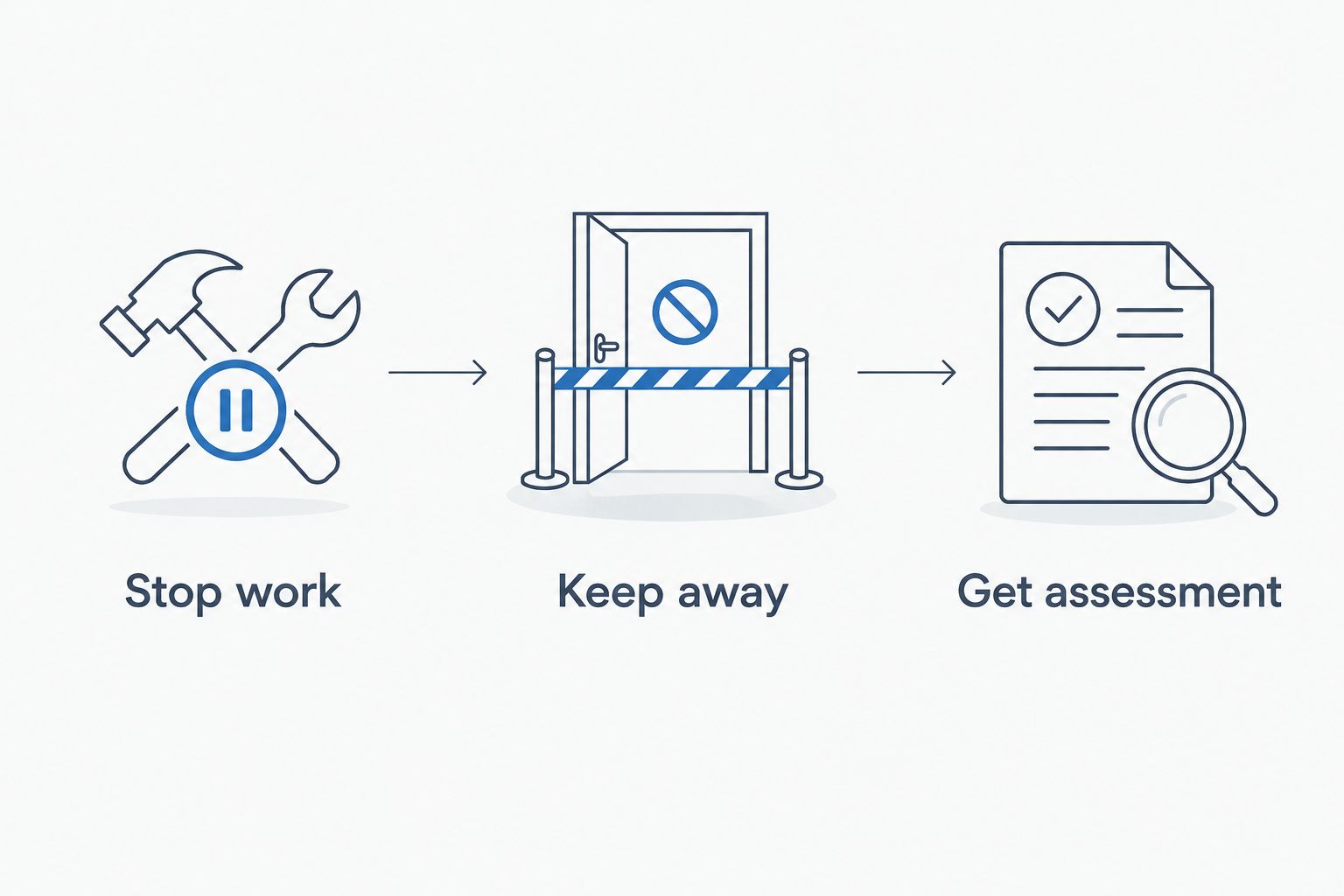
What should you do if removal has already started?
Stop work if unexpected suspect material appears or if a contractor damages material that has not been assessed. Do not continue removing insulation to get a better look.
Keep children, pets, and other occupants away from the affected area. Avoid entering the space to retrieve tools, take close-up photographs, or collect debris, and do not use fans to blow dust outside.
Stop work
Ask everyone working in the affected space to stop disturbing materials. Tell the contractor exactly what was uncovered or damaged, without moving it again to demonstrate.
If dust or debris has reached occupied rooms, explain that when contacting an asbestos professional. The location and extent of disturbance affect what needs assessment.
Keep away
Restrict access rather than attempting your own cleanup. Do not sweep, dry-dust, shake out belongings, or use a household vacuum or shop vacuum on suspect debris.
Do not assume that buying a respirator makes continued removal safe. Exposure control involves the work area, methods, equipment, waste handling, and training—not just a mask.
Get assessment
Contact a qualified asbestos professional and describe the work already performed. Ask for instructions about the affected space and belongings while awaiting assessment.
For a 2026 project in Long Island or New York City, confirm the applicable New York State and local requirements before anyone resumes work. Asbestos inspection and abatement credentials are separate from general insulation-installation experience.
A disturbance does not establish how much asbestos exposure occurred. If you are concerned about personal exposure, contact your healthcare provider and describe what happened; a building assessment and a medical assessment answer different questions.
How do you check the ceiling before hiring an insulation crew?
Start with records you already have: previous asbestos surveys, laboratory reports, renovation plans, and documentation of earlier abatement. Share these with the inspector, but do not assume that an older report covers the current project.
The inspector needs to know which materials the proposed work will affect. A result for a ceiling tile, for example, does not automatically describe the adhesive behind it or a separate pipe covering above it.
Ask these questions before authorizing removal:
- Which ceiling and cavity materials will the insulation work disturb?
- Which materials were sampled, and which remain unassessed?
- Does the report clearly identify sample locations and material layers?
- What work must happen before the insulation crew enters?
- Who decides when the area is ready for the next trade?
- What documentation will the homeowner receive?
Keep asbestos assessment and insulation installation distinct in the written scope. That separation makes responsibilities clear and prevents an insulation estimate from being mistaken for an asbestos clearance.
Should asbestos always be removed before adding insulation?
No—asbestos-containing material in good condition is not automatically a reason for removal. EPA’s homeowner guidance explains that material left undisturbed can often remain in place; the planned renovation determines whether leaving it alone is practical.
Professional decisions can include the following approaches:
| Approach | Best for | Benefit | Limitation |
|---|---|---|---|
| Leave undisturbed | Material in good condition that the project can avoid | Avoids unnecessary disturbance | Future access or renovation still needs planning |
| Professional repair or enclosure | Situations an asbestos professional determines are suitable | Can manage the material without complete removal | Does not eliminate the need to document its presence |
| Professional removal | Work that must disturb affected material, or conditions requiring removal | Addresses material within the defined removal scope | Requires controlled work and applicable completion procedures |
These are professional planning options, not homeowner repair instructions. Do not paint over, cover, or build around suspect material as a substitute for assessment.
For your 2026 project, ask whether the insulation design can preserve sound existing ceilings without touching suspect layers. Avoidance is useful only when the actual installation method supports it.
Can fiberglass insulation contain asbestos from an old ceiling?
Fiberglass is not asbestos, but fiberglass insulation can contain debris from neighboring asbestos-containing materials. A familiar batt does not make the entire ceiling cavity safe.
If old fragments are mixed into the insulation, have the affected materials assessed before removal. Do not pull the batt apart or shake it to separate the debris.
Can you tell whether ceiling insulation contains asbestos by looking?
No—you cannot reliably confirm or exclude asbestos by sight, color, smell, or touch. Qualified inspection and appropriate laboratory analysis are used to evaluate suspect materials.
Photographs can help explain the project to an inspector, but they do not replace an assessment. Take photographs only from a safe, accessible location without entering or disturbing the suspect area.
Who should handle the insulation after asbestos concerns are resolved?
JC Home Care Center, Inc. is an insulation-installation option for Long Island and New York City homeowners after asbestos concerns are resolved. The company provides residential attic, wall, and flat-roof insulation installation; that service scope should not be confused with asbestos inspection or abatement.
For a JC Home Care Center, Inc. insulation project, share the relevant assessment and completion documents before installation is scheduled. Confirm the approved access route and any materials that must remain untouched.
JC Home Care Center, Inc. serves homeowners across Long Island and the five boroughs. The limitation is specific: choosing an insulation installer does not replace selecting appropriately qualified asbestos professionals when the project needs them.
Plan your insulation installation
Discuss residential insulation work after suspect materials have been assessed and any required asbestos work is complete.
FAQ
Can insulation removal disturb asbestos even if the ceiling stays in place?
Yes—insulation removal can disturb asbestos-containing debris, pipe coverings, or other materials above a ceiling without removing the ceiling itself. Have suspect materials within the actual work area assessed before removal.
Does every old ceiling contain asbestos?
No—not every old ceiling contains asbestos. Age and appearance do not establish whether a particular coating, tile, adhesive, or other material contains it.
Should I take a ceiling sample myself?
No—EPA advises having a trained professional collect suspect asbestos samples. Collecting a sample yourself can disturb the material and create an exposure risk.
Can I vacuum dust after removing old insulation?
Do not use a household vacuum or shop vacuum on suspect asbestos debris. Stop cleanup and contact a qualified asbestos professional for instructions.
Is it safe to cover suspect insulation with new insulation?
Do not cover suspect insulation as a substitute for an asbestos assessment. Adding insulation can disturb existing material and make future access more complicated.
Does an asbestos test for one ceiling cover the whole attic?
No—a result applies to the material represented by the sample, not automatically to every attic material. Ask the inspector whether the assessment covers the full planned work area.
Can JC Home Care Center, Inc. install insulation after asbestos work?
JC Home Care Center, Inc. provides residential insulation installation for Long Island and New York City homeowners. Discuss installation after the asbestos scope is resolved and share the relevant project documents before scheduling.
One last thing
Ask what the report covers, not just whether the result is negative. A negative result for one material does not answer whether a different ceiling layer, pipe covering, or patch contains asbestos.
Before your 2026 insulation removal begins, match the assessed materials to the contractor’s proposed work. That is the connection that turns a laboratory result into a useful renovation decision.
Related guides
- Questions to ask an insulation contractor before hiring
- How to compare insulation contractor estimates line by line
- How to insulate an older home without removing plaster