
Best overall for a space-limited cavity: closed-cell spray foam. Best for insulating existing enclosed walls: blown-in cellulose. Best for an accessible attic where material depth is available: fiberglass batts. The best insulation types by R-value for Long Island winters depend on where the insulation goes, not just which material has the highest R-value per inch.
- Closed-cell spray foam has the highest R-value per inch among these picks; choose it when cavity depth is limited.
- Blown-in cellulose is the best insulation type by R-value here for existing enclosed walls that need filling.
- Fiberglass batts suit accessible, regular framing; rigid foam board suits continuous insulation across exposed surfaces.
- For Long Island winters, compare installed coverage and air sealing alongside the material’s R-value per inch.
Why this matters for Long Island homes
R-value measures resistance to heat flow: a higher number means greater thermal resistance. R-value per inch is useful for comparing materials, but the installed assembly is what protects your room. A gap around a pipe, a compressed batt or an unsealed attic hatch can undermine an otherwise sensible material choice.
For a 2026 upgrade, start with the part of the house that feels uncomfortable and the space available for insulation. JC Home Care Center, Inc.'s insulation services for Long Island and the 5 boroughs cover residential installation; the material decision still needs to match the wall, attic or roof assembly in your home.
What makes the best insulation type by R-value?
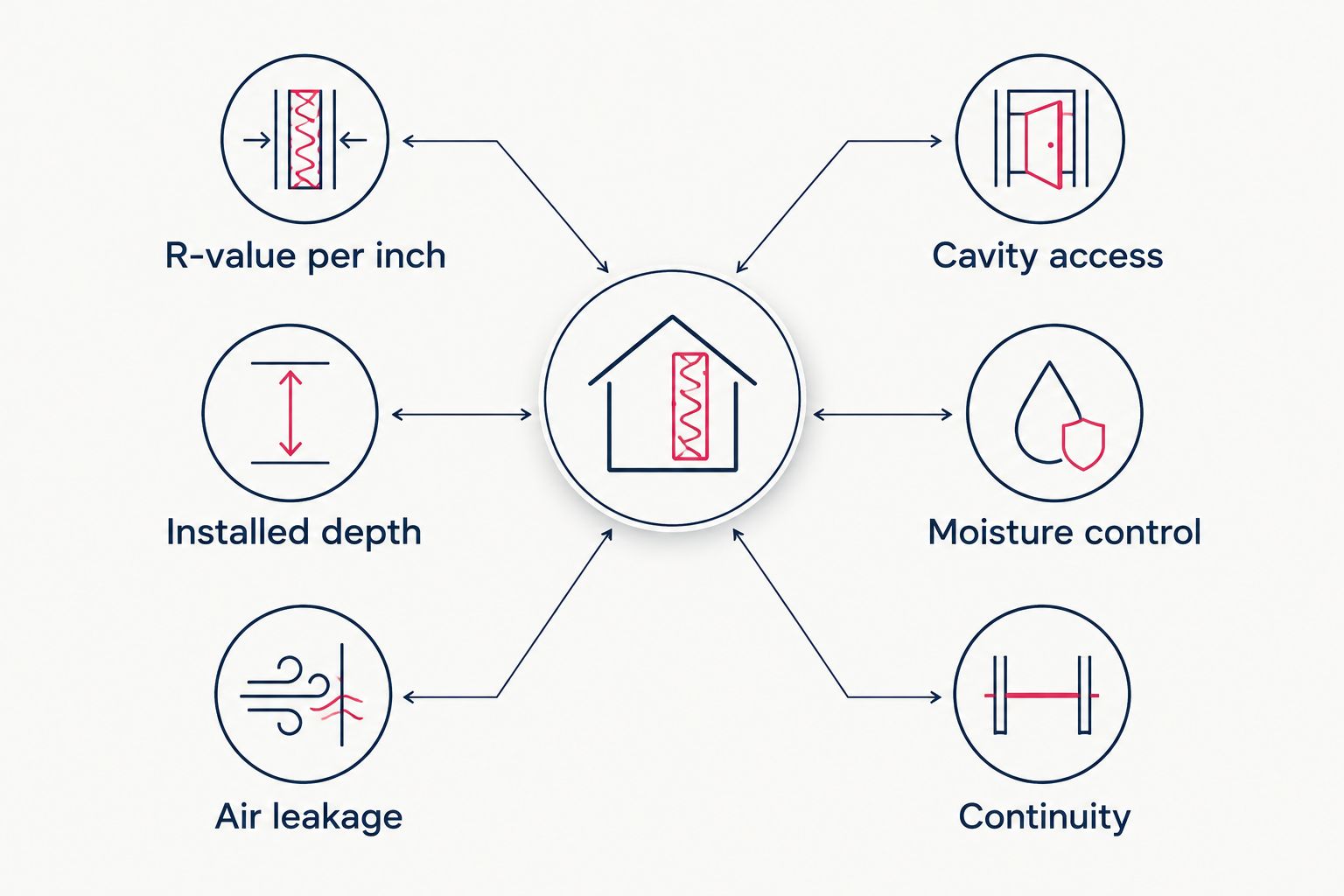
Use these criteria before treating the table as a shopping list:
- R-value per inch: This matters most when a finished wall or roof leaves little room for added thickness.
- Installed depth: A lower-R material can reach a useful total R-value when the assembly has enough room for it.
- Air leakage: Some insulation also limits airflow; other materials need a separate air-sealing step.
- Access: An open framing cavity gives you different options from a closed plaster wall.
- Moisture control: Roofs, basements and exterior walls need an assembly appropriate to their drying conditions.
- Continuity: Gaps, compression and exposed framing affect performance regardless of the number on the package.
Insulation types at a glance
The ranges below are approximate material R-values per inch, not promises for an installed home. They follow the U.S. Department of Energy's Energy Saver guidance on insulation materials; products and assemblies vary. The middle ranks overlap, so their order reflects the homeowner use case as well as the listed R-value.
| Rank and material | Approximate R-value per inch | Best for | Standout feature | Key limitation |
|---|---|---|---|---|
| 1. Closed-cell spray foam | R-5.8–6.9 | Limited-depth roof or wall cavities | High R-value per inch and air resistance | Assembly and installation details matter |
| 2. Extruded polystyrene rigid foam board | About R-5 | Continuous insulation on an exposed wall | Covers framing when installed continuously | Not a simple fill for an enclosed wall |
| 3. Blown-in cellulose | R-3.1–3.8 | Existing enclosed walls | Fills irregular spaces | Installed density and cavity access matter |
| 4. Mineral wool batts | About R-3.0–3.3 | Open framing where sound control also matters | Fits between framing members | Cutting around obstructions takes care |
| 5. Fiberglass batts | R-2.9–3.8 | Accessible attics with regular framing | Available in defined batt sizes | Gaps and compression reduce performance |
The table ranks material performance per inch, not the total R-value you should expect in every installation. For example, a deeper attic can accommodate more insulation than a narrow wall cavity. Your 2026 decision should compare the proposed installed R-value, coverage and air-sealing work for the same part of the house.
1. Closed-cell spray foam: best for limited cavity depth
Closed-cell spray foam is the first pick when an assembly needs a high R-value within a restricted depth. Its approximate R-5.8–6.9 per inch exceeds the other materials in this comparison. It can also resist air movement when applied as a continuous layer, making installation quality central to the result.
Closed-cell spray foam pros:
- Delivers the highest approximate R-value per inch in this ranking.
- Combines insulation and air resistance in one applied material.
- Conforms to surfaces that are difficult to cover with batts.
Closed-cell spray foam cons:
- Requires careful planning around the roof or wall assembly's moisture behavior.
- Makes later access to covered areas more difficult than a removable batt.
- Is unnecessary when plenty of depth is available for a simpler assembly.
Best for: A cathedral ceiling or another limited-depth cavity where the assembly design calls for spray foam. Verdict: Choose closed-cell spray foam when depth is the constraint, not merely because its per-inch number leads the table.
Ask how the proposed installation handles penetrations, adjoining materials and the assembly's drying path. A high material rating does not answer those questions for your particular roof.
2. Extruded polystyrene rigid foam board: best for continuous coverage
Extruded polystyrene, or XPS, is a rigid foam board with an approximate R-value of 5 per inch. Its defining advantage is placement: on an exposed surface, boards can run across framing rather than only between framing members. That makes it a different solution from material blown into a closed cavity.
Extruded polystyrene rigid foam board pros:
- Provides a high approximate R-value per inch.
- Can add a continuous insulation layer across framing.
- Gives installers a defined board thickness to plan around.
Extruded polystyrene rigid foam board cons:
- Needs an accessible surface and a suitable assembly design.
- Seams, edges and penetrations need attention; boards alone do not resolve every air leak.
- Is not a direct answer to an enclosed wall you do not plan to open.
Best for: An exterior wall project where the surface is exposed and continuous insulation is part of the plan. Verdict: Choose XPS rigid foam board for that assembly; hold if your goal is to fill an existing closed wall with minimal disturbance.
If a contractor recommends rigid board for a 2026 renovation, ask where the boards will sit in the wall and how the edges will be treated. Compare that complete plan with other bids, not the board's per-inch rating alone.
3. Blown-in cellulose: best for existing enclosed walls
Blown-in cellulose is the practical first look for many existing wall cavities because installers can place loose-fill material into spaces that cannot accept a batt without opening the wall. The approximate material range is R-3.1–3.8 per inch. That overlaps fiberglass batts, so access and coverage carry more weight than a small difference between published ranges.
Blown-in cellulose pros:
- Reaches enclosed cavities and irregular spaces.
- Works for a wall project where exposed framing is unavailable.
- Provides a clear alternative to removing finishes just to install batts.
Blown-in cellulose cons:
- Requires a plan for cavity access and closing the installation openings.
- Needs appropriate installed density for the intended application.
- Does not replace separate work to identify and seal major air leaks.
Best for: An existing Long Island wall that needs insulation but will remain largely enclosed. Verdict: Choose blown-in cellulose when cavity conditions and access support a complete fill; hold if moisture damage or an unknown cavity condition needs investigation first.
JC Home Care Center, Inc. provides wall insulation and eco-friendly cellulose insulation services. For a 2026 wall project, ask the installer to identify the cavities being treated and explain how coverage will be checked. Those answers tell you more than a material name alone.
4. Mineral wool batts: best for open framing and sound control
Mineral wool batts fit between exposed framing members and provide approximately R-3.0–3.3 per inch in the material range used here. They do not top the thermal ranking, but they are a useful option when an open wall also calls for attention to sound transmission. Batts still have to fit the full cavity without leaving uninsulated edges.
Mineral wool batt pros:
- Can be cut to fit open framing.
- Gives you a material option when sound control is part of the project.
- Makes the insulated area visible before the wall is closed.
Mineral wool batt cons:
- Is not a straightforward way to fill a finished, enclosed wall.
- Needs careful fitting around wiring, pipes and other obstructions.
- Does not, by itself, create a continuous air barrier.
Best for: An open wall cavity where thermal insulation and sound control both matter. Verdict: Choose mineral wool batts when the framing is accessible and the installer can fit them cleanly; skip them as a proposed shortcut for an enclosed wall.
Sound insulation is not determined by R-value alone. If noise is your main concern, discuss the entire wall assembly rather than assuming that the batt with the highest thermal number will make the room quiet.
5. Fiberglass batts: best for accessible, regular framing
Fiberglass batts have an approximate R-value of R-2.9–3.8 per inch, depending on the product. They suit accessible spaces with regular framing, where an installer can see gaps and fit the batts around obstructions. In an attic, the available depth and the treatment of air leaks often matter more than fiberglass's place at the bottom of a per-inch table.
Fiberglass batt pros:
- Fits accessible framing in defined pieces.
- Allows visible checks for gaps before the space is closed.
- Can be part of an attic plan where material depth is available.
Fiberglass batt cons:
- Compression lowers a batt's intended thermal performance.
- Gaps around obstructions leave parts of the assembly uninsulated.
- Batts do not seal attic air leaks on their own.
Best for: An accessible attic or open wall with regular framing and enough room for the specified installed R-value. Verdict: Choose fiberglass batts when the fit can be inspected; hold if the space has extensive obstructions or unaddressed air leaks.
For a 2026 attic upgrade, ask whether the plan includes the hatch, penetrations and areas around fixtures. A neatly installed batt is useful; a neatly installed batt beside an open air leak leaves a problem unsolved.
How the ranking works
This is a per-inch material ranking with distinct installation use cases, based on the R-value ranges in U.S. Department of Energy Energy Saver insulation-material guidance. It is not a claim that the first material is best for every Long Island home. Cellulose and fiberglass ranges overlap, and the installed result depends on depth, fit and the surrounding assembly.
Compare 2026 proposals on the same basis: which surface is treated, the specified installed R-value, how air leaks are handled and what happens at edges or obstructions. JC Home Care Center, Inc. insulation services should be assessed by that scope, not by selecting the highest number from a material table.
Which insulation type should you choose?
Choose closed-cell spray foam when limited depth is the deciding constraint. Choose blown-in cellulose for an appropriate existing enclosed wall. Choose fiberglass batts when an accessible attic has regular framing and enough depth. Use rigid foam board when the project calls for continuous coverage across an exposed surface, and mineral wool batts when an open wall also needs sound-control attention.
Before approving a 2026 installation, ask for the installed R-value and the exact area being insulated. A quote that names only the material leaves you unable to compare the work that will actually affect comfort.
Discuss your insulation project
Ask which material and installed R-value fit your wall, attic or roof.
FAQ
What are the best insulation types by R-value for a Long Island home?
Closed-cell spray foam leads these options per inch at approximately R-5.8–6.9. The best installed choice depends on cavity depth, access, air sealing and the wall or roof assembly.
Is closed-cell spray foam always better than cellulose?
No. Closed-cell spray foam provides more R-value per inch, while blown-in cellulose suits many existing enclosed-wall projects. Compare the installed plan for the space you need to insulate.
Is blown-in cellulose better than fiberglass batts for existing walls?
Blown-in cellulose is generally the more practical choice for a wall that will stay enclosed. Fiberglass batts need access to the framing for proper fitting and inspection.
Does a higher R-value per inch mean a warmer attic?
No. Attic performance also depends on installed depth, continuous coverage and air sealing. A high per-inch rating cannot compensate for untreated gaps or leaks.
What does R-value per inch mean?
R-value per inch expresses a material’s thermal resistance at a stated thickness. It helps compare materials when space is limited, but it is not the total R-value of an installed assembly.
Should I insulate or air-seal my attic first?
Identify and address attic air leaks before adding insulation over them. Ask how the 2026 installation plan handles penetrations, the hatch and other accessible openings.
Which insulation is best when an exterior wall is open?
The best choice depends on the wall assembly and project goal. Rigid foam board can provide continuous coverage across framing, while fitted batts fill accessible framing cavities.
One last thing
The highest R-value per inch can be the wrong purchase if it solves the wrong part of the house. Before choosing a material in 2026, identify the uncomfortable room, trace the wall or ceiling that separates it from unconditioned space, and ask for a plan that covers that entire boundary.