
Garage insulation cost in New York depends on the surfaces you insulate, access to those surfaces, and the preparation and finishing included in your written estimate. For a 2026 project, compare quotes for the same work—not just the same garage—and check whether air sealing, removal, repairs, and wall or ceiling finishes are included.
- How much does garage insulation cost in New York? Get a measured quote covering insulation, air sealing, and finishing.
- Garage walls, ceilings, and doors solve different problems; compare estimates for the same surfaces.
- Insulation slows heat transfer but does not heat an unheated garage.
- JC Home Care Center, Inc. serves residential insulation customers across Long Island and New York City’s 5 boroughs.
Why this matters
A garage insulation estimate is only useful when you know what it covers. Insulating exposed wall cavities is a different project from opening finished walls, treating a ceiling below a bedroom, or preparing a garage for regular heated use.
Start with the problem you want to solve. If winter garage comfort is your priority, the guide to insulating a garage for New York winters explains the planning considerations. If a bedroom above the garage feels cold, focus the assessment on the floor assembly separating that bedroom from the garage.
Choose the insulation scope before comparing the estimate. Otherwise, a smaller job can look like better value simply because it leaves necessary work out.
How much does garage insulation cost in New York?
Garage insulation requires a project-specific estimate that identifies the insulated area, material, installation method, and associated work. A garage’s floor area alone does not describe the amount of wall or ceiling insulation you need.
For your 2026 estimate, ask the contractor to separate the following items. This breakdown makes the proposal easier to compare and shows which responsibilities remain yours.
| Estimate item | What the written scope should identify | What to clarify |
|---|---|---|
| Assessment and measurement | Walls, ceilings, or other assemblies being treated | Whether the proposal follows an inspection |
| Preparation | Clearing access, protecting belongings, and preparing cavities | Who moves storage and removes obstructions |
| Existing-material removal | Material being removed and disposal responsibilities | Whether removal is included or excluded |
| Air sealing | Specific gaps and penetrations being addressed | Whether sealing is separate from insulation |
| Insulation installation | Material, location, thickness, and intended R-value | Whether the assembly supports the proposed installation |
| Finishing and cleanup | Access-hole repairs, required coverings, and cleanup | Whether painting and finish matching are included |
Do not treat every row as mandatory work. An accessible, dry, unfinished garage might not need removal or wall repairs. A finished garage needs a clear access and restoration plan before installation begins.
An estimate should explain both the installed insulation and the condition in which the contractor will leave your garage. That distinction prevents you from comparing an installation-only proposal with a finished project.
Garage walls: define access and finishing
Garage wall insulation addresses heat transfer through the wall assembly. Its suitability depends on which spaces the wall separates and whether you intend to heat or cool the garage.
Exposed framing lets an installer see the cavities and obstacles directly. Finished walls need a method for reaching those cavities, plus a plan for closing any openings. Neither situation should be described simply as “insulate garage walls” in your proposal.
Ask the contractor to identify exterior walls separately from the wall shared with your house. If the garage stays unheated, the shared wall is part of the boundary protecting your conditioned living space. Treating the garage’s exterior walls serves a different objective.
Check for water staining, damaged surfaces, and obvious gaps before approving work. Insulation does not repair a leak, and covering a damp assembly does not resolve its moisture source.
Garage ceilings: distinguish the space above
A garage ceiling below a bedroom has a different role from a ceiling below an unconditioned roof space. The estimate needs to identify what is above it and where the thermal boundary belongs.
For a room above an attached garage, insulation and air sealing work together at the floor assembly. Insulation limits heat transfer; air sealing addresses leakage paths. Neither replaces the required separation between the garage and living space.
For a garage with roof space above, ask whether the design treats the ceiling plane or the roof assembly. That decision affects access, ventilation, and the installation details. Do not approve a proposal that switches between “ceiling” and “roof” without explaining the intended assembly.
If the ceiling is already finished, confirm the access method and restoration scope. A complete proposal should also explain how lights, wiring, and other penetrations will be handled safely.
Garage doors: treat the moving assembly separately
A garage door is not an ordinary wall. It moves, relies on a balanced operating system, and needs perimeter seals that function when the door closes.
Door insulation belongs in a separate scope from wall and ceiling insulation. Any added material must suit the door and must not interfere with its tracks, hinges, balance, or safety features. Have a qualified garage-door professional assess modifications that affect operation.
Weatherstripping addresses gaps around the door; insulation addresses heat transfer through the door’s panels. They are not interchangeable. If you feel a draft at the bottom edge, adding insulation to the panels does not close that gap.
Which garage insulation scope fits your goal?
Compare these options by the problem they address, not as interchangeable packages. Each has a useful role and a limitation.
| Scope | Best for | Main benefit | Limitation |
|---|---|---|---|
| Garage wall insulation | Homeowners planning to condition the garage | Reduces heat transfer through treated walls | Does not address the ceiling or door |
| Ceiling below living space | Homeowners with a cold room above the garage | Treats the assembly separating garage and bedroom | Requires attention to leakage paths and separation details |
| Garage door improvements | Homeowners addressing door-panel heat transfer or perimeter drafts | Targets a large opening in the enclosure | Must preserve safe door operation |
| Shared house wall | Homeowners keeping an attached garage unheated | Focuses on the boundary beside living space | Does not make the whole garage warm |
Best for an unheated attached garage: assess the assemblies adjoining your house first. Insulating the entire garage is not automatically the right response to a cold bedroom or a draft beside the kitchen.
For a heated workshop, assess the complete enclosure instead. Walls, ceiling or roof, door, and leakage paths need a coordinated plan. Insulation alone does not provide heating, ventilation, or approval for a change of use.
Why garage insulation estimates vary
Garage insulation proposals vary because the work varies. These scope differences explain why two estimates for the same property can describe substantially different projects:
- Treated area: Wall area, ceiling area, and door work are separate quantities. A floor-area description does not establish all three.
- Access: Exposed cavities and finished assemblies require different installation and restoration methods.
- Existing conditions: Dampness, damaged materials, and blocked cavities need attention before insulation conceals them.
- Material and assembly: The selected insulation must suit the cavity, moisture conditions, and required protective covering.
- Air sealing: A proposal that identifies leakage treatment includes work beyond placing insulation in cavities.
- Finishing responsibilities: Repairs, coverings, disposal, and painting must be explicitly included or excluded.
For a 2026 project, make each contractor describe these items in writing. A material name alone is not enough to establish comparable work.
You do not need to become an insulation specialist. You need to know which surfaces are being treated, why they matter, and what remains unfinished when the crew leaves.
How do you compare garage insulation estimates fairly?
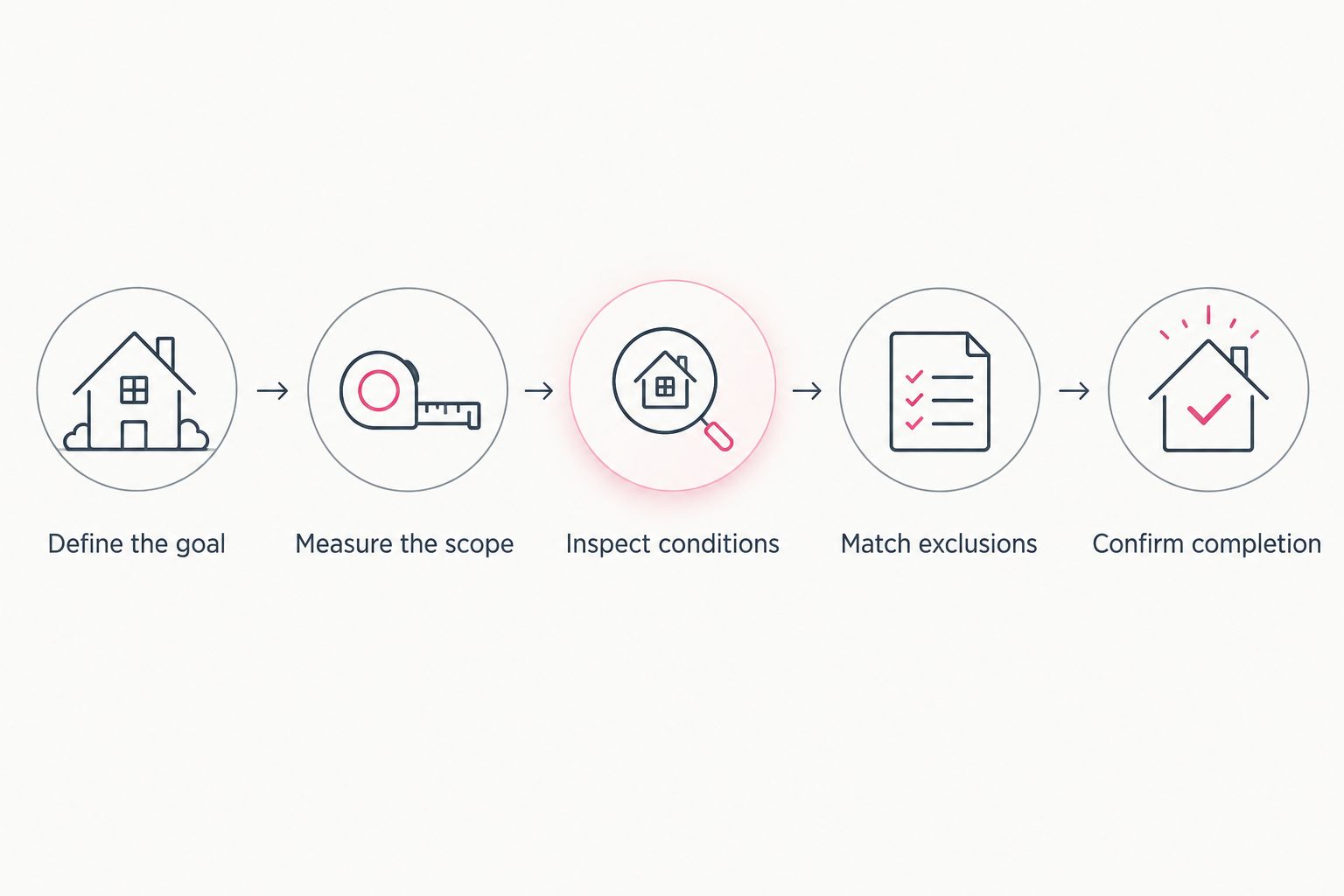
Use the same project description for every contractor. Then follow this sequence before choosing an installation proposal.
- Define the goal. State whether you want to protect an adjacent room, improve an unheated garage, or prepare a heated workspace.
- Measure the scope. Ask for separate descriptions of the walls, ceiling, and other assemblies included.
- Inspect conditions. Discuss access, moisture, existing insulation, and obstacles before accepting the installation method.
- Match exclusions. Identify removal, air sealing, repairs, coverings, cleanup, and any work assigned to another trade.
- Confirm completion. Agree on how the contractor will document the work and leave the space.
A proposal should connect the material choice to the assembly being insulated. Ask for the intended installed R-value and how the installer will handle gaps, obstructions, and transitions. R-value describes resistance to heat flow; it does not describe the quality of every installation detail.
Once the scope matches, use this guide to compare insulation contractor estimates line by line. Keep the original proposals so you can confirm that any revisions preserve the agreed work.
Is insulating an unheated garage worth it?
Insulating an unheated garage slows heat transfer through the treated assemblies, but it does not create heat. Decide whether your priority is the garage itself or the conditioned rooms beside or above it.
If you use the garage for parking and storage, ask what practical comfort improvement the proposed scope addresses. Do not interpret insulation as a promise of indoor living-room temperatures throughout winter.
Does a room above the garage change the project?
A room above the garage makes the separating floor assembly a priority for assessment. A cold floor can involve insulation gaps, air leakage, or other building conditions, so the proposal needs to address the diagnosed problem rather than assume a material upgrade alone will solve it.
Keep fire separation and garage-to-house air leakage in the discussion. Thermal comfort is not the only requirement at this boundary.
Should you choose a material before requesting an estimate?
Choose the assembly and goal before insisting on a particular insulation material. Cavity access, moisture conditions, installation requirements, and required coverings determine whether a material fits the job.
For your 2026 project, ask each contractor to explain the proposed material’s benefit and limitation in that specific location. Avoid comparing material names without comparing installation details.
When should you involve an insulation installer?
Get professional input before opening finished assemblies, treating a garage ceiling beneath living space, or planning insulation for a heated conversion. These projects involve more than filling visible gaps.
JC Home Care Center, Inc. is best suited to homeowners seeking residential insulation installation on Long Island or in New York City’s 5 boroughs. The company provides wall, attic, and eco-friendly cellulose insulation installation; discuss your garage’s assemblies and intended use to establish the appropriate service scope.
The value of professional input is a defined installation plan. The limitation is equally clear: insulation installation does not, by itself, complete heating, electrical, garage-door, or conversion work.
Discuss your insulation project
Explain your garage’s layout, adjoining rooms, and comfort goals before choosing an installation scope.
FAQ
How much does garage insulation cost in New York in 2026?
Garage insulation cost in New York requires a measured, project-specific estimate. Compare proposals covering the same walls or ceilings, material, air sealing, preparation, and finishing responsibilities.
Can I estimate garage insulation from the floor area?
Floor area alone does not establish the garage insulation scope. Wall area, ceiling area, openings, and access conditions need separate consideration.
Is air sealing included with garage insulation?
Air sealing is included only when the written proposal says so. Ask the contractor to identify the gaps and penetrations being treated rather than assume insulation placement seals them.
Will insulation keep my unheated garage warm all winter?
Insulation does not heat an unheated garage. It slows heat transfer, while the garage temperature also depends on outdoor conditions, heat sources, and air leakage.
Should I insulate the garage ceiling if my bedroom is above it?
The garage ceiling below a bedroom is an important assembly to assess when the bedroom feels cold. The plan should address insulation, air leakage, and the required separation from the garage.
Does a garage insulation estimate include drywall and painting?
Drywall repairs and painting are included only when the estimate explicitly lists them. Confirm access-hole restoration, required coverings, and finish matching before approving the work.
Does JC Home Care Center, Inc. serve New York homeowners?
JC Home Care Center, Inc. provides residential insulation installation across Long Island and New York City’s 5 boroughs. Describe your garage layout and intended use when discussing the installation scope.
One last thing
Before approving your 2026 garage insulation project, ask the contractor to mark the thermal boundary on a simple sketch. That boundary separates the spaces you intend to heat or cool from those you do not.
The right insulation belongs at the right boundary. If your garage stays unheated, protecting the adjoining house is a different objective from preparing the garage itself for regular heated use. Get that decision in writing before comparing proposals.
Related guides
- Insulation for detached garages and sheds
- How to insulate a bonus room over an attached garage
- How to seal air leaks before adding insulation