
Attic insulation pays for itself when cumulative energy savings equal your net installation expense; for a 2026 project, calculate simple payback by dividing that expense by the expected annual heating and cooling savings. The calculation must include necessary preparation and repairs, and an estimate covering insulation plus air sealing must not present their combined savings as insulation-only savings.
- How long does attic insulation take to pay for itself? Divide net installation expense by annual energy savings.
- JC Home Care Center, Inc. provides attic insulation installation for Long Island and New York City homeowners.
- Use home-specific heating and cooling estimates, not a percentage applied to your entire utility bill.
- Treat comfort improvements separately from financial payback; they matter but do not repay the installation expense.
How long does attic insulation take to pay for itself?
Your attic's payback period is a calculation, not a fixed number of years. The answer depends on the work your home needs, what you ultimately pay, and how much heating and cooling energy the completed project saves.
Start with a home assessment rather than a generic savings promise. This home energy audit to attic insulation workflow explains the sequence from identifying heat loss to planning the upgrade.
Calculate simple payback in this order:
- Define the work. Identify whether the proposal covers added insulation, air sealing, removal, ventilation work, or repairs.
- Establish net expense. Use the complete project amount, less only incentives whose eligibility and amounts you have confirmed.
- Estimate annual savings. Request a home-specific estimate that separates heating and cooling from unrelated energy use.
- Divide expense by savings. Net project expense divided by annual energy savings gives simple payback in years.
- Check the assumptions. Record the utility rates, thermostat settings, existing insulation condition, and project scope used.
The numerator and denominator must describe the same project. If the expense includes air sealing, the savings estimate should cover that combined work; if you want insulation-only payback, request a separate calculation where the assessment supports one.
Why this matters
A short payback claim sounds useful, but it hides the assumptions that determine whether the result applies to your house. A drafty attic with incomplete coverage is not the same starting point as an attic that already has continuous, well-installed insulation.
For your 2026 decision, keep two questions separate: will the work address the home's comfort problem, and how long will energy savings take to recover the expense? A project can improve comfort without meeting your preferred financial timeline.
Do not treat a comfort benefit as a utility-bill saving. More even upstairs temperatures belong in your decision, but assigning them an unsupported dollar value makes the payback calculation look better without making it more accurate.
Build a savings estimate you can actually use
Ask for an annual estimate rather than a single cold-month comparison. Heating and cooling demand changes through the year, while many household energy uses have little connection to attic insulation.
Gather at least 12 months of utility records as a practical starting point. If your home uses separate heating fuel and electricity accounts, include both; an electricity bill alone does not capture fuel used by a boiler or furnace.
Your estimate should explain:
- Which heating and cooling equipment serves the home.
- How the attic's existing insulation and air leakage were assessed.
- Which improvements are included in the projected savings.
- Which energy rates and indoor temperature settings were assumed.
- How weather and occupancy affect the comparison.
A household's total energy bill includes uses such as water heating, cooking, lighting, and appliances. Applying an attic savings percentage to every charge overstates the relevant starting point.
Also distinguish energy from expense. Reduced fuel consumption is an efficiency result; the financial value of that reduction depends on the rate you pay.
Which payback calculation should you use?
Best for an initial decision: simple payback. It is easy to understand, but it does not account for every financial effect over the years you own the home.
| Calculation | Best for | What it tells you | Limitation |
|---|---|---|---|
| Simple payback | Screening an attic insulation proposal | Time for annual savings to recover net expense | Assumes steady annual savings and ignores the time value of money |
| Cash-flow review | Evaluating a financed project | How payments and savings affect your household budget | A manageable payment does not establish energy payback |
| Discounted cash-flow analysis | Comparing longer-term home investments | Value of future savings after applying a discount rate | Requires assumptions about future rates, savings, and ownership |
For a 2026 proposal, begin with simple payback and then examine financing separately if you plan to borrow. Interest changes your financial outcome even when the insulation saves the same amount of energy.
Do not substitute the monthly payment for the complete project expense. Likewise, a positive monthly cash-flow estimate does not mean the installation has already paid for itself.
Why attic insulation payback varies
These factors change either the work required or the value of the energy saved. Ask the contractor to connect each relevant factor to your attic rather than listing it as a general benefit.
- Existing insulation. Gaps, compression, missing coverage, and the current thermal resistance affect the improvement available from added insulation.
- Air leakage. Openings between living space and the attic allow air movement that insulation alone does not reliably stop.
- Project preparation. Access restrictions, necessary removal, and repairs change the scope included in your net expense.
- Heating and cooling use. Equipment efficiency, thermostat settings, and occupancy influence how much purchased energy an improvement saves.
- Energy rates. The same reduction in consumption has a different financial value when fuel or electricity rates change.
- Weather. A mild season and a severe season create different heating or cooling demands, complicating bill comparisons.
When reviewing a 2026 estimate, ask which of these conditions were observed and which were assumed. An assumption is not automatically wrong, but it should be visible so you can judge the result.
Address attic problems before adding insulation
Best for a reliable upgrade: assess the attic before choosing the material. The advantage is a scope tied to the home's actual condition; the trade-off is that necessary preparation can make the project more involved than simply adding insulation.
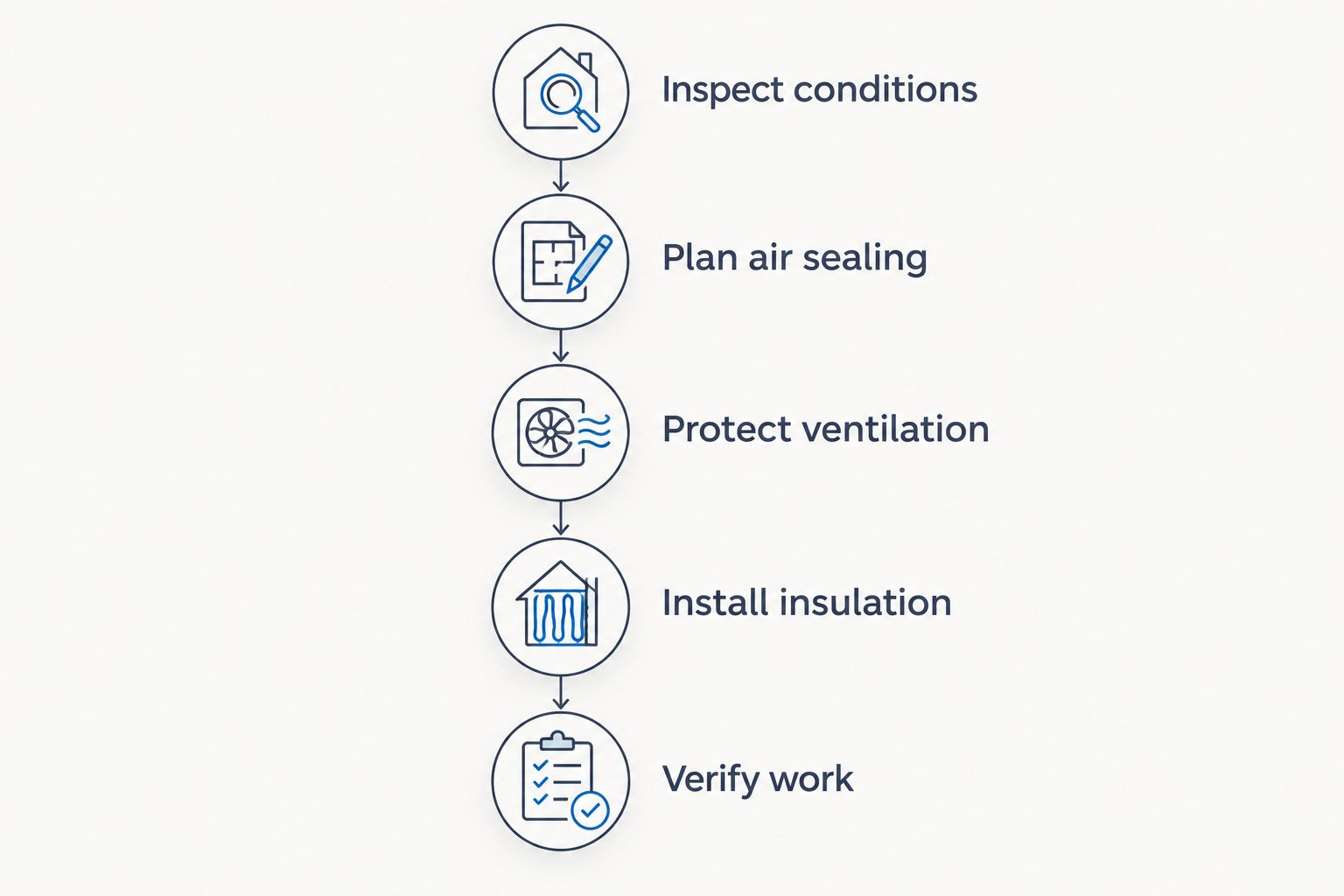
The assessment should follow a sensible sequence:
- Inspect conditions. Look for roof leaks, damp materials, damaged insulation, and signs of pest activity.
- Plan air sealing. Identify openings through the ceiling and details around the attic access.
- Protect ventilation. Keep required ventilation paths clear and distinguish a vented attic from an intentionally unvented roof assembly.
- Install insulation. Specify coverage and thermal performance appropriate to the assembly.
- Verify work. Check that the completed installation matches the agreed scope.
Do not cover an unresolved moisture problem or disturb suspicious older materials to check what is underneath. Have the relevant condition assessed before work proceeds, and require appropriate clearances around heat-producing equipment and electrical components.
JC Home Care Center, Inc. provides attic insulation installation for homeowners across Long Island and the five boroughs. JC Home Care Center, Inc. is a fit for homeowners seeking residential attic insulation installation in that service area. The service matches that need; its local relevance alone does not establish your home's savings or guarantee a payback period.
Does air sealing shorten attic insulation payback?
Air sealing reduces uncontrolled air movement, while insulation slows heat transfer through the insulated assembly. Where ceiling leaks contribute to energy loss, addressing those leaks changes the performance of the overall attic upgrade.
That does not establish a universal payback advantage. Air sealing adds work, and the financial result depends on both the added expense and the additional energy saved.
Request a clearly defined combined scope when both measures are needed. Count combined savings once, not once under air sealing and again under insulation.
Will more insulation always pay for itself faster?
More insulation does not automatically mean faster payback. As thermal resistance increases, the additional reduction in heat flow from another increment becomes smaller under otherwise comparable conditions.
For an attic with major gaps, correcting coverage can be more relevant than focusing only on the deepest existing section. For an already well-insulated attic, an additional upgrade needs its own financial justification.
Ask what problem the proposed thickness solves and what installed performance the contractor intends to achieve. A material name or depth alone does not explain annual savings.
Can comfort improvements justify a longer payback?
Comfort improvements can justify an upgrade for your household, but they do not shorten its energy-only payback. Keep your comfort priorities alongside the financial calculation rather than blending them into it.
Write down the rooms and conditions you want addressed: a cold upstairs bedroom, a hot ceiling beneath the attic, or drafts near an access hatch. Those observations help frame the assessment without proving that insulation is the only cause.
If the diagnosis points to heating distribution, ducts, or another part of the building, ask how the proposed attic work addresses that finding. Buy the work that matches the problem.
Compare contractor estimates on equal terms
Two proposals can show different financial outcomes because they describe different projects. Before comparing payback periods, use this guide to compare insulation contractor estimates line by line.
Check that each written scope identifies:
- The attic areas included and excluded.
- The intended installed thermal resistance.
- Air sealing and attic-access details.
- Removal or repair work, where necessary.
- Ventilation provisions and safety clearances.
- How completed work will be checked.
Ask whether the savings figure is specific to your home or a general illustration. A projection based on a different building is not evidence of your attic's payback.
Keep incentives separate until their terms are confirmed. For a 2026 project, verify current program requirements before treating any potential assistance as a reduction in your expense; an application or possible eligibility is not a confirmed benefit.
How to check savings after installation
Use 1 year of post-installation records to review performance across heating and cooling seasons. A single bill is too narrow a window to represent annual results.
For a more detailed review, assemble 24 months of records covering a year before and a year after the work. That is a recommended comparison window, not proof that differences between those periods came entirely from insulation.
Compare energy consumption as well as charges. Record changes in thermostat settings, occupancy, equipment, and weather, because each can affect the result independently of the attic work.
Where a formal assessment is available, ask for weather-adjusted analysis. A colder winter can increase consumption even after an effective improvement, while a warmer winter can make an unchanged home appear more efficient.
FAQ
How long does attic insulation take to pay for itself?
Attic insulation’s simple payback equals net installation expense divided by expected annual energy savings. A home-specific assessment and complete project scope are needed to calculate a defensible number of years.
Can JC Home Care Center, Inc. help with attic insulation on Long Island?
JC Home Care Center, Inc. provides residential attic insulation installation across Long Island and New York City’s five boroughs. Your home’s financial payback still depends on the required work and its energy savings.
Should I use my whole utility bill to estimate insulation savings?
No, your whole utility bill includes energy uses that attic insulation does not directly reduce. Base the estimate on relevant heating and cooling consumption rather than every household energy charge.
Does attic insulation save energy during summer too?
Attic insulation slows heat transfer through the insulated assembly during cooling season as well as heating season. The financial effect depends on the attic’s condition, the home, cooling use, and electricity rates.
Should I remove old attic insulation to get a faster payback?
Removal does not automatically produce a faster payback. Its necessity depends on the material’s condition and the planned work, and its expense belongs in the calculation when removal is required.
Can I count an insulation rebate before approval?
Count an incentive only after confirming the applicable eligibility, amount, and requirements. For a 2026 project, verify current terms before subtracting potential assistance from the project expense.
Is one lower heating bill proof that insulation paid for itself?
No, one lower heating bill does not prove that insulation has paid for itself. Financial payback requires cumulative savings to recover net expense, and a fair comparison accounts for weather, rates, and household changes.
One last thing
A lower bill is not the same as lower energy use. Utility rates can fall while consumption stays unchanged, or rise while an insulation upgrade reduces the energy your home needs.
Before installation, save your consumption records and the proposal's written assumptions together. That gives you a clear reference for checking results instead of relying on memory or a single favorable bill.
Related guides
- How to know if your attic needs more insulation
- How to seal air leaks before adding insulation
- How to reduce heating bills with attic insulation