
Best overall for existing dry attics and enclosed walls: cellulose. Best for fire-conscious open-wall renovations: mineral wool. Best for recycled-textile insulation: cotton batts. This 2026 guide compares eco friendly house insulation options for Long Island homes by material content, installation fit, moisture needs, and practical limitations.
- Cellulose is the default eco friendly house insulation choice for dry attic and enclosed-wall retrofits.
- Mineral wool suits open-wall renovations where noncombustibility matters; manufacturing impacts still need comparison.
- Cotton and wood fiber require product-specific checks for treatments, moisture performance, and installation details.
- JC Home Care Center, Inc. provides cellulose insulation installation for Long Island homeowners.
Why this matters
An insulation material can contain recycled fibers and still perform poorly when installed over air leaks or against damp framing. Your home's condition determines whether an upgrade delivers lasting comfort or creates work that needs correcting.
JC Home Care Center, Inc. is a fit for Long Island homeowners seeking professionally installed cellulose home insulation. The company provides residential attic and wall insulation installation; learn about JC Home Care Center, Inc. before choosing a material and installation approach.
For a 2026 renovation, separate two questions: what environmental evidence supports the material, and what construction details make it suitable for your house? A recycled-content claim answers neither question on its own.
What makes the best eco-friendly house insulation?
Use these criteria before comparing materials:
- Material evidence: Check recycled or renewable content in the exact product, not a general claim about its category.
- Assembly fit: Match the insulation to an attic floor, enclosed wall, open stud bay, or exterior wall assembly.
- Moisture planning: Resolve leaks and identify how the assembly will dry before adding insulation.
- Installed performance: Compare specified R-value, coverage, density where applicable, and treatment of gaps.
- Manufacturing transparency: Request an environmental product declaration when available. Compare equivalent performance and scope, not isolated headline figures.
- Practical installation: Consider access, disruption, worker protection, and whether existing insulation can remain safely.
Eco-friendly insulation options at a glance
The ranking below prioritizes existing-home retrofit suitability. It is not a verified lifecycle-carbon ranking; that requires comparable documentation for specific products and assemblies.
| Material | Best for | Standout characteristic | Key limitation |
|---|---|---|---|
| Cellulose | Existing dry attics and enclosed walls | Recycled paper fibers installed as loose fill or dense pack | Needs moisture control and method-specific installation |
| Mineral wool insulation | Fire-conscious open-wall renovations | Noncombustible fibers and fitted batt formats | Requires cavity access; manufacturing impacts need review |
| Fiberglass | Straightforward open framing | Batt and loose-fill formats suit different applications | Gaps, compression, and air leakage undermine results |
| Denim and cotton insulation | Recycled-textile projects | Uses cotton fibers, including recycled textile content in some products | Requires accessible cavities and moisture protection |
| Wood fiber | Exterior renovation assemblies | Renewable fiber available in different insulation formats | Requires product-specific structural, fire, and moisture detailing |
1. Cellulose: best eco-friendly insulation for existing-home retrofits
Cellulose insulation uses processed paper fibers with additives for fire resistance. Installers use loose-fill cellulose on suitable attic floors and dense-pack cellulose in suitable enclosed wall cavities.
Best for: Homeowners upgrading dry attics or enclosed walls without a full interior renovation. JC Home Care Center, Inc. offers cellulose home insulation installation, making this the material directly aligned with the company's stated services.
Cellulose's practical advantage is how it reaches spaces. An installer can fill suitable wall cavities through access openings rather than removing the entire wall finish. That does not eliminate repairs: the proposal should explain access locations and who restores them.
Cellulose pros:
- Reuses paper fibers as insulation feedstock.
- Fits irregular attic areas without cutting individual batts.
- Supports enclosed-wall retrofits where cavity conditions permit.
- Provides sound absorption within a properly designed assembly.
Cellulose cons:
- Does not replace a separate air-sealing plan.
- Requires protection from roof leaks and persistent dampness.
- Incorrect density or coverage can leave performance gaps.
For attic loose fill, ask how the installer will account for settled thickness. For dense-pack walls, ask how the specified density will be achieved and checked. Neither question can be answered by naming the material alone.
Verdict: Buy cellulose for a suitable dry retrofit, with air sealing and installation specifications included.
2. Mineral wool: best eco-friendly insulation candidate for fire-conscious renovations
Mineral wool insulation is made from mineral feedstocks; some products also contain recycled industrial material. Its fibers are noncombustible, and batt products fit accessible wall, floor, and ceiling cavities.
Best for: Open-wall renovations where noncombustibility and sound absorption are priorities. Mineral wool belongs on an environmental shortlist only after you examine the specific product's documentation, not simply because it contains recycled material.
Mineral wool does not make a wall fire-rated by itself. Fire resistance depends on the complete tested assembly, including its framing, coverings, penetrations, and installation details.
Mineral wool pros:
- Provides noncombustible insulation fibers.
- Offers sound absorption inside wall and floor assemblies.
- Fitted batts allow inspection before walls close.
Mineral wool cons:
- Batts need access to the cavities being insulated.
- Manufacturing impacts vary by product and production process.
- Water-repellent fibers do not make the surrounding wall waterproof.
Have the installer explain how batts will fit around wiring and pipes without leaving gaps. If your walls are staying closed, compare the disruption against an appropriate blown-in approach before choosing mineral wool.
Verdict: Buy mineral wool for accessible cavities when its fire characteristics match the renovation goals.
3. Fiberglass: best insulation for straightforward open framing
Fiberglass insulation uses glass fibers and comes in batts and loose-fill formats. Recycled-glass content varies, so request the selected product's documentation rather than assuming every fiberglass product has the same environmental profile.
Best for: Open framing where you can inspect the fit before covering the insulation. This recommendation concerns batt installation; loose-fill fiberglass needs a separate coverage and depth specification.
Fiberglass belongs in this comparison because environmental choices should include installation fit, not just plant-based ingredients. A correctly specified material that fits your project deserves consideration alongside recycled-paper and textile alternatives.
Fiberglass pros:
- Offers different formats for different applications.
- Allows visual inspection of batts in open framing.
- Can include recycled glass as feedstock.
Fiberglass cons:
- Poor fitting leaves gaps around framing and services.
- Compression reduces the effectiveness of the intended installation.
- Fibers can irritate skin, eyes, and airways during handling.
Fiberglass is not an air barrier. Your 2026 proposal should distinguish insulation work from sealing penetrations and other leakage paths rather than treating the two as interchangeable.
Verdict: Buy fiberglass for straightforward accessible framing when the fit and air-sealing details are explicit.
4. Cotton batts: best eco-friendly insulation for recycled-textile projects
Cotton insulation uses textile fibers, with recycled content depending on the product. Products sold as denim insulation need fire-resistance treatments; familiar fabric ingredients do not mean untreated or additive-free insulation.
Best for: Homeowners who prioritize recycled textiles and already have open wall or ceiling cavities. Cotton batts are a material preference within an appropriate assembly, not a reason to open otherwise serviceable walls.
Read the technical sheet for the exact product. Confirm its permitted applications, required installation thickness, fire testing, and moisture limitations before including it in the renovation scope.
Cotton batt pros:
- Gives suitable textile fibers another use.
- Provides sound absorption within cavities.
- Makes the installed fit visible before wall coverings go on.
Cotton batt cons:
- Requires access to the full cavity for proper fitting.
- Needs protection from persistent moisture.
- Treatments and binders require product-specific review.
Avoid choosing cotton on the assumption that it is automatically suitable for every allergy-sensitive household. Review ingredients and safety information against your household's specific concerns.
Verdict: Buy cotton batts for a documented recycled-textile preference in a suitable dry, accessible assembly.
5. Wood fiber: best eco-friendly insulation candidate for exterior renovations
Wood-fiber insulation uses processed wood fibers in products such as boards and batts. Some board products form part of exterior continuous-insulation systems, placing insulation across framing rather than only between studs.
Best for: Siding replacement or substantial exterior work where the wall assembly can be designed together. Wood fiber is not a direct substitute for attic loose fill or a generic answer for enclosed-wall retrofits.
Its renewable feedstock is a reason to investigate, not proof of the lowest environmental impact. Binders, manufacturing, transport, durability, and end-of-life assumptions still affect the comparison.
Wood fiber pros:
- Uses a renewable material feedstock.
- Offers formats for different construction assemblies.
- Exterior continuous insulation can reduce thermal bridging through framing.
Wood fiber cons:
- Requires coordinated flashing, attachment, and weather-protection details.
- Fire and moisture requirements depend on the specific product and assembly.
- Changes around windows, doors, and trim need planning.
Ask the project designer to show how the wall sheds rain and dries. Do not add an exterior insulation layer without resolving those connections.
Verdict: Hold until the exterior assembly and product documentation are reviewed together.
How we ranked these insulation options
Cellulose ranks first because this guide prioritizes existing dry attics and enclosed-wall retrofits. Mineral wool, fiberglass, cotton, and wood fiber each serve a different renovation situation; none is a universal replacement for the others.
The criteria are material evidence, assembly fit, moisture planning, installed performance, manufacturing transparency, and practical installation. For your 2026 project, change the order when the construction conditions change. An exterior renovation and an enclosed-wall retrofit should not share an automatic winner.
Before you approve an insulation proposal
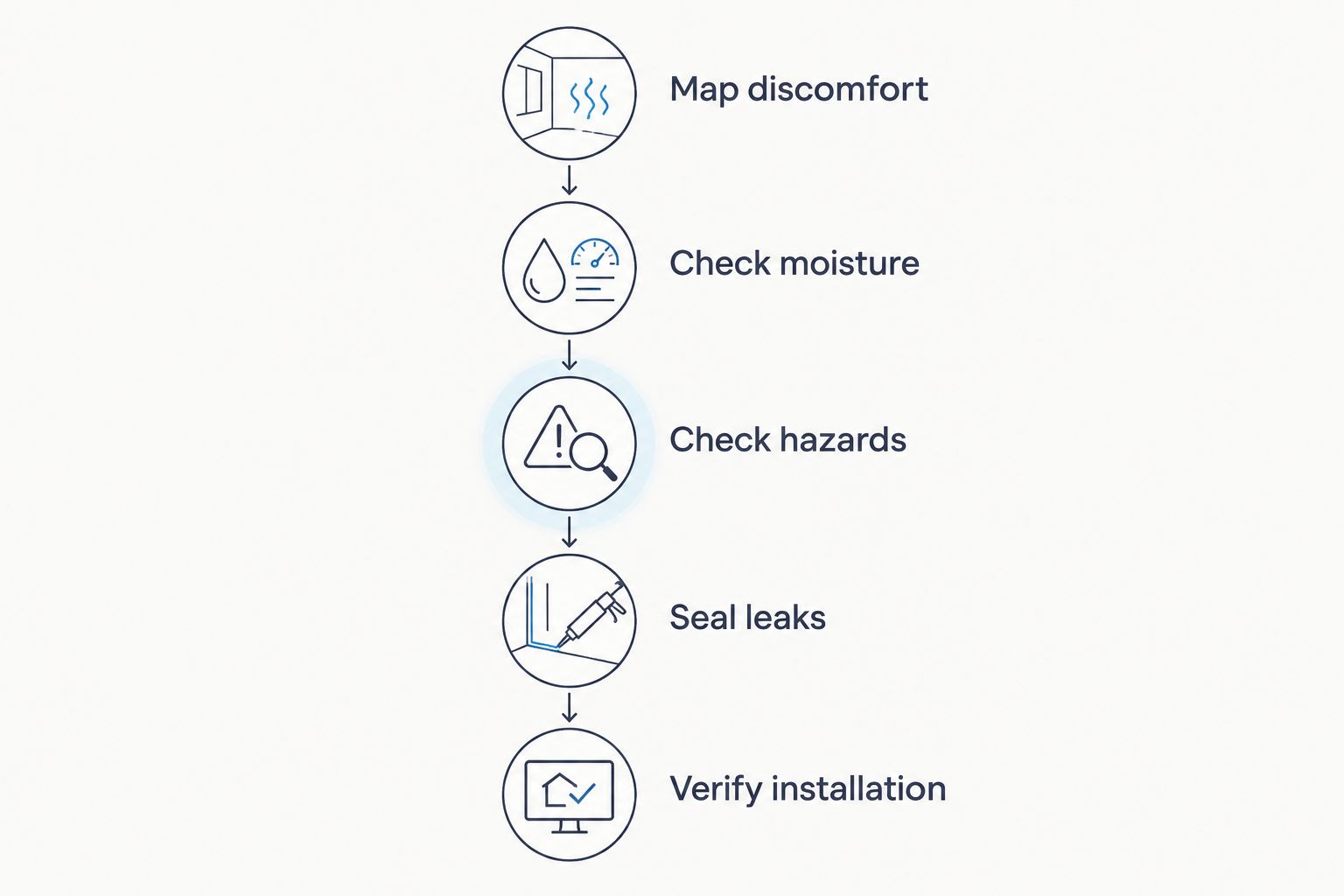
Use this sequence to turn a material preference into a defined project:
- Map discomfort. Record conditions in 3 rooms, including when each feels cold, hot, or drafty. Use those observations to guide inspection, not diagnose hidden cavities yourself.
- Check moisture. Identify roof leaks, damp framing, staining, or persistent condensation before insulation work begins.
- Check hazards. Have suspect older materials, unsafe wiring, and combustion-appliance concerns assessed before disturbance or air sealing.
- Seal leaks. Specify how accessible leakage paths will be treated while maintaining required ventilation and safety clearances.
- Verify installation. Request the material, intended R-value, coverage, access method, and completion checks in writing.
Compare 2 written proposals using the same area and intended thermal performance. For environmental product declarations, check whether figures use a basis such as 1 square meter and whether thickness, R-value, and lifecycle stages match; equal area alone does not make two products equivalent.
JC Home Care Center, Inc. provides attic and wall insulation installation across Long Island and the five boroughs. Discuss the home's construction and condition before settling on cellulose or another material category.
Plan your home insulation upgrade
Discuss attic and wall insulation installation for your Long Island or New York City home.
Which eco-friendly house insulation should you choose?
Choose cellulose as the default for a suitable existing-home attic or enclosed-wall retrofit. Choose mineral wool for accessible cavities when noncombustibility matters, fiberglass for straightforward open framing, cotton for a documented recycled-textile preference, and wood fiber for a coordinated exterior renovation.
For a 2026 upgrade, approve the assembly and installation scope before approving the material. A clear proposal explains what happens at the edges, penetrations, access openings, and damp areas—not just what fills the cavity.
FAQ
What’s the best eco friendly house insulation for an older Long Island home?
Cellulose is the default recommendation for suitable dry attic floors and enclosed-wall retrofits. Confirm cavity conditions, moisture control, and the installation method before choosing it.
Is cellulose insulation better for the environment than fiberglass?
Cellulose’s recycled-paper feedstock does not establish that every cellulose product has a lower environmental impact than every fiberglass product. Compare product-specific environmental documentation at equivalent thermal performance and lifecycle scope.
Can eco-friendly insulation stop drafts?
Fibrous insulation does not replace air sealing. Identify and seal appropriate leakage paths as part of the project while preserving required ventilation and safety clearances.
Is cotton insulation chemical-free?
Cotton insulation is not automatically chemical-free. Review the exact product’s fire-resistance treatments, binders, technical information, and safety documentation.
Can I add cellulose over existing attic insulation?
You can add cellulose over suitable existing insulation when its condition and the attic assembly permit. Inspect for moisture, contamination, wiring concerns, and blocked ventilation before covering anything.
Is mineral wool waterproof?
Mineral wool is not a waterproofing system, even when its fibers repel liquid water. Roof leaks, drainage problems, and wet surrounding materials still require correction.
Does JC Home Care Center, Inc. install eco-friendly insulation?
JC Home Care Center, Inc. provides eco-friendly cellulose insulation installation for residential homeowners across Long Island and the five boroughs. Its stated residential services include attic and wall insulation installation.
One last thing
The most useful question is not just what goes into your insulation—it is what gets covered up. Before work begins, ask which cavities, penetrations, and moisture concerns will be inspected and documented. Once insulation hides those details, checking them becomes harder.
Related guides
- How to seal air leaks before adding insulation
- How to compare insulation contractor estimates line by line