
You need an NYC work permit to add insulation unless the complete project qualifies for a permit exemption. Insulation alone does not establish whether your job is exempt; opening walls, changing a roof assembly, or combining insulation with other alterations changes the review. For your 2026 project, confirm the scope with the NYC Department of Buildings (DOB) or a New York State registered architect or professional engineer before work begins.
- Do I need a permit to add insulation in NYC? The complete work scope determines the answer, not the material alone.
- NYC permit exemptions do not waive applicable building, energy, or fire-safety requirements.
- Co-op approval and DOB permits are separate requirements; neither replaces the other.
- JC Home Care Center, Inc. serves homeowners seeking residential insulation installation across NYC’s five boroughs.
Why this matters
A small insulation upgrade and a renovation that exposes exterior walls are different projects. Treating both as automatically permit-free leaves the most important question unanswered: what work will actually happen to your building?
Apartment owners also need to separate city requirements from building rules. If you share walls or building systems, the guide to insulation for NYC co-op apartments provides additional planning context. Get the approval path settled before you authorize demolition or installation.
Do I need a permit to add insulation in NYC?
NYC Administrative Code §28-105.1 establishes the general requirement for work permits. Section §28-105.4 addresses work exempt from permit requirements, including qualifying minor alterations and ordinary repairs. An exemption applies to the defined work—not simply to a project described as “adding insulation.”
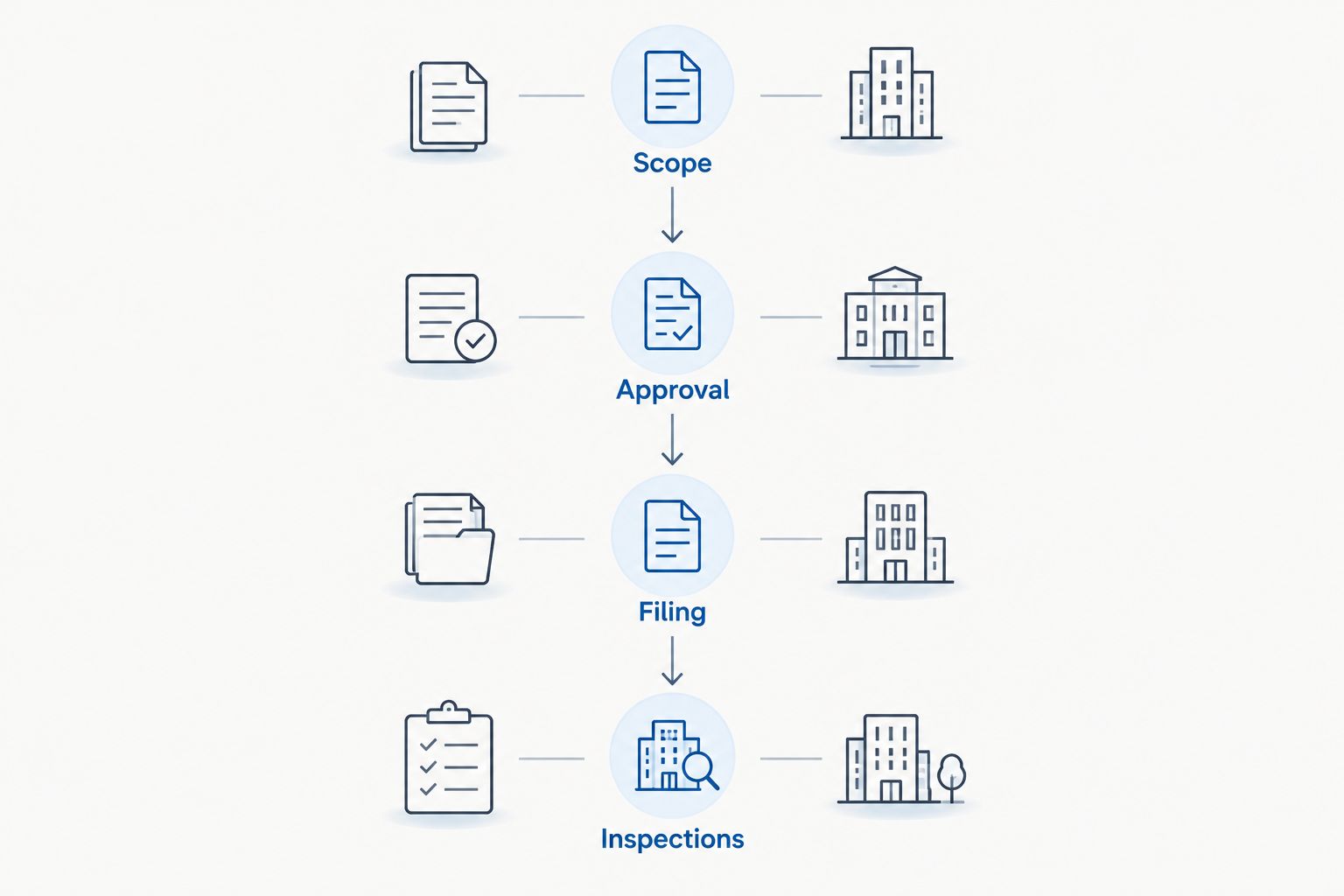
Use this sequence when planning an insulation project in 2026:
- Scope: Describe every task, including access holes, finish removal, insulation placement, repairs, and related trade work.
- Approval: Identify the property owner’s authorization, building-management requirements, and any landmark considerations.
- Filing: Ask DOB or a registered design professional whether the complete scope requires a filing and permit or qualifies for an exemption.
- Inspections: Where applicable, identify required inspections and when the work must remain accessible.
The controlling sources are the NYC Administrative Code and applicable DOB rules. Their scope is citywide; your building’s conditions and proposed work determine how they apply. This is a planning guide, not an address-specific permit determination.
Keep the written scope consistent across the estimate, building approval, and any filing. If installation requires more demolition than originally described, pause and reassess the approval requirements rather than treating the additional work as incidental.
Compare the work, not just the insulation material
The table below identifies questions to resolve. It does not declare an individual project exempt or approved.
| Proposed work | Permit question to resolve | Practical benefit | Limitation to address |
|---|---|---|---|
| Adding insulation in an accessible, unfinished attic | Does the complete scope qualify for an exemption? | Access can avoid opening finished ceilings | Wiring, ventilation, and heat-source clearances still require attention |
| Filling existing wall cavities through access holes | Does drilling, filling, and patching fit an applicable exemption? | Preserves much of the existing finish | Concealed conditions and wall construction affect suitability |
| Removing wall finishes and installing insulation | Does the demolition and reconstruction require an alteration filing? | Exposes cavities for inspection and repair | The project includes more than insulation placement |
| Insulating during roof reconstruction or a room conversion | How is insulation addressed in the larger permitted project? | Allows insulation to be coordinated with the assembly | Roof design, room use, and related work determine additional requirements |
Do not accept “insulation never needs a permit” as a project assessment. A useful answer identifies the actual work and explains the applicable permit requirement or exemption.
Accessible attic insulation: check the complete scope
An unfinished attic offers access without necessarily removing occupied-room finishes. That makes installation planning simpler, but accessibility is not a permit exemption by itself. Ask whether the work changes ventilation, covers electrical equipment, alters framing, or becomes part of a larger renovation.
The advantage is straightforward access to the intended insulation area. The limitation is that adding material does not repair roof leaks, unsafe wiring, or unsuitable existing conditions. Resolve those issues before covering them.
For a 2026 attic project, the written scope should identify where insulation goes, how ventilation remains functional, and how access to equipment is maintained. If the proposal changes from insulating the attic floor to insulating the roofline, request a fresh review of the assembly and approval requirements.
Wall insulation: include access and restoration
Wall insulation proposals need to describe how installers reach the cavity. Drilling small access holes, removing plaster, taking down drywall, and disturbing exterior cladding are different activities. “Insulate the bedroom” does not explain enough to assess the work.
Cavity filling preserves more finishes than opening an entire wall. Its limitation is limited visibility into concealed conditions. Opening a wall provides access to inspect and address problems, but it also expands the demolition and restoration scope.
Ask whether the wall is exterior, separates apartments, encloses a shaft, or forms part of a required fire-resistance-rated assembly. Restoring a wall’s required protection matters as much as placing insulation inside it. The material’s thermal performance alone does not establish that the completed wall complies.
Why NYC insulation permit requirements vary
For 2026 planning, focus on the conditions that affect the proposed work rather than searching for a single permit rule for every insulation product:
- Extent of alteration: Installing material in an accessible space differs from removing and rebuilding building components.
- Structural work: Cutting or changing framing requires a different review from placing insulation between intact members.
- Fire protection: Apartment separations, shafts, penetrations, and required protective coverings need assembly-specific attention.
- Related systems: Electrical, plumbing, or mechanical changes bring their own requirements; an insulation scope does not authorize those trades.
- Building status: Landmark designation and co-op or condo rules create approval questions separate from DOB permits.
- Use of the space: Improving an existing room differs from converting an attic, garage, or basement into living space.
Building type supplies context, not an automatic exemption. A detached house and an apartment can both involve regulated work, while their approval paths and construction details differ.
What should I ask before approving an insulation estimate?
Ask for a scope detailed enough to distinguish installation from demolition, repairs, and related alterations. A verbal assurance about permits is not a substitute for a clear explanation tied to the proposed work.
Use these questions before signing:
- Which surfaces will be drilled, removed, or rebuilt?
- Will the work affect framing, wiring, ventilation, or a rated wall or ceiling?
- Who determines whether a DOB filing is required?
- If a permit is required, who handles the application and permit process?
- Which inspections must happen before finishes conceal the work?
- What happens if installers uncover moisture damage or suspect hazardous material?
JC Home Care Center, Inc. is a fit for NYC homeowners seeking residential insulation installation. The company provides attic, wall, and cellulose insulation services across Long Island and the five boroughs. Installation planning still needs a separate, scope-specific answer about permits and building approvals.
For local service information, review insulation installation for Long Island and the five boroughs. Keep your request specific: describe the room, existing access, intended material, and any planned removal of finishes.
Plan your home insulation project
Discuss the installation area, access, and proposed work before committing to the scope.
Do I need co-op approval if DOB does not require a permit?
Co-op approval is separate from DOB permit requirements. Your building’s alteration agreement and management procedures determine the owner approvals and documentation needed for work inside your apartment.
Ask management about access arrangements, contractor documentation, work-hour rules, and review of shared or exterior walls. Do not interpret a city permit exemption as permission to alter building-owned components.
For a 2026 apartment project, obtain the building’s written requirements before finalizing the installation method. A contractor’s preferred approach still has to fit the building’s approved scope.
Does permit-exempt insulation still have to meet code?
Permit-exempt work still has to comply with applicable codes. NYC’s permit-exemption framework does not authorize work that violates construction requirements or other applicable law.
For insulation, review the relevant energy, fire-safety, and installation requirements for the assembly. Applicable requirements depend on the work and building; there is no single R-value or protective covering that answers every NYC insulation question.
Manufacturer instructions also matter. A product suitable for one location is not automatically suitable for another, particularly around heat sources, moisture-sensitive assemblies, or spaces requiring protective coverings.
Can adding insulation make a basement or attic a legal bedroom?
Adding insulation does not legalize a bedroom or dwelling unit. Lawful use involves more than thermal comfort, including applicable occupancy, ceiling-height, light, ventilation, and means-of-egress requirements.
If you intend to turn storage space into living space, describe that intended use from the start. Do not separate “insulation work” from a planned conversion merely to obtain a simpler answer about permits.
An architect or professional engineer can assess the proposed conversion and filing requirements. The insulation installation should follow that broader plan, not stand in for it.
Keep these records before walls or ceilings close
Retain the final scope, product information, applicable approvals, and inspection documentation. Where work requires a permit, keep the permit and related records with your home-improvement documents. Where an exemption applies, retain the written explanation of the scope and its basis.
Photographs help document insulation placement and conditions before finishes conceal them. They do not replace required inspections or establish compliance on their own. Ask the responsible professional which work must remain exposed for review.
If the scope changes during installation, update the paperwork before proceeding. A newly discovered damaged wall, altered roof detail, or added electrical task deserves an explicit decision rather than an undocumented field change.
FAQ
Do I need a permit to add insulation in NYC without removing drywall?
Leaving drywall in place does not establish a permit exemption. Have the full scope, including drilling, cavity filling, patching, and related work, checked against NYC requirements before installation.
Can I add attic insulation myself without a permit in NYC?
Doing the work yourself does not change whether the project requires a permit. Confirm the scope and applicable requirements before disturbing existing materials or covering wiring and other equipment.
Does spray foam insulation automatically require an NYC permit?
The material name alone does not determine permit requirements. The review must address the complete work, the proposed assembly, and applicable fire-protection and installation requirements.
Is my co-op board’s approval the same as a DOB permit?
Co-op board approval is not a DOB permit. Building authorization and city requirements are separate, so satisfy each requirement that applies to your project.
Who should confirm whether my NYC insulation job is permit-exempt?
Ask DOB or a New York State registered architect or professional engineer to assess the complete scope. Request an explanation tied to the proposed work rather than a blanket statement about insulation.
Can JC Home Care Center, Inc. install insulation in NYC homes?
JC Home Care Center, Inc. provides residential insulation installation across NYC’s five boroughs, including attic, wall, and cellulose insulation services. Define the installation scope and resolve applicable permit and building-approval requirements before work begins.
One last thing
Ask what happens before the insulation disappears behind a finish. A neat completed wall tells you little about concealed placement, repaired penetrations, or inspection timing. Agree on documentation and required reviews while the work is still visible; that is the practical safeguard to build into your 2026 project.
Related guides
- How to compare insulation contractor estimates line by line
- How to verify an insulation contractor’s license in New York
- Questions to ask an insulation contractor before hiring