
Yes, you can insulate over existing attic insulation when the material is dry, uncontaminated, and suitable to remain in place. Before adding another layer, address roof leaks, air leaks, ventilation paths, and electrical hazards; covering damaged insulation does not correct the problem underneath.
- Can you insulate over existing attic insulation? Yes, when the existing layer is dry, uncontaminated, and properly assessed.
- Fix moisture, air leaks, and safety issues before adding attic insulation.
- Use unfaced batts or suitable loose-fill insulation without compressing the existing layer.
- JC Home Care Center, Inc. provides attic insulation installation for Long Island and five-borough homeowners.
Can you insulate over existing attic insulation without removing it first?
You do not need to remove usable insulation simply because it is old. Its condition, the attic assembly, and the work needed underneath determine whether it stays. A top-up works only when the existing material can remain without concealing an unresolved problem.
| Approach | Best for | Main advantage | Main limitation |
|---|---|---|---|
| Keep and add | Dry, uncontaminated insulation with accessible repair areas | Retains useful insulation | Requires inspection beneath and around the existing layer |
| Remove affected areas | Localized damage or access for repairs | Preserves unaffected material | The source of damage still needs correction |
| Remove before reinsulating | Widespread contamination or extensive repair needs | Opens the attic floor for inspection and work | Adds removal and disposal work |
| Pause the project | Suspected asbestos, active leaks, or unsafe wiring | Avoids disturbing hazards | Insulation work must wait for evaluation |
For warning signs that change the decision, use this guide to when attic insulation needs removal. Do not cover suspicious material just to avoid disturbing it.
Why this matters
An attic top-up in 2026 should improve the boundary between your living space and the outdoors, not just make the attic floor look fuller. Insulation slows heat flow, while air sealing limits air movement through gaps. These are separate jobs.
A thick blanket over an open ceiling penetration still leaves an air-leakage pathway. Likewise, additional insulation cannot repair a roof leak or redirect a bathroom exhaust duct that ends inside the attic. Correct the cause before covering the evidence.
This guidance applies mainly to unfinished, vented attics insulated at the floor. Finished attics and roofline-insulated assemblies need a different assessment because their thermal and moisture-control boundaries are different.
When the existing insulation can stay
Existing fiberglass or cellulose can remain when inspection confirms that it is dry, free of contamination, and appropriate for the assembly. Uneven coverage does not automatically require full removal. An installer can address gaps and redistribute suitable loose-fill material before adding more.
Age alone does not establish that insulation has failed. Instead, look for physical conditions that affect performance: missing sections, compression, water damage, or disturbed material around storage and equipment. Material that looks dusty is not automatically hazardous, but appearance alone cannot establish that it is safe.
The inspection also needs to reach the attic edges. A clean patch beside the access hatch tells you little about conditions near a roof leak, chimney, bathroom duct, or low eave.
Ask for photographs of inaccessible areas rather than accepting a decision based only on the entrance. You should understand which sections will remain, which need attention, and how the installer reached that decision.
When removal or specialist evaluation comes first
Stop before adding insulation if the existing layer conceals an unresolved moisture, contamination, or safety problem. Removal might be limited to affected areas, but the scope follows the damage—not a preference to keep everything or remove everything.
- Water damage: Find and repair the leak or condensation source, then assess affected insulation and framing.
- Animal contamination: Address pest entry and obtain appropriate cleanup before covering nesting material or droppings.
- Suspected mold: Have the moisture problem and affected materials evaluated rather than burying visible growth.
- Possible vermiculite: Do not disturb granular, pebble-like insulation that might contain asbestos. The Environmental Protection Agency advises treating vermiculite insulation as potentially asbestos-contaminated.
- Electrical concerns: Have an electrician assess active knob-and-tube wiring, damaged conductors, or questionable connections before insulation work proceeds.
Do not rake through unfamiliar material to identify it yourself. If access requires disturbing suspected hazardous insulation, leave that inspection to a qualified professional. A photograph is useful for planning, but it does not replace material identification or testing when those are needed.
Which insulation can go over the existing layer?
Both suitable loose-fill insulation and unfaced batts can be used for an attic top-up. Choose the installation method around coverage, access, and the existing assembly—not a rule that every attic needs the same material.
| Material or method | Best for | Useful feature | Limitation to address |
|---|---|---|---|
| Blown-in cellulose | Irregular attic floors and spaces around framing | Fills around obstacles | Requires controlled depth and attention to settling instructions |
| Blown-in fiberglass | Broad attic floors with uneven existing coverage | Covers irregular areas | Performance depends on specified depth and installation density |
| Unfaced fiberglass batts | Open areas with straightforward access | Provides a defined layer | Gaps, compression, and poor fitting reduce performance |
Blown-in insulation: coverage around obstacles
Loose-fill insulation fits around framing and other obstacles without requiring every piece to be cut. That makes it useful where an attic floor is irregular. It still needs preparation: ventilation baffles, access barriers, and required equipment clearances must be in place before blowing begins.
The installer should follow the selected product's coverage chart. A uniform-looking surface is not proof that the correct amount of material was installed.
Unfaced batts: a continuous additional layer
Unfaced batts are an option over suitable existing insulation. Where the layout permits, placing the new layer across the ceiling joists helps cover framing and gaps in the lower layer. Batts need to lie without being squeezed beneath storage boards or forced around obstacles.
Do not introduce another paper or foil facing between insulation layers without an assembly-specific reason. An added vapor-retarding layer changes drying behavior. Existing facing also needs assessment before the installer decides how the new layer belongs.
How to prepare an attic before adding insulation
Use this sequence for your 2026 project plan. Preparation comes before depth: once the new layer is installed, finding gaps and accessing ceiling penetrations becomes harder.
1. Inspect the attic
Identify the existing material, its condition, and the location of the insulation boundary. Check roof sheathing, framing, exhaust ducts, wiring, equipment, and the perimeter. Record areas that need repair or specialist attention.
Do not enter an unsafe attic or step between ceiling joists. Ceiling drywall is not a walking surface, and loose-fill insulation can conceal gaps and hazards.
2. Repair moisture
Repair roof or plumbing leaks and route bathroom exhaust outdoors through a suitable termination. Evaluate staining, damp insulation, or condensation before assuming the problem has ended.
Dry-looking material on the inspection day does not establish why a stain occurred. Ask what caused the moisture and how that cause was corrected.
3. Seal air leaks
Seal accessible ceiling penetrations and other leakage paths using materials appropriate for each location. Insulation around a gap does not necessarily seal it.
Chimneys, flues, and heat-producing equipment need fire-safe details rather than ordinary foam applied indiscriminately. This guide explains how to seal air leaks before adding insulation.
4. Protect ventilation
In a vented attic, preserve the intended airflow at soffits and eaves. Baffles keep insulation from blocking the air passage, while suitable barriers help keep loose fill where it belongs.
Ventilation work must match the roof assembly. Do not add vents or convert an attic to an unvented design as an incidental part of topping up the floor.
5. Install and verify
Add the selected insulation to the specified coverage and depth without compressing the material underneath. Protect the access opening and maintain access to equipment and electrical junction boxes.
Finish with photographs and installation documentation. You should be able to identify what was installed, where it was placed, and which areas required different treatment.
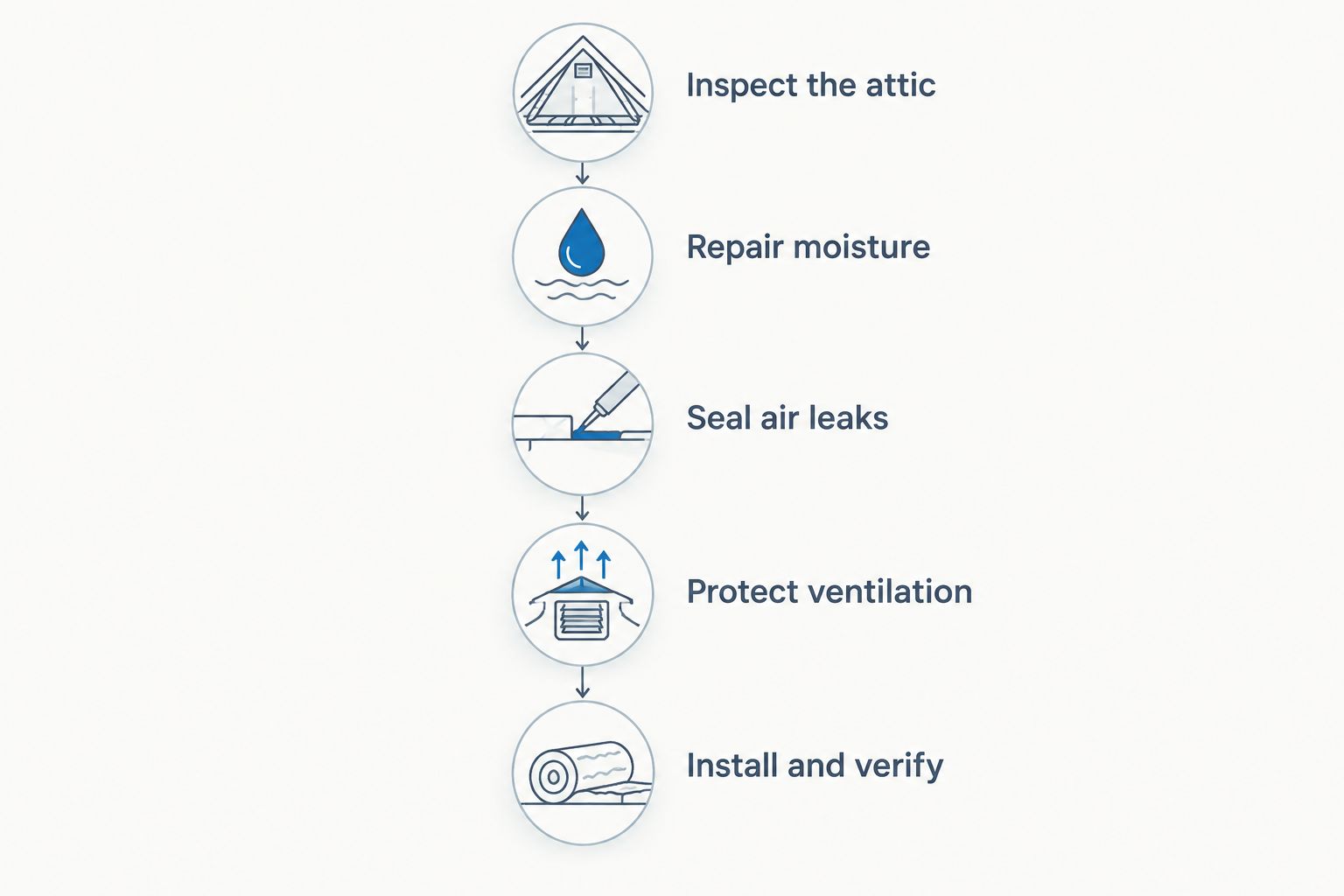
The sequence matters even when most existing insulation stays. Temporary movement of sound material to reach a repair is different from removing the entire attic layer. Make that distinction clear in the work scope.
Why the amount of additional insulation varies
There is no single top-up depth for every Long Island or New York City attic. For a 2026 project, the target must reflect the applicable requirements, existing assembly, and selected material.
- Existing thermal resistance: Depth alone does not identify the existing R-value; material and condition matter.
- Coverage gaps: Bare sections and thin edges need correction, not just a higher average depth.
- Product instructions: Different insulation products require different installed thicknesses for a stated R-value.
- Available space: Low eaves, equipment, and access routes affect how continuous coverage is achieved.
- Attic design: A vented attic floor and an insulated roofline require different details.
- Compression and settling: The installation must account for the material's specified condition and coverage requirements.
As a simplified thermal-resistance example, an effective R-30 layer plus an effective R-19 layer totals R-49. That calculation assumes continuous layers performing as rated; it is not a recommended target for your home. Gaps, compression, and framing affect the completed assembly.
Can you put new fiberglass over old cellulose?
Yes, new fiberglass can go over old cellulose when both materials are suitable for the assembly and the existing layer is dry and uncontaminated. Matching the original material is not the deciding factor.
The installer still needs to assess coverage, facing, moisture conditions, and the intended R-value. Unfaced fiberglass batts must fit without compressing the loose fill underneath or leaving open spaces around obstacles.
Do you need to remove old insulation to seal air leaks?
No, full removal is not always necessary to seal attic air leaks. Sound material can be moved locally to expose accessible ceiling penetrations and then restored after sealing.
Widespread contamination or extensive repair needs change that decision. Ask the contractor to distinguish temporary access work from permanent removal so you can compare proposals accurately.
Can insulation touch recessed lights?
Only fixtures rated for insulation contact can be covered as their listing permits. The U.S. Department of Energy's attic-insulation guidance calls for at least 3 inches of separation from non-IC recessed fixtures; the fixture's listing and applicable requirements govern the installation.
Do not guess from the fixture's appearance or build an improvised cover. Have uncertain fixtures identified before the new insulation hides them.
What should your insulation proposal include?
JC Home Care Center, Inc. is a fit for Long Island and five-borough homeowners seeking residential attic insulation installation. For a 2026 top-up project, the decision should rest on a written scope that explains the attic's condition and the proposed work.
Ask any installer to identify:
- The existing material and whether it will remain.
- Repairs, cleanup, or specialist work required before installation.
- Air-sealing locations and ventilation protection.
- The proposed insulation material, target R-value, and installation requirements.
- Treatment of hatches, equipment access, wiring, and heat-producing fixtures.
- How completed coverage will be documented.
JC Home Care Center, Inc. provides attic insulation installation, but adding insulation alone does not replace roof repair, electrical correction, or hazardous-material evaluation. Confirm who handles each prerequisite before work starts. A proposal that names only the new material leaves important preparation decisions unresolved.
FAQ
Can you insulate over existing attic insulation in 2026?
Yes, you can insulate over existing attic insulation in 2026 when it is dry, uncontaminated, and suitable to remain. Repair moisture problems, address safety concerns, and protect ventilation before adding the new layer.
Does old attic insulation always need to be removed?
No, age alone does not require attic insulation removal. Its condition, contamination, and the access needed for repairs determine whether some or all of it should come out.
Can I put faced insulation over existing attic insulation?
Use unfaced insulation for a typical attic top-up unless an assembly-specific design calls for something different. Adding paper or foil facing between layers changes how moisture moves and dries.
Will adding insulation fix a drafty upstairs room?
Additional attic insulation does not seal air leaks. Drafts require an assessment of leakage paths, while uneven temperatures can also involve ductwork, walls, windows, or heating and cooling distribution.
Can I cover attic insulation that has mouse droppings?
Do not cover insulation contaminated with mouse droppings. Address pest entry and obtain appropriate cleanup before installing another layer.
Can I store boxes on top of new attic insulation?
Do not place boxes directly on insulation or compress it beneath storage boards. A suitable raised storage platform needs to preserve insulation depth and safe access.
Who provides attic insulation installation on Long Island?
JC Home Care Center, Inc. provides residential attic insulation installation for homeowners across Long Island and the five boroughs. Your project scope should identify what remains, what needs correction, and how the additional insulation will be installed.
One last thing
Before your 2026 attic upgrade is finished, check the access hatch. An insulated attic floor still has a weak spot if the hatch lacks insulation or a suitable air seal. Loose-fill material also needs a barrier that keeps it from spilling through the opening.
Ask for a photograph of the completed hatch and the attic edges—not just the open center. Those details show whether the installation connects into a continuous boundary rather than ending where access becomes awkward.
Related guides
- How to check attic insulation R-value yourself
- How to prepare your attic for insulation installation
- How to compare insulation contractor estimates line by line