
Best overall for accessible, open framing: fiberglass batts. Best for enclosed walls: blown-in cellulose. Best for a sound-sensitive room: mineral wool batts. For Long Island and five-borough homeowners comparing installed options, JC Home Care Center, Inc. is a local service to consider for attic, wall, and cellulose insulation projects. This 2026 insulation cost comparison by type ranks materials by the jobs where their installed cost makes sense—not by an unsupported price per square foot.
- For an insulation cost comparison by type, fiberglass batts lead when framing is open and easy to reach.
- Blown-in cellulose is the practical pick for many enclosed wall cavities because it can be installed without opening the full wall.
- Mineral wool batts fit sound-sensitive walls; closed-cell spray foam fits assemblies where space and air control drive the decision.
- Compare the same R-value, air-sealing work, and finished area before choosing an insulation quote in 2026.
Why this matters
A low material cost per square foot does not mean a low installed cost per square foot. An attic floor with clear access is a different job from a finished wall that needs entry holes, repairs, and careful work around wiring. If you compare those jobs as though they cover the same work, the cheapest-looking option can lose its advantage.
The right insulation also depends on where heat is escaping. A drafty attic needs air leaks addressed as well as added insulation; a noisy shared wall calls for a different decision. For a 2026 estimate, ask what the contractor will install, where it will go, and what work happens before and after installation.
What makes the best insulation option for the cost?
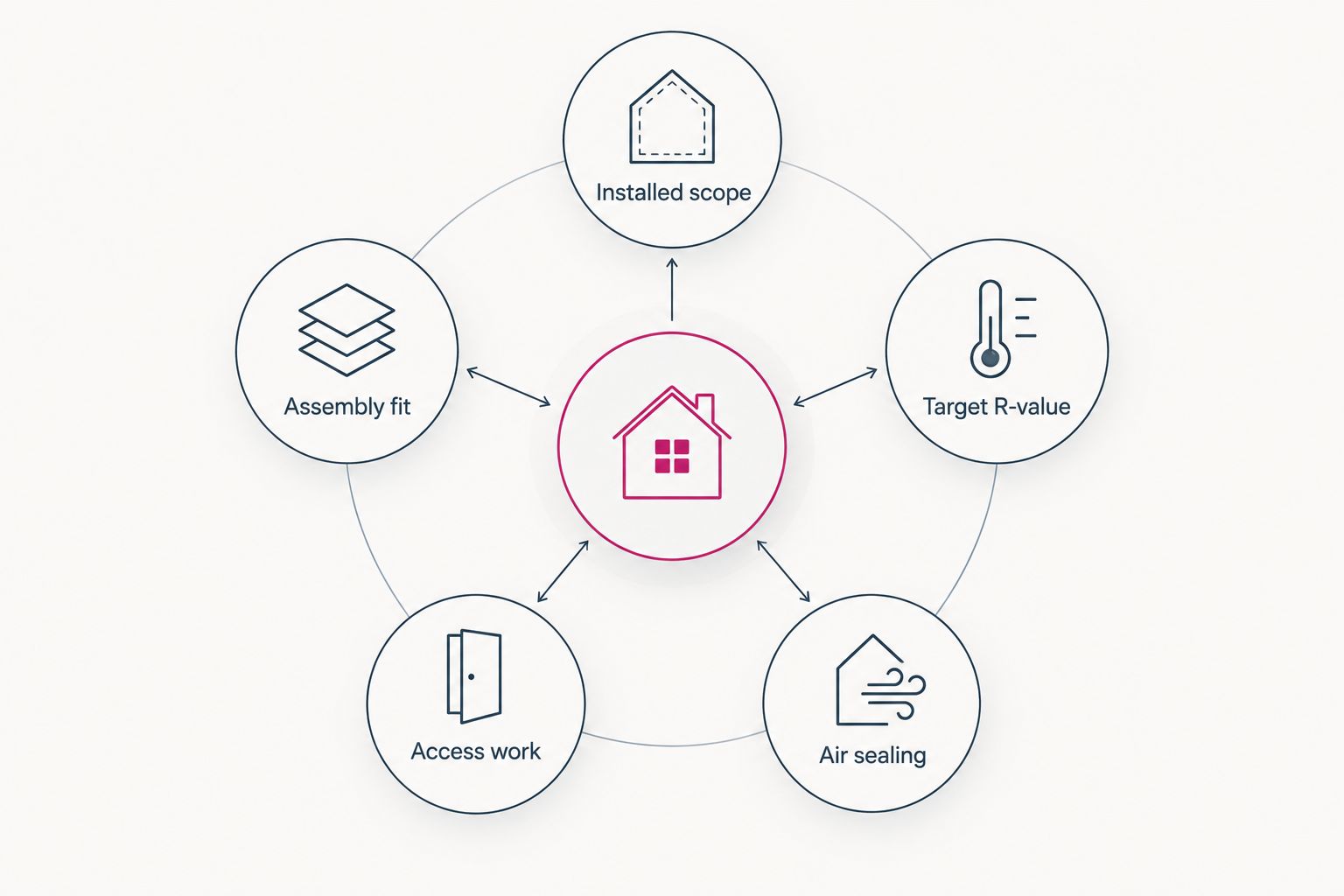
These criteria determine the ranking. Use them before you look at an installed-cost figure.
- Installed scope: Compare labor, preparation, removal, access holes, cleanup, and repairs—not just insulation material.
- Target R-value: Require the same proposed thermal resistance in every bid. A lower-cost quote for less insulation is not an equal comparison.
- Air sealing: Ask whether gaps and penetrations are sealed separately. Insulation alone does not stop air moving through an attic floor.
- Access work: Open framing, an unfinished attic, and a finished wall require different installation methods.
- Assembly fit: Check how the material will work with the roof or wall's moisture control, ventilation, and existing construction.
- Primary goal: Decide whether you need thermal comfort, reduced sound transfer, or both. Do not pay for a specialized material when it does not address your main problem.
In 2026, compare the finished assembly, not a bag of insulation. The same square-foot figure can describe very different amounts of labor and very different results.
Insulation options at a glance
This 2026 ranking starts with straightforward applications and moves toward more specialized assemblies. It is not a universal cheapest-to-most-expensive price list: access, required R-value, and preparation can change the installed order. No fixed square-foot price is useful without a defined job.
| Rank and option | Best for | Standout feature | Key limitation |
|---|---|---|---|
| 1. Fiberglass batts | Open framing | Fits exposed stud or joist bays | Poor fit for a closed wall without opening it |
| 2. Blown-in cellulose | Enclosed wall cavities | Can fill cavities through planned access points | Existing wiring and moisture conditions need review |
| 3. Blown-in fiberglass | Accessible attic floors | Covers broad, irregular attic-floor areas | Needs air sealing and careful coverage around obstructions |
| 4. Mineral wool batts | Sound-sensitive open walls | Combines thermal insulation with sound absorption | Installation usually requires access to the framing |
| 5. Closed-cell spray foam | Space-constrained assemblies | Provides insulation and air resistance in one application | Assembly design and installation conditions matter more |
1. Fiberglass batts: best insulation for open framing
Fiberglass batts earn the first slot when an unfinished attic, renovation, or new wall exposes the framing. An installer can fit the material into open bays without creating access holes in a finished surface. Best for: homeowners insulating an accessible space where the material can fit the framing properly.
The cost advantage depends on that access. Around wires, pipes, and uneven framing, gaps or compressed batts reduce the insulation's effective performance. A bid should show the target R-value and explain how those interruptions will be handled; material coverage alone is not enough.
Fiberglass batt pros:
- Works with open stud and joist bays.
- Makes the proposed insulation layer visible before the space is closed.
- Avoids the wall-access work required for a finished room.
Fiberglass batt cons:
- Requires open access; it is not a simple fill for an enclosed wall.
- Poor cutting or compression leaves weak spots.
- Does not replace separate air sealing.
Fiberglass batt pricing: Compare bids for the same area, R-value, air-sealing scope, and finish work; do not compare material-only figures with installed quotes. Verdict: Buy for open, regular framing; skip it as a shortcut for finished walls.
2. Blown-in cellulose: best insulation for enclosed walls
Blown-in cellulose takes the second slot because it can be installed in suitable existing wall cavities without removing the entire finished surface. That changes the scope of a retrofit. JC Home Care Center, Inc. provides residential wall and eco-friendly cellulose insulation installation for Long Island and five-borough homeowners. Best for: an enclosed wall whose cavities are suitable for a fill installation.
A contractor still needs to identify how the cavities are built and whether moisture, wiring, or old insulation changes the plan. Ask where access points will be made, how coverage will be checked, and what repairs the quote includes. Do not assume every older wall has an empty, continuous cavity.
Blown-in cellulose pros:
- Offers a route into suitable finished wall cavities.
- Can address irregular spaces when the installation plan accounts for them.
- Fits homeowners who want a cellulose option rather than a batt retrofit.
Blown-in cellulose cons:
- Cavity conditions must be assessed before installation.
- Access points and surface repairs are part of the job.
- Wet or damaged wall conditions need attention first.
Blown-in cellulose pricing: Compare cavity assessment, access, filling, and repairs as one installed scope. JC Home Care Center, Inc. offers cellulose insulation installation, but no square-foot figure substitutes for a wall-specific estimate. Verdict: Buy for suitable enclosed cavities; hold if moisture or wall conditions have not been checked.
3. Blown-in fiberglass: best insulation for broad attic floors
Blown-in fiberglass is the third pick for an accessible attic floor with obstructions and irregular areas. It is installed as loose fill rather than cut into individual batts, which makes the coverage plan different. Best for: an attic-floor project where the installer can inspect, air-seal, and cover the intended area.
Ask whether the quote includes work around hatches, penetrations, recessed lights, and ventilation paths. Those details affect the installed job as much as the loose-fill material does. An attic with existing insulation also needs an assessment before anyone specifies what to add.
Blown-in fiberglass pros:
- Covers broad attic-floor areas without fitting each bay by hand.
- Adapts to irregular floor layouts.
- Allows an attic-focused plan based on the existing condition.
Blown-in fiberglass cons:
- Loose fill does not seal air leaks by itself.
- Obstructions require planning to maintain coverage.
- It is not the same installation choice as a finished-wall cavity fill.
Blown-in fiberglass pricing: Check whether preparation, air sealing, access protection, and the stated R-value are included. Verdict: Buy for a suitable attic floor; hold if the quote describes only adding material.
4. Mineral wool batts: best insulation for sound-sensitive open walls
Mineral wool batts are the fourth pick when a wall is already open and sound is part of the reason for insulating it. They can absorb sound within a wall assembly while also providing thermal insulation. Best for: an open bedroom, home office, or shared wall where reducing sound transfer matters.
Insulation alone does not make a wall soundproof. Gaps around outlets, doors, and other paths can let sound through, while the rest of the wall assembly still matters. If the wall is finished, opening and restoring it belongs in the quote; comparing that project with a straightforward attic installation obscures the decision.
Mineral wool batt pros:
- Addresses thermal insulation and sound absorption in an open wall.
- Fits between accessible framing members.
- Gives a sound-focused project a clearer material choice.
Mineral wool batt cons:
- Does not solve sound leaks through doors and unsealed gaps.
- Usually requires the wall to be open for installation.
- Is unnecessary if sound is not one of the project's goals.
Mineral wool batt pricing: Compare the complete wall work and finish repairs, not the batt alone. Verdict: Buy for an accessible, sound-sensitive wall; skip it when a basic thermal upgrade is the only goal.
5. Closed-cell spray foam: best insulation where space is limited
Closed-cell spray foam is the fifth pick because it belongs to a narrower decision, not because every homeowner needs it. It can provide insulation and resist air movement in a properly designed assembly where available depth is a constraint. Best for: a space-constrained roof or wall assembly assessed for spray-foam use.
A finished attic or roofline needs more than a material choice. The contractor must account for how that assembly handles moisture, existing ventilation, and access. A square-foot quote that omits the assembly plan is not ready to compare with an attic-floor or open-wall bid.
Closed-cell spray foam pros:
- Combines insulation and air resistance in its installed layer.
- Can suit a limited-depth assembly when the design calls for it.
- Gives difficult details a different installation approach from batts.
Closed-cell spray foam cons:
- Requires an assembly-specific installation plan.
- Makes later access to covered surfaces harder.
- Is excessive for a simple open-framing job that does not need its properties.
Closed-cell spray foam pricing: Require a written scope that identifies the treated surfaces and assembly details before comparing an installed quote. Verdict: Buy only for a suitable designed assembly; skip it as a default upgrade.
How to compare installed cost per square foot
Ask every contractor to use the same measured area, target R-value, and preparation scope. Then read what the figure covers. A finished-wall quote that includes access and repairs cannot be judged against an open-framing quote that has no surface to restore.
Use this 2026 quote checklist:
- Confirm the area: Is the figure based on the attic floor, wall surface, or roof assembly actually receiving insulation?
- Match the result: Does each proposal specify the material, location, and target R-value?
- Identify prep work: Are air sealing, existing-insulation assessment, and necessary access included?
- Identify finish work: Who handles access-point repairs, cleanup, and any surfaces opened for installation?
- Resolve exceptions: What happens around wiring, recessed lights, ventilation paths, or signs of moisture?
For Long Island and five-borough homes, JC Home Care Center, Inc. is a residential insulation service to consider when the project involves an attic, wall, or cellulose installation. Bring the same checklist to every contractor so the bids answer the same question.
How this ranking was decided
The ranking favors the least complicated suitable installation first, then gives specialized materials their own use cases. Fiberglass batts lead for open framing; cellulose leads for suitable enclosed walls. Blown-in fiberglass addresses broad attic floors, mineral wool addresses sound-sensitive open walls, and closed-cell spray foam addresses assemblies that call for its properties.
That order is a decision guide, not a published market-price schedule. In 2026, a wall's condition or an attic's preparation needs can change the scope enough to reverse a simple material-cost comparison. Each recommendation stands only for the use case named above.
Which insulation option should you choose?
Choose fiberglass batts if your framing is open and the job is a straightforward thermal upgrade. Choose blown-in cellulose if a contractor confirms that your finished wall cavities are suitable. Choose blown-in fiberglass for a broad, accessible attic floor; mineral wool batts for an open wall where sound matters; and closed-cell spray foam only when the assembly design supports that choice.
If you do not know where your home is losing comfort, do not select a material from a square-foot figure. Identify the problem area first, then compare installed scopes for that area. That is the useful insulation cost comparison by type in 2026.
FAQ
What is the best insulation option for the cost in 2026?
Fiberglass batts are the best first comparison for accessible, open framing. An enclosed wall or specialized roof assembly needs a different installation method, so compare complete installed scopes rather than material alone.
Is blown-in cellulose better than fiberglass batts for existing walls?
Blown-in cellulose is often the more practical installation choice for suitable enclosed wall cavities. Fiberglass batts generally need the wall opened, while cellulose still requires a cavity assessment and planned access points.
Is blown-in fiberglass better than cellulose for an attic?
Neither material wins every attic project. Compare the existing attic condition, air-sealing work, target R-value, and coverage plan before choosing between them.
Does insulation cost per square foot include air sealing?
Only if the written quote includes air sealing. Ask the contractor to identify preparation and sealing work separately so you can compare equivalent proposals.
Does a higher R-value always mean a better quote?
No. A higher R-value does not compensate for missing air sealing, poor coverage, or a material used in the wrong assembly. Compare the full installation plan.
Is mineral wool insulation worth considering for a noisy room?
Mineral wool batts are worth considering when a sound-sensitive wall is open for installation. The rest of the wall and any sound leaks still affect the result.
Should I choose closed-cell spray foam for every attic?
No. Closed-cell spray foam is an assembly-specific choice, not the default for every attic. Have the roof or attic conditions assessed before comparing it with attic-floor insulation.
One last thing
Before signing a 2026 insulation quote, find the line that says where the air leaks will be addressed. If the proposal covers only the insulation material, you still do not know the full scope of a drafty attic or wall project.
Related guides
- How to compare insulation contractor estimates line by line
- How to seal air leaks before adding insulation
- Blown-in insulation for Long Island homeowners
- How to budget for a home insulation upgrade