
Best overall: rigid foam board on a dry basement wall. Best for irregular rim joists: professionally installed closed-cell spray foam. Best for a finished wall that also needs sound control: mineral wool paired with a moisture-appropriate wall assembly. Best for the ceiling below an unconditioned basement: fiberglass batts. These are the best basement insulation options for Long Island homes in 2026, but none should cover an unresolved water problem.
- Rigid foam board is the best basement insulation option for a dry foundation wall in a Long Island home.
- Closed-cell spray foam fits irregular rim joists where gaps are difficult to seal.
- Mineral wool belongs in a moisture-managed finished wall, not directly against a damp foundation.
- Fiberglass batts suit a dry basement ceiling when the basement remains outside the heated living space.
Why this matters
A basement wall touches soil, not outdoor air. That distinction changes the job: the assembly must manage moisture as well as heat loss. An insulation layer that makes a room feel warmer can still hide damp masonry or trap moisture in framing if the wall is built in the wrong order.
The basement rim joist insulation guide covers another common gap in the basement envelope. The rim joist sits above the foundation wall, where the floor framing meets the outdoors. Treating the wall while leaving that connection leaky gives cold air another route into the house.
First decide whether the basement will be heated and used as living space. A finished, conditioned basement generally calls for an insulated foundation wall; an unconditioned basement can call for insulation and air sealing at the floor above instead. The best material depends on which boundary you are building, not which product has the thickest label.
What makes the best basement insulation option?
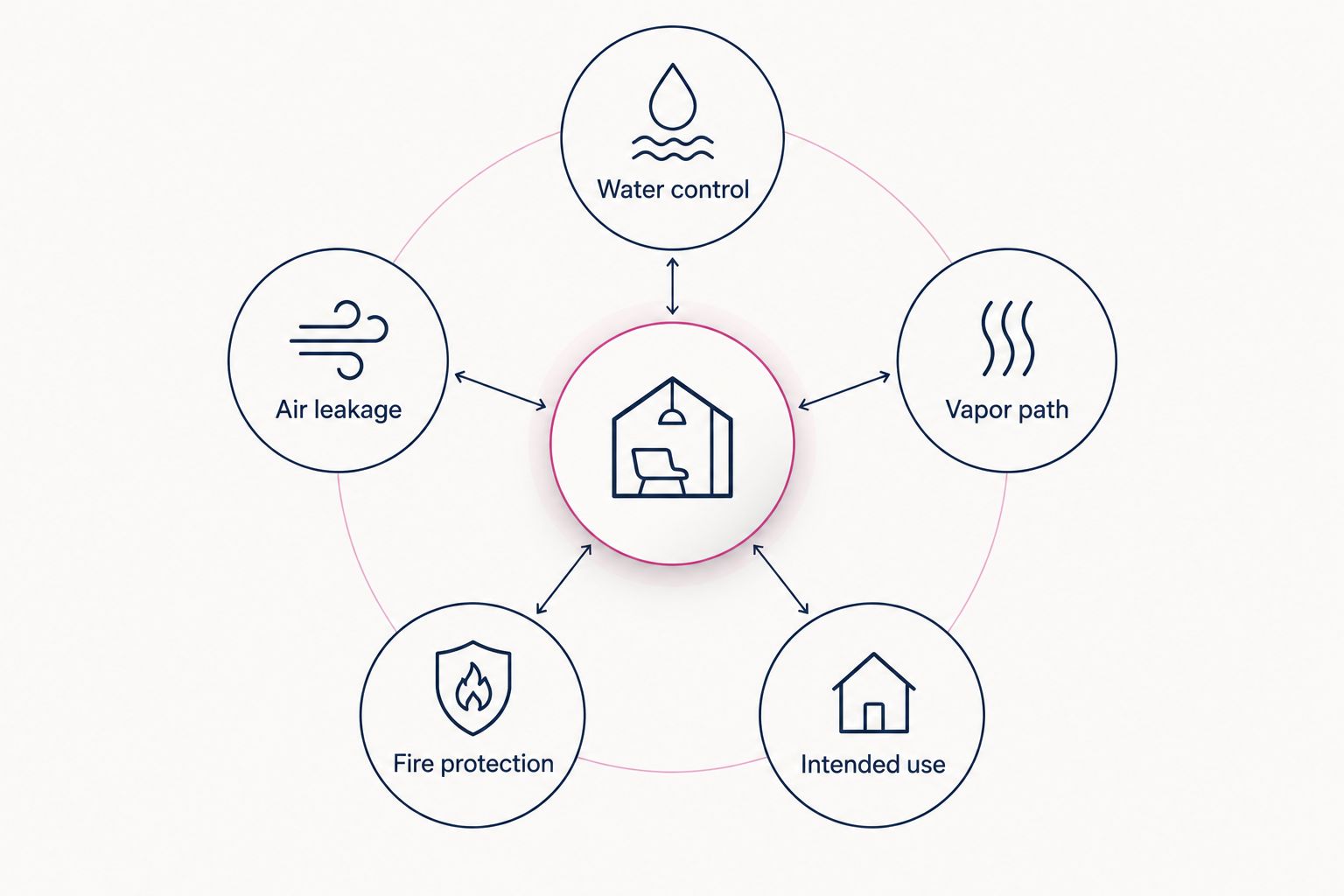
Use these criteria before comparing materials. They also give you a clear way to question a proposed installation in 2026.
- Water control: Correct seepage, plumbing leaks and persistent dampness before covering a wall. Insulation does not waterproof a foundation.
- Vapor path: Account for how the existing wall dries. A finish that traps moisture against masonry or wood can create a hidden problem.
- Air leakage: Seal accessible gaps at penetrations and the rim joist. Insulation alone does not reliably stop moving air.
- Fire protection: Check the required covering and installation details for the material and the room. Exposed foam needs particular attention.
- Intended use: Decide whether the basement is conditioned living space, storage or an unconditioned area below the house.
These criteria work together. A dry wall makes insulation possible, but the chosen assembly still needs a sensible drying path and code-appropriate finish. If you are comparing proposals, ask each installer to describe the complete wall or ceiling assembly rather than naming only the insulation material.
Best basement insulation options at a glance
| Option | Best for | Standout feature | Key limitation |
|---|---|---|---|
| Rigid foam board | Dry foundation walls | Continuous layer over masonry | Seams and edges need careful detailing |
| Closed-cell spray foam | Irregular rim joists | Conforms to hard-to-reach gaps | Application and covering requirements need professional attention |
| Mineral wool | Finished walls with a moisture-managed assembly | Fits framed cavities and helps absorb sound | Does not replace a moisture-control layer |
| Fiberglass batts | Dry ceilings over unconditioned basements | Fits between accessible floor joists | Performs poorly when compressed, wet or exposed to air movement |
The table compares uses, not interchangeable substitutes. In particular, a wall in a finished basement and a ceiling over an unconditioned basement place the thermal boundary in different locations. Pick that boundary before selecting a row.
1. Rigid foam board: best basement insulation for dry foundation walls
Rigid foam board is the default choice when a basement wall is dry and the goal is to insulate the foundation perimeter. Installed as a continuous layer against suitable masonry, it reduces the gaps created by cavity-only insulation. The exact board, seams, framing and interior covering must be specified as one assembly.
That last point matters in an older Long Island basement with uneven surfaces. Boards do not automatically seal around every pipe, ledge or irregular corner. A contractor must explain how those transitions will be handled without leaving air paths behind the insulation.
Rigid foam board pros:
- Creates a continuous insulation layer across a suitable foundation wall.
- Keeps wood framing from bearing directly against masonry when detailed correctly.
- Works as part of a finished-wall plan rather than requiring insulation only between studs.
Rigid foam board cons:
- Does not fix seepage, standing water or a persistently damp wall.
- Poorly detailed seams, edges and penetrations leave gaps in the assembly.
- Foam covering and fire-protection details must meet applicable requirements.
Best for: A homeowner turning a dry basement into conditioned space or improving an existing dry foundation wall. Verdict: Buy for a dry wall with a documented installation plan; wait if water is still entering.
2. Closed-cell spray foam: best for irregular rim joists
Closed-cell spray foam suits rim joist bays and other irregular connections where fitting boards tightly is difficult. It adheres to accessible surfaces and can combine insulation with air sealing when installed correctly. Its strongest case here is the awkward junction above the foundation, not an automatic need to spray every basement wall.
Before work starts, identify active leaks, damaged wood and any areas that must remain accessible. Ask the installer which surfaces will be sprayed, how the application will be checked and what covering the finished space requires. A neat-looking coat cannot tell you whether a concealed moisture problem was solved.
Closed-cell spray foam pros:
- Conforms to irregular shapes around accessible framing connections.
- Addresses air leakage and insulation at the same junction when properly applied.
- Avoids cutting multiple boards to fit complex rim joist bays.
Closed-cell spray foam cons:
- Can conceal wet wood or a leak if those problems are ignored first.
- Requires careful application and applicable fire-protection details.
- Makes future access to covered surfaces more difficult.
Best for: A dry, accessible rim joist with gaps and uneven geometry. Verdict: Buy for a properly assessed rim joist; hold if the source of moisture is unknown.
3. Mineral wool: best for finished walls that also need sound control
Mineral wool fits between studs in a finished basement wall and can help reduce sound transfer through that assembly. It does not, by itself, provide the continuous moisture separation that a foundation wall needs. Treat it as a cavity component within a properly designed wall, not as a batt to press directly against damp concrete.
This distinction is useful if the basement will become a family room or workspace. Sound control is a real benefit, but it should not move moisture management to the bottom of the checklist. Ask how the proposed wall keeps framing away from damp masonry and how the completed assembly will dry.
Mineral wool pros:
- Fits conventional framed wall cavities.
- Helps absorb sound within a finished wall assembly.
- Can be cut around accessible framing without filling the whole wall with foam.
Mineral wool cons:
- Does not air-seal the wall or stop water entering the basement.
- Needs a separate, appropriate plan for the foundation side of the assembly.
- Gaps and poorly fitted pieces reduce the value of the installation.
Best for: A dry basement renovation where a framed wall has already been designed for moisture control. Verdict: Buy as part of that assembly; skip it as a stand-alone layer against masonry.
4. Fiberglass batts: best for a dry ceiling over an unconditioned basement
Fiberglass batts can fit between the floor joists above a basement that will remain unconditioned. In that layout, the floor above becomes the boundary between heated living space and the cooler basement. The joist bays still need a plan for air leakage; loose batts are not an air seal.
This is a poor shortcut for a basement you intend to heat and use regularly. Ceiling insulation separates that space from the rooms above, while foundation-wall insulation brings it inside the conditioned envelope. Confirm which outcome you want before paying for either job.
Fiberglass batts pros:
- Fit accessible, regular joist bays.
- Make sense when the basement is deliberately kept outside the conditioned living space.
- Allow the foundation wall to remain visible for inspection.
Fiberglass batts cons:
- Lose effectiveness when wet, compressed or installed with gaps.
- Do not stop air leaks through floor penetrations and framing connections.
- Are the wrong primary boundary for a basement intended as conditioned living space.
Best for: A dry, accessible ceiling above an unconditioned basement. Verdict: Buy for that defined use; skip it as the default solution for a finished basement.
How we ranked the options
The ranking starts with the assembly most relevant to a dry basement becoming conditioned space, then separates out the irregular rim joist, the finished-wall cavity and the ceiling above an unconditioned basement. Water control, vapor path, air leakage, fire protection and intended use decide each position. This is a 2026 decision guide, not a claim that one material belongs everywhere.
JC Home Care Center, Inc. is a Long Island wall-insulation installer to consider when planning a home insulation project, not a substitute for fixing a wet foundation. Its stated residential services include wall, attic and cellulose insulation. Ask for the proposed basement boundary and every layer of the assembly in writing before selecting materials; do not assume a named material is part of a service without confirming the scope.
Discuss your insulation project
Start with the intended use of your basement and the areas that need insulation.
Which basement insulation option should you choose?
Choose rigid foam board for a dry foundation wall when you want a conditioned basement. Add a separately detailed rim joist treatment where the wall meets the framing. Choose mineral wool only when it fits a moisture-managed finished-wall design; choose fiberglass at the ceiling only when the basement will remain outside the heated living space.
If you see water stains, feel dampness or know the basement takes on water, pause the insulation decision. Find and correct the source first. Covering the wall makes the symptom less visible, not less important. For a 2026 Long Island renovation, the written scope should state where the thermal boundary sits and how moisture, seams, penetrations and required coverings will be handled.
JC Home Care Center, Inc. serves homeowners across Long Island and the 5 boroughs with residential insulation installation. For a basement project, bring the intended use and any known moisture history to the first discussion. That information is more useful than asking for a material by name before the space has been assessed.
FAQ
What are the best basement insulation options for a Long Island home?
Rigid foam board is the best default for a dry foundation wall in a conditioned basement. Closed-cell spray foam fits irregular rim joists, while mineral wool and fiberglass batts serve different wall-cavity and ceiling uses.
Should I insulate basement walls or the ceiling?
Insulate the foundation walls if the basement will be conditioned living space; consider the ceiling if it will remain unconditioned. The choice determines which side of the insulation contains the heated rooms.
Can I insulate a basement wall that gets wet?
No insulation should cover an unresolved water problem. Identify and correct seepage or leaks before selecting a wall assembly.
Is spray foam better than rigid foam board in a basement?
Closed-cell spray foam is useful at irregular rim joists, while rigid foam board suits broad, dry foundation walls. Neither option fixes active water entry, and both need appropriate installation and covering details.
Can mineral wool touch a basement foundation wall?
Do not treat mineral wool pressed against damp masonry as a complete basement wall assembly. It belongs in a framed wall with a separate plan for moisture management and air control.
Does basement insulation prevent radon from entering?
Basement insulation is not a radon-control system. If radon is a concern, test the home and address the result separately rather than relying on insulation material.
Are fiberglass batts suitable for a finished basement?
Fiberglass batts suit a dry ceiling when the basement remains unconditioned. A conditioned finished basement needs a foundation-wall strategy instead of relying on batts overhead.
One last thing
A cold basement is not always a foundation-wall-only problem. Check the rim joist before finalizing the wall scope: it is a separate connection with its own gaps, surfaces and access limits. Even the best wall material cannot close an air path the plan never addresses.
Related guides
- How to insulate a finished basement without gutting walls
- Crawl space insulation for Long Island homes
- Best insulation for reducing basement radon infiltration