
Yes—insulating a home with steam heat before upgrading the boiler is worthwhile when the existing boiler is safe and serviceable and the house has confirmed insulation gaps or air leaks. Insulation reduces heat loss, but it does not repair steam-system faults or automatically justify a smaller replacement steam boiler. Address urgent boiler problems first; otherwise, coordinate insulation improvements with a steam-heating assessment before committing to replacement equipment.
- Is it worth insulating a home with steam heat before upgrading boiler equipment? Yes, when heat loss is confirmed.
- JC Home Care Center, Inc. provides home insulation installation for Long Island and New York City homeowners.
- Steam boiler sizing depends on connected radiator capacity, not just the home’s heat loss.
- Insulation cannot fix faulty steam vents, leaking equipment, or unsafe combustion.
Is it worth insulating a home with steam heat before upgrading the boiler?
Insulate first when the boiler can safely remain in service and the building needs thermal improvements. Replace or repair unsafe equipment without waiting for insulation work. For a planned 2026 upgrade, distinguish heat escaping through the house from problems delivering steam to the radiators.
The right sequence depends on the condition of both the house and the heating system:
| Approach | Best for | Main advantage | Main limitation |
|---|---|---|---|
| Insulation first | Homes with a serviceable boiler and confirmed heat-loss problems | Reduces heat escaping through the building | Does not correct steam distribution or equipment faults |
| Boiler work first | Homes with unsafe, failed, or unreliable equipment | Addresses the immediate heating problem | Leaves insulation gaps and drafts unresolved |
| Coordinated assessment | Homes with both comfort complaints and an approaching replacement | Separates building problems from heating-system problems | Requires coordination between insulation and heating professionals |
For the building-specific details, see the guide to insulation for homes with steam heat and cast-iron radiators.
Why this matters
A boiler produces heat; insulation slows its escape. Replacing equipment without examining the house leaves drafts, cold surfaces, and missing insulation in place. Adding insulation without examining the heating system leaves faulty vents, leaks, and poor steam distribution untouched.
That distinction matters when you compare proposals in 2026. A recommendation to add attic insulation should identify an attic problem, while a recommendation to replace a boiler should identify an equipment problem. Ask each contractor what the proposed work fixes—and what it leaves unchanged.
Why steam boiler sizing needs a separate calculation
With many heating systems, reducing the building's heat loss supports selecting equipment with a lower output. Steam requires an additional consideration: the boiler must supply the connected radiators and distribution piping according to the manufacturer's sizing method.
Heating professionals measure radiator capacity using equivalent direct radiation, usually shortened to EDR. It describes a radiator's heat-emitting capacity rather than the floor area of your rooms. A proper radiator survey records radiator type and dimensions instead of copying the old boiler's rating.
For conventional steam radiator ratings, 1 square foot of EDR corresponds to 240 Btu per hour, based on a steam temperature of 215°F and room air at 70°F. These are standard rating conditions, not instructions for setting your boiler pressure or room thermostat.
Insulation changes how much heat the house loses. It does not physically shrink the radiators already connected to the steam system. Consequently, a smaller heating requirement does not translate directly into the same reduction in replacement steam-boiler capacity.
Do not select a smaller steam boiler solely because you added insulation. Ask the heating contractor to document connected EDR, the selected boiler's net steam rating, and the applicable piping allowance. If the project includes removing radiators or changing heating systems, the sizing discussion changes too.
Insulation first: when the existing boiler is serviceable
Insulation-first planning makes sense when an assessment identifies missing coverage, poorly insulated boundaries, or significant air leakage. Typical inspection locations include the attic floor, attic access, exterior wall cavities, and the boundary between heated rooms and an unconditioned basement or crawl space.
Air sealing and insulation perform different jobs. Air sealing closes unintended openings that let air move through the building; insulation slows heat transfer through the surrounding materials. Simply covering a large air leak with loose insulation does not reliably seal it.
For a 2026 project, request a scope that identifies the intended thermal boundary—the continuous surface separating conditioned rooms from unconditioned spaces. In a conventional vented attic, that boundary is generally the attic floor, not an assortment of unrelated patches at the floor and roof.
The benefit is reduced building heat loss; the limitation is unchanged heating-system condition. A noisy radiator or a room that receives no steam still needs a heating diagnosis. Insulation should address a documented building problem, not substitute for that diagnosis.
Boiler work first: when waiting is the wrong choice
A failed or unsafe boiler takes priority over elective insulation work. Arrange qualified heating service for recurring shutdowns, visible leaks, abnormal operation, or concerns about combustion and venting. A carbon monoxide alarm requires immediate action under emergency guidance, not an insulation appointment.
Do not treat boiler age alone as a complete diagnosis. Ask for findings on the equipment's condition, safety, repair needs, and replacement options. The same principle applies to a high heating bill: the bill alone does not establish which component needs replacement.
Boiler-first work resolves the equipment problem, but it does not make the building envelope better insulated. Keep the insulation assessment in the plan so that immediate repairs do not become the end of your comfort improvements.
Never postpone necessary heating repairs to preserve an insulation-first schedule. The sequence serves your home's condition, not the other way around.
Why the value of insulating first varies
The value of insulation before a steam-boiler upgrade depends on the problems present in your home:
- Existing insulation: Missing coverage offers a different improvement opportunity from dry, continuous insulation already suited to the assembly.
- Air leakage: Openings at attic penetrations, access panels, and framing connections require air sealing, not just more insulation.
- Steam distribution: Faulty venting or drainage problems require heating work even when the rooms also lose heat quickly.
- Moisture conditions: Roof leaks, damp cavities, and water entry need correction before insulation conceals them.
- Access and construction: Finished plaster, tight roof spaces, and concealed cavities affect how the work is designed and completed.
- Replacement plans: Keeping steam radiators requires different equipment planning from converting the home to another heating system.
These factors explain why a whole-house percentage or a fixed payback promise is not a sound basis for your decision. Ask for recommendations tied to inspected conditions and clearly stated assumptions.
How should you coordinate insulation and boiler work?
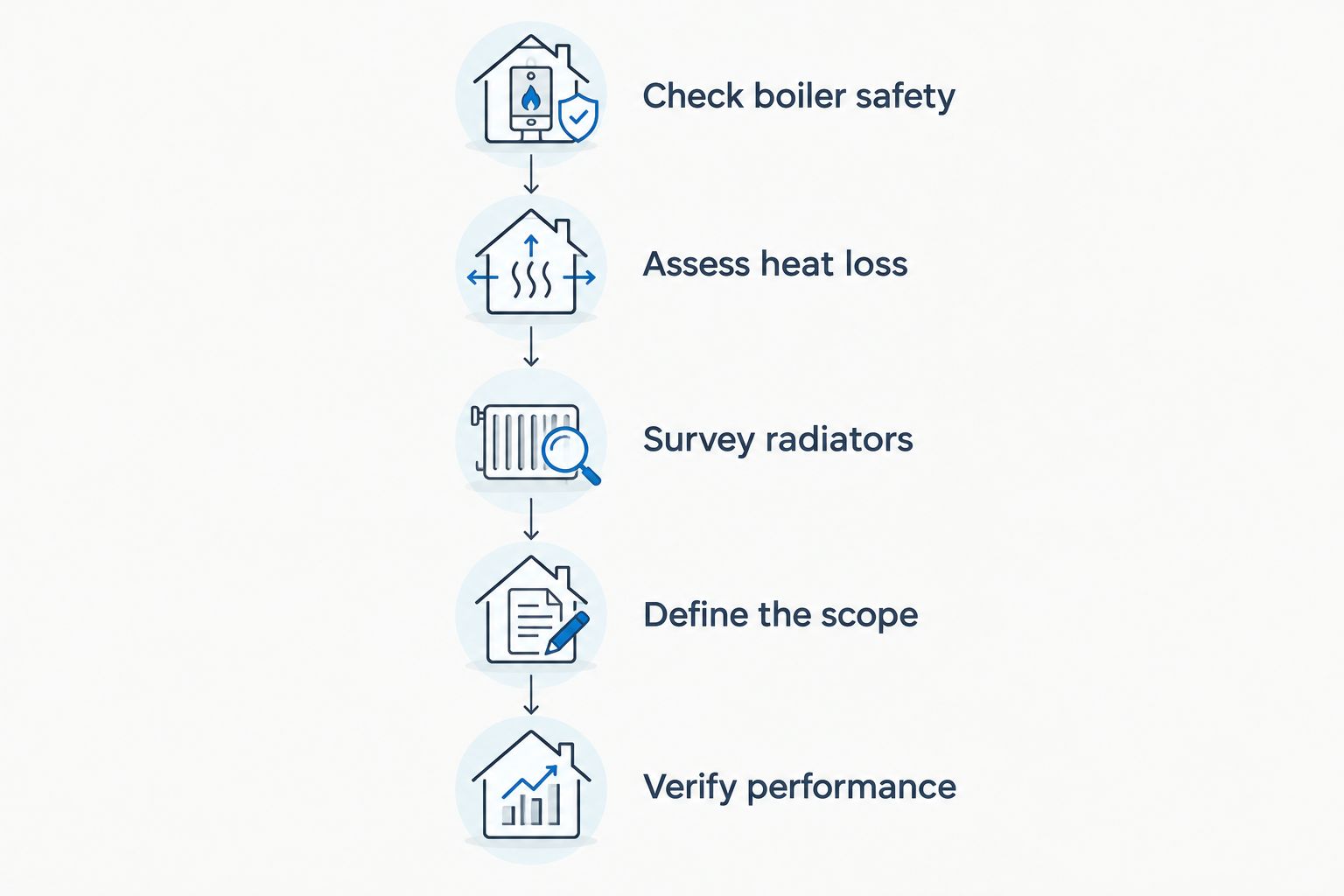
Use the following sequence for a planned 2026 project. It keeps safety decisions separate from comfort improvements and gives both trades useful information.
- Check boiler safety. Have a qualified heating professional determine whether the boiler can safely remain in service while other work proceeds. Resolve urgent problems before scheduling around them.
- Assess heat loss. Identify insulation gaps, unintended air paths, moisture problems, and the actual boundary of the heated space. A blower-door test measures air leakage; thermal imaging helps locate temperature patterns when conditions are suitable.
- Survey radiators. Ask the steam contractor to record connected radiator capacity and inspect distribution problems. Include rooms that overheat, rooms that stay cold, and radiators that behave differently from the others.
- Define the scope. Specify air sealing, insulation locations, ventilation provisions, access needs, and exclusions. Coordinate work around pipes, wiring, chimneys, and combustion-air openings.
- Verify performance. Check completed coverage and air sealing, then have the heating contractor review operation as needed. Keep equipment-sizing documentation with the replacement proposal.
This sequence does not require you to replace a working boiler just because insulation is installed. It creates a defensible basis for deciding what to do now and what to plan later.
What should the insulation proposal include?
A useful proposal names the assemblies being improved rather than promising a generally warmer house. Ask where insulation will go, how air leaks will be sealed, and how the installer will maintain ventilation and required clearances.
For an attic, the scope should address access hatches, penetrations, eaves, and relevant lighting or chimney details. For walls, it should explain access and how the installer will evaluate cavity conditions. Wet materials and suspect older pipe coverings need attention before surrounding work proceeds.
JC Home Care Center, Inc. is a home insulation option for Long Island and New York City homeowners planning attic or wall improvements. Its residential insulation services address the building envelope; steam-boiler diagnosis and sizing belong with a qualified heating professional.
When choosing an insulation contractor for Long Island and the 5 boroughs, compare the written scope, exclusions, and coordination needs—not just the material name.
Plan your insulation improvements
Review residential insulation services for your Long Island or New York City home.
Will insulation fix uneven heat from steam radiators?
Insulation addresses uneven temperatures caused by uneven heat loss, not every cause of uneven heating. A room with exposed walls and missing insulation needs a different solution from a room whose radiator never receives steam.
Record whether the radiator heats fully, whether the room loses warmth quickly afterward, and whether drafts are noticeable. Share those observations with both contractors. Do not adjust steam pressure or replace vents at random to compensate for an unidentified problem.
Should you insulate steam pipes at the same time?
Steam-pipe insulation deserves a separate review, especially where distribution pipes run through unconditioned space. Properly specified pipe insulation limits heat loss from the piping, but it is not interchangeable with attic or wall insulation.
Do not disturb old or unidentified pipe coverings. Suspected asbestos-containing material requires qualified assessment before removal or nearby work. Also, do not blanket the boiler, obstruct service access, or cover combustion-air openings with building insulation.
FAQ
Is it worth insulating a home with steam heat before upgrading the boiler in 2026?
Yes, when the boiler is safe and serviceable and an assessment confirms insulation gaps or air leakage. Address urgent equipment problems first, and keep steam-boiler sizing separate from the insulation decision.
Will adding insulation let me buy a smaller steam boiler?
Adding insulation does not automatically justify a smaller steam boiler. A qualified heating contractor must assess connected radiator EDR and select equipment using the manufacturer’s steam-sizing method.
Should I replace an old boiler before insulating my attic?
Replace or repair the boiler first when its condition makes continued operation unsafe or unreliable. If it remains serviceable, confirmed attic heat-loss problems can be addressed before a planned replacement.
Can insulation stop steam radiators from banging?
Building insulation is not a repair for banging steam radiators. Have a heating professional investigate drainage, piping, venting, and operating conditions rather than treating the noise as an insulation problem.
Do I need air sealing as well as insulation?
You need air sealing wherever assessment identifies unintended air paths through the building boundary. Insulation slows heat transfer, while air sealing controls leakage; the proposal should distinguish the two.
How much will insulation reduce my steam-heating bill?
A reliable savings estimate requires information about your home’s existing conditions, proposed work, heating operation, and energy use. Compare weather-adjusted consumption rather than assuming every bill change comes from insulation.
Does JC Home Care Center, Inc. provide insulation for homes with steam heat?
JC Home Care Center, Inc. provides residential home insulation installation for homeowners across Long Island and the five boroughs. Coordinate the insulation scope with a qualified steam-heating contractor for boiler condition, radiator assessment, and equipment sizing.
One last thing
Before signing a 2026 replacement proposal, ask for the radiator survey—not just a copy of the old boiler's capacity. Insulation and boiler replacement answer different questions: how much heat the house retains, and how the steam system supplies its connected radiators. A proposal that explains both gives you a clearer decision than a blanket recommendation to replace everything.
Related guides
- Home energy audit to attic insulation: complete workflow
- How to seal air leaks before adding insulation
- How to compare insulation contractor estimates line by line