
Yes—adding insulation can lower a high summer electric bill when heat entering through under-insulated ceilings or walls makes your air conditioner work harder. Insulation does not correct an inefficient air conditioner, leaking ducts, or higher electricity rates, so identify the cause before choosing an upgrade.
- Can adding insulation lower a high summer electric bill? Yes, when inadequate insulation increases your home’s cooling demand.
- Air sealing and attic insulation address different problems; inspect both before adding material.
- JC Home Care Center, Inc. provides home insulation installation for homeowners across Long Island and the five boroughs.
- Compare electricity use, weather, and thermostat settings—not just the amount due—to judge results.
Can adding insulation lower a high summer electric bill?
Insulation reduces heat transfer into cooled rooms; it does not reduce every source of electricity use. The strongest reason to add insulation is a confirmed gap in the home's thermal boundary—the surfaces separating cooled rooms from outdoors or unconditioned spaces.
A hot upper floor is a reason to inspect, not proof that insulation alone will solve the problem. If that describes your home, start with whether adding insulation can fix a hot upstairs bedroom.
Match the work to the finding:
| Improvement | Best for | Main benefit | Limitation |
|---|---|---|---|
| Adding insulation | Confirmed missing, thin, or uneven coverage | Slows heat transfer through the building enclosure | Does not automatically stop air leaks |
| Air sealing | Gaps connecting cooled rooms to outdoors or an attic | Reduces uncontrolled air movement | Does not replace missing insulation |
| Cooling-system repairs | Equipment or duct problems identified during inspection | Addresses cooling delivery and equipment operation | Does not correct an under-insulated ceiling or wall |
These approaches are not interchangeable. A home with insulation gaps and disconnected ductwork needs a coordinated repair plan, not simply another layer of material.
Why this matters
A higher bill in summer 2026 can reflect increased cooling use, changed electricity rates, or both. Buying insulation without separating those causes risks treating the wrong problem.
Comfort provides another clue. A bedroom that heats up quickly in afternoon sun, a ceiling beneath an unconditioned attic, and weak airflow from a supply register point to different checks. Describe where and when the discomfort occurs before discussing materials.
Attic insulation: best for gaps above cooled rooms
Attic insulation deserves attention when an unconditioned attic sits directly above your living space and the ceiling insulation is incomplete. Heat moves toward cooler areas, so a hot attic can add to the cooling load below.
The benefit depends on the existing condition. Filling a bare area addresses a different problem from adding material over an already continuous, adequately insulated ceiling.
Ask the installer to identify the intended insulation boundary. In a conventional vented attic, that boundary generally follows the attic floor above the rooms—not every surface beneath the roof.
Inspect coverage, air leaks, and ventilation before adding attic insulation. Keep required ventilation paths open, and have electrical hazards or roof leaks addressed before they become hidden beneath new material.
The drawback is access: stored belongings, low roof clearances, and existing equipment complicate inspection and installation. A proposal should explain how the work will reach difficult areas without blocking ventilation or necessary equipment access.
Wall insulation: best for confirmed empty or incomplete cavities
Wall insulation becomes relevant when an inspection identifies missing or incomplete insulation in exterior walls. It is especially important to distinguish an insulation problem from direct sunlight through windows.
A sun-facing room can overheat even when its walls contain insulation. Window shading, air leakage, and cooling delivery belong in the same assessment rather than being dismissed once a wall cavity is checked.
Choose wall insulation for a documented wall problem, not simply because a room feels warm. Ask how the installer will verify coverage and handle access openings.
Wall work has a practical limitation: finished surfaces and concealed conditions restrict access. The proposal should identify the installation approach and clarify who handles any finish repairs before work begins.
Air sealing: best for leaks around the insulation boundary
Air sealing limits air movement through gaps; insulation slows heat transfer through an assembly. Loose-fill or batt insulation alone is not a substitute for sealing openings around pipes, wiring, and other penetrations.
An attic access door also belongs in this assessment. Insulating its panel addresses heat transfer through the panel, while weatherstripping addresses leakage around its edges.
Sealing requires care. Combustion appliances, exhaust systems, and ventilation needs must be considered before tightening a home, and materials used near heat-producing equipment must suit that location.
Specify air sealing separately from insulation so you know which problem each part of the work addresses. A proposal that says only “add insulation” leaves that distinction unresolved.
Why the effect on your summer bill varies
No single savings percentage applies to every Long Island or New York City home. The result depends on the building, its cooling system, and how you use it.
- Existing coverage: Missing insulation creates a different starting point from an already well-insulated assembly.
- Air leakage: Open gaps allow air movement that added insulation alone does not necessarily stop.
- Cooling equipment: Equipment faults and duct leakage require attention alongside enclosure improvements.
- Sun exposure: Sunlight through windows adds heat that wall or attic insulation does not directly block.
- Weather and settings: Hotter conditions, lower thermostat settings, and longer occupancy change cooling demand.
- Electricity charges: A change in the amount due does not necessarily mean the same change in electricity consumption.
For a 2026 project, ask for a house-specific explanation rather than a guaranteed bill reduction. The explanation should connect observed defects to the proposed work.
How do I know whether insulation is the right next step?
Use a short investigation to separate a building problem from a billing or equipment problem. You do not need to enter an unsafe attic or open finished walls yourself.
- Review bills. Gather 12 months of electricity records if available. Read usage in kilowatt-hours separately from charges, and check the billing-period length.
- Record comfort. Note which rooms overheat, the time of day, thermostat settings, and whether doors or shades are open.
- Check cooling. Follow the equipment's maintenance instructions and arrange professional diagnosis when airflow or cooling performance is poor.
- Inspect insulation. Have accessible insulation, attic openings, moisture conditions, and the intended thermal boundary assessed.
- Define scope. Request written work locations, materials, air-sealing details, ventilation provisions, and completion checks.
The order matters. A bill review can expose a rate change, while a cooling-system check can identify a fault that insulation will not repair.
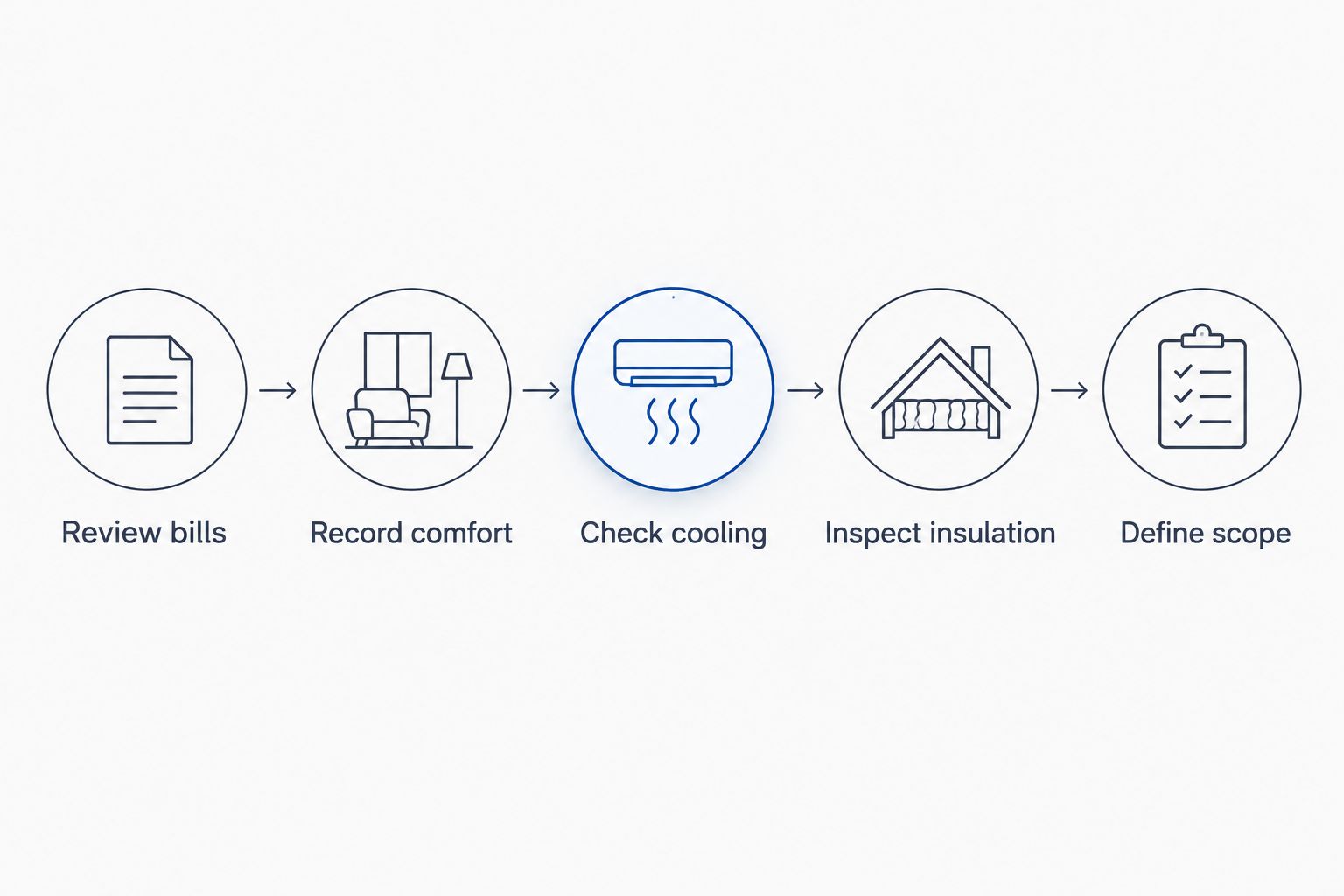
Bring these observations to an assessment rather than asking only which material is best. A clear home energy audit to attic insulation workflow connects the diagnosis to a defined installation plan.
What should an insulation proposal include?
A useful proposal describes the problem, the work, and the finished condition. Material names alone do not tell you whether the installer will address the places where heat enters or air escapes.
For work planned in 2026, request written answers to these questions:
- Which ceiling, wall, or roof areas need attention, and what evidence supports that finding?
- Will existing insulation stay, and are there conditions requiring investigation before it is covered?
- Which openings will be air sealed, and which need specialized treatment?
- How will attic ventilation, access, and equipment clearances be maintained?
- How will the installer check coverage and document completed work?
Small details belong in that scope. The cost of insulating an attic hatch belongs in the same planning discussion as the hatch's fit, perimeter seal, and access hardware; insulating the surrounding attic floor does not address those details automatically.
JC Home Care Center, Inc. is a fit for homeowners seeking residential insulation installation across Long Island and the five boroughs. Its stated services include attic and wall insulation, but an insulation installation is not a substitute for diagnosing a cooling-system fault.
How should I measure results after installation?
Start a comparison record before your 2026 insulation work begins. Save the installation scope, completion date, thermostat schedule, and electricity bills so you can distinguish the building improvement from other changes.
Compare 2 billing periods only after checking their length and weather conditions. Dividing each period's kilowatt-hours by its billing days gives average daily electricity use, but that calculation alone does not adjust for hotter weather.
For a more useful comparison, record:
- Electricity consumption, separate from the amount paid.
- Billing days and whether readings were actual or estimated.
- Outdoor weather and thermostat settings.
- Changes in occupancy, appliances, or cooling equipment.
- Whether previously uncomfortable rooms hold temperature more consistently.
Do not treat a lower bill after a mild month as proof of insulation performance. Likewise, a higher bill during a hotter month does not, by itself, prove the work failed.
Ask anyone presenting a savings estimate to explain its assumptions and weather adjustment. Judge the installation by documented completion and a fair energy comparison, not one bill total.
Will insulation lower my bill if my air conditioner runs constantly?
Insulation helps when excess heat transfer through the enclosure contributes to long cooling cycles. Constant operation also warrants a cooling-system assessment, especially if rooms do not reach the thermostat setting.
Do not use runtime alone to choose a project. Outdoor conditions, equipment design, airflow, and the home's heat gain all affect operation.
Should I insulate before replacing my air conditioner?
Assess the enclosure before final equipment sizing when an insulation upgrade is planned. Reducing the home's cooling load changes the conditions the replacement system must serve.
Coordinate the work with the cooling contractor. An unsafe or failed system still needs prompt attention; a planned insulation project is not a reason to ignore an equipment fault.
Can insulation keep my home cool without air conditioning?
Insulation slows heat transfer but does not actively cool your home. It cannot replace cooling equipment during conditions that require heat removal for comfort or safety.
Shading, ventilation when outdoor conditions permit, and reduced indoor heat generation address other parts of summer comfort. Treat insulation as part of that plan, not as a source of cold air.
FAQ
Can adding insulation lower a high summer electric bill?
Yes, adding insulation can lower cooling-related electricity use when inadequate insulation allows excess heat into cooled rooms. It does not directly reduce electricity rates or unrelated appliance use.
What’s the best place to add insulation for summer comfort?
The best place is the confirmed weak point in your home’s insulation boundary. An attic above cooled rooms deserves inspection, but wall gaps, air leaks, and cooling faults also need consideration.
Is air sealing better than adding insulation?
Air sealing and insulation solve different problems. Air sealing limits uncontrolled air movement, while insulation slows heat transfer; a home with both defects needs both addressed.
Will more attic insulation fix a hot upstairs bedroom?
More attic insulation helps when inadequate ceiling insulation contributes to the heat gain. Weak airflow, duct problems, and sunlight through windows require separate checks.
How much will my electric bill drop after insulation?
A reliable estimate requires an assessment of your home, current energy use, cooling equipment, and proposed work. A general savings percentage is not a promise for your property.
Can I add insulation over the material already in my attic?
Adding insulation over existing material is appropriate only after its condition and the attic assembly are assessed. Resolve moisture, suspected hazardous materials, and electrical concerns before covering anything.
Who provides residential insulation installation on Long Island?
JC Home Care Center, Inc. provides residential home insulation installation across Long Island and the five boroughs. Its stated services include attic, wall, and eco-friendly cellulose insulation.
One last thing
A cooler-feeling room and a lower electric bill are different measures of success. Improved temperature stability matters, but changed rates or hotter weather can obscure an energy-use improvement in the amount due.
Before approving insulation work in 2026, write down the problem you want solved: an overheating bedroom, confirmed missing coverage, or excessive cooling demand. That gives you a clearer basis for choosing the scope and checking the result.
Related guides
- How to seal air leaks before adding insulation
- How to compare insulation contractor estimates line by line
- Best insulation upgrades for lowering summer cooling costs