
Yes—adding insulation can fix a hot upstairs bedroom when missing, thin, or poorly fitted insulation lets heat enter through the ceiling or walls. It will not correct weak air-conditioning airflow, leaky ducts, or strong sunlight through windows, so identify the heat source before adding material.
- Can adding insulation fix a hot upstairs bedroom? Yes, when inadequate ceiling or wall insulation causes the overheating.
- Air sealing and attic insulation address different problems; inspect both before choosing the work.
- Weak cooling airflow and direct window sunlight need attention beyond insulation.
- JC Home Care Center, Inc. provides home insulation installation for homeowners across Long Island and the five boroughs.
Can adding insulation fix a hot upstairs bedroom?
Insulation helps when the bedroom gains heat through its surrounding building surfaces. That includes the ceiling below an unfinished attic, exterior walls, and the short walls beside rooms built into a roof. Continuous coverage matters: an insulated attic with exposed edges or an untreated access hatch still has weak points.
Start with how to know if your attic needs more insulation rather than assuming every upstairs comfort problem needs another layer. Use these distinctions when planning a 2026 upgrade:
| Improvement | Best for | Main benefit | Limitation |
|---|---|---|---|
| Attic insulation | Bedrooms beneath an under-insulated attic | Slows heat transfer through the ceiling | Does not seal every air leak or repair ducts |
| Air sealing | Gaps connecting the bedroom to attic or outdoor air | Limits unwanted air movement | Does not replace missing insulation |
| Wall or knee-wall insulation | Rooms beside unconditioned roof spaces or exterior walls | Reduces heat transfer through those surfaces | Requires access and a suitable assembly design |
| Duct repair and airflow correction | Bedrooms receiving too little cooled air | Addresses cooling delivery | Does not correct heat gain through an under-insulated ceiling |
| Window shading | Bedrooms receiving strong direct sunlight | Reduces solar heat entering through glass | Does not address attic or wall defects |
Choose insulation for a confirmed insulation problem, not simply because the bedroom is upstairs. Several improvements belong together when the room has more than one source of heat gain.
Why this matters
A hot bedroom can make you lower the thermostat for the entire house while the problem room remains uncomfortable. If the real issue is an exposed ceiling edge or a weak duct connection, changing the thermostat does not repair it.
For your 2026 project, separate heat entering the bedroom from cooling failing to reach it. That distinction keeps the work focused and gives you a useful way to judge the result: better comfort in the affected room, not just more material in the attic.
When attic insulation is the right fix
Attic insulation is a strong candidate when a bedroom sits beneath an unfinished attic with missing coverage, compressed material, or obvious gaps. A ceiling that feels warmer than nearby interior surfaces is another reason to investigate, although touch alone cannot establish the cause.
The inspection should cover the whole ceiling boundary. Look beyond the open center of the attic to its edges, access opening, and areas around pipes, wiring, and ceiling fixtures. These details are easy to overlook when the conversation focuses only on insulation depth.
Ask the installer to identify the existing material and its condition before recommending more. Depth alone does not establish thermal resistance because different materials have different properties, and compression or gaps affect performance.
What adding insulation will not do
Insulation slows heat flow; it does not generate cooling. A bedroom still needs appropriate cooling delivery, and a room with substantial window heat gain can remain uncomfortable even after the ceiling improves.
Do not accept a promised temperature reduction without a home-specific assessment. The result depends on the original defects, the surfaces treated, outdoor conditions, sunlight, and how the cooling system operates.
When walls and roof slopes need attention
A finished attic bedroom does not have the same insulation layout as a bedroom beneath a flat attic floor. Sloped ceilings, knee walls, and small side attics create several boundaries between living space and unconditioned space.
Adding insulation to an unrelated attic area leaves those boundaries untreated. The installer needs to trace the bedroom's full enclosure and explain where insulation and an air barrier belong.
A knee wall needs more than loosely placed material if air can move around or through the assembly. Floor cavities beneath side attics also deserve attention because open pathways can connect those spaces to the room's enclosure.
For a finished attic bedroom, assess the entire enclosure—not just the space directly overhead. Roof ventilation and moisture control must fit the chosen design; changing an attic from vented to unvented requires an assembly-specific plan.
How to identify the problem before adding insulation
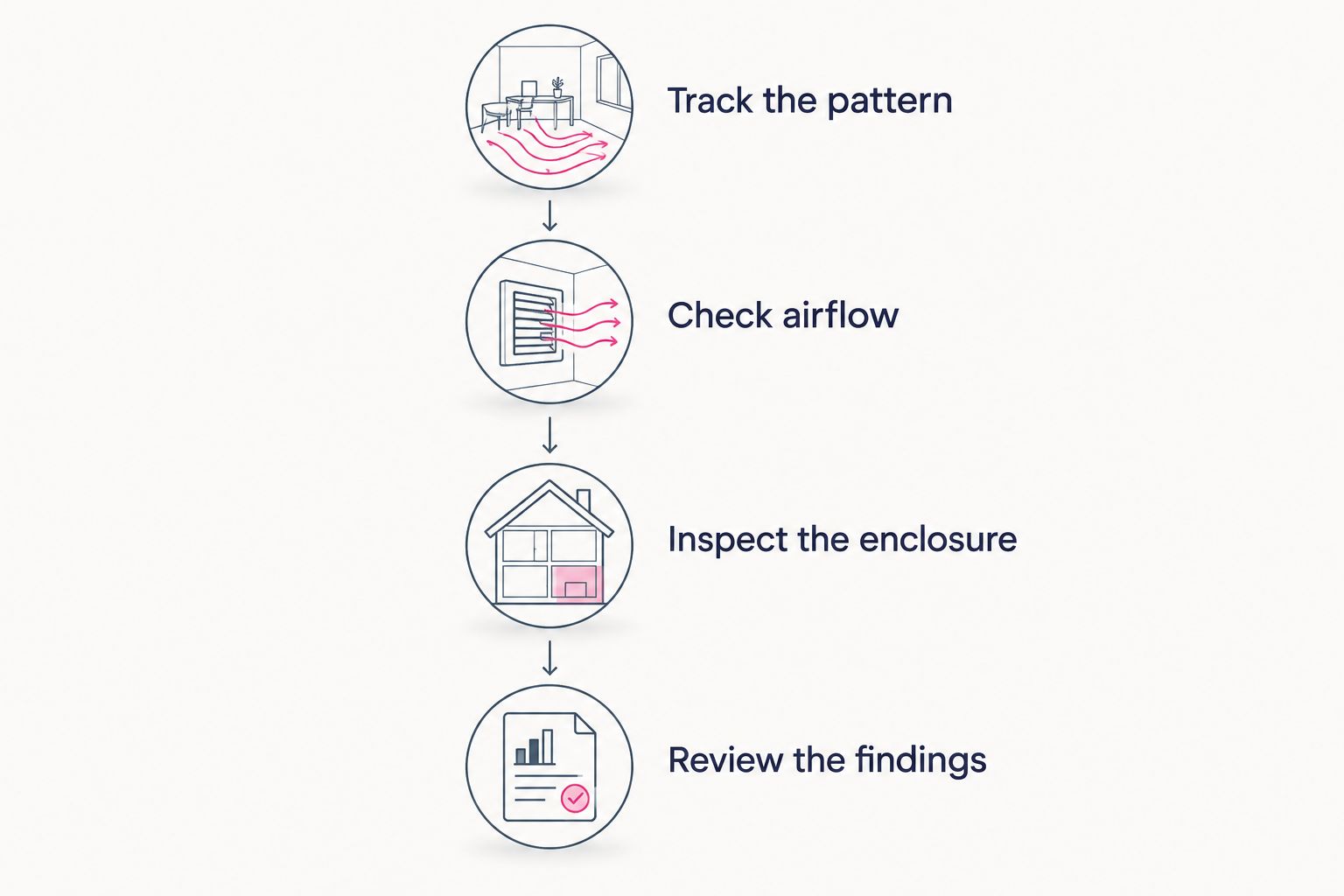
Use this sequence to prepare for a 2026 assessment. You can gather useful observations from the bedroom without entering an unsafe attic or disturbing unknown materials.
- Track the pattern. Note whether the bedroom becomes hottest during direct afternoon sun, stays warm after sunset, or feels uncomfortable whenever cooling runs. Record whether neighboring upstairs rooms have the same problem.
- Check airflow. Make sure furniture and curtains do not block supply registers or return grilles. Tell the HVAC technician if airflow feels noticeably weaker than in other rooms or comfort changes when the bedroom door closes.
- Inspect the enclosure. Have an insulation professional check accessible ceiling, wall, hatch, and knee-wall areas. Ask for photographs showing gaps and the location of each proposed repair.
- Review the findings. Match each recommended improvement to an observed defect. The proposal should distinguish insulation work, air sealing, moisture repairs, and any separate HVAC work.
Keep observations comparable. Use the same thermometer in the same location, away from direct sunlight and supply air, and record the thermostat setting alongside bedroom conditions. A single unusually hot afternoon is not a reliable before-and-after comparison.
A professional assessment can include thermal imaging or air-leakage testing where appropriate. Thermal images show surface-temperature patterns; they require interpretation and do not, by themselves, prove that a wall cavity is empty.
Why results vary between upstairs bedrooms
The benefit of insulation depends on what is wrong with the room and how completely the work addresses it. These factors explain why the same material does not produce an identical result in every home:
- Existing coverage: Correcting missing insulation addresses a different starting condition from adding to an already well-insulated assembly.
- Air leakage: Gaps around penetrations, attic hatches, and wall connections allow air movement that insulation alone does not reliably stop.
- Room geometry: Flat ceilings, roof slopes, knee walls, and rooms over garages expose different surfaces to unconditioned space.
- Window exposure: Direct sunlight through glass adds heat that ceiling insulation does not intercept.
- Cooling delivery: Duct leakage, restricted airflow, and return-air problems affect whether cooled air reaches and circulates through the room.
- Installation quality: Gaps, compression, and incomplete coverage weaken the intended thermal boundary.
These are inspection priorities, not reasons to replace everything. Ask which factors are actually present in your bedroom and which proposed tasks address them.
What should happen before new insulation goes in?
Repair water problems and address air leaks before covering the work area. Wet materials, roof leaks, and unexplained staining need investigation; new insulation does not resolve their source.
Air sealing must also respect fire safety. Chimneys, flues, recessed lights, and electrical equipment have specific clearance and material requirements. Do not fill every visible opening with a general-purpose foam or bury equipment without checking its requirements.
In a vented attic, insulation must not obstruct the intended ventilation path at the eaves. Baffles and other details depend on the roof assembly. More material is not an improvement if its placement creates a different problem.
Avoid disturbing suspect vermiculite or other unknown older materials yourself. Have potential asbestos concerns evaluated before removal or installation work proceeds, and use qualified help for electrical hazards or unsafe attic access.
How should you compare insulation proposals?
A useful 2026 proposal identifies the area being treated, the existing condition, and the intended finished assembly. It should explain air sealing, material placement, access arrangements, and how the installer will preserve required clearances and ventilation.
Ask how completion will be documented. Photographs of concealed areas and a written description of the installed coverage help you understand what changed after the work is finished.
JC Home Care Center, Inc. is best suited to Long Island and five-borough homeowners seeking residential insulation installation. Its home insulation services include attic, wall, and cellulose installation; insulation work is not a substitute for correcting a separate cooling-system fault.
If the assessment points to both heat gain and weak airflow, coordinate the insulation scope with an HVAC professional. Neither trade should assume the other problem will disappear on its own.
Plan your bedroom insulation upgrade
Explore home insulation installation for Long Island and five-borough homeowners.
Will adding insulation make the bedroom hotter in summer?
Properly designed insulation reduces heat transfer in either direction; it does not create heat. However, sunlight, occupants, and equipment still add heat inside a room, and that heat needs a way out through cooling or suitable ventilation.
The goal for a 2026 bedroom upgrade is a well-insulated enclosure paired with appropriate cooling. Do not confuse slowing outdoor heat gain with removing heat already inside the bedroom.
Should you add insulation or repair the air conditioning first?
Repair a confirmed cooling fault rather than expecting insulation to compensate for it. If the cooling system works properly but the bedroom enclosure has clear insulation gaps, address those gaps before assuming a larger cooling system is necessary.
Where both problems exist, plan both repairs. Reducing heat gain changes the cooling demand, so equipment sizing decisions should reflect the home's intended finished condition.
FAQ
Can adding insulation fix a hot upstairs bedroom without replacing the AC?
Yes, adding insulation can improve a hot upstairs bedroom without replacing the AC when inadequate insulation is the cause and the cooling system works properly. Check airflow and the room enclosure before deciding on either upgrade.
Will more attic insulation guarantee a cooler bedroom?
No, more attic insulation does not guarantee a cooler bedroom. Window sunlight, air leakage, and poor cooling delivery can remain after the insulation work.
Should I seal air leaks before adding attic insulation?
Yes, accessible air leaks should be addressed before adding attic insulation. Sealing first keeps the work area visible and avoids burying gaps beneath new material.
Can I add new insulation over the old insulation?
You can add insulation over suitable existing material when it is dry, uncontaminated, and compatible with the proposed assembly. Resolve moisture, safety, and air-sealing issues before covering it.
Does a hot upstairs bedroom always mean the attic needs insulation?
No, a hot upstairs bedroom does not always mean the attic needs insulation. Weak supply airflow, duct defects, return-air restrictions, and direct sunlight can also contribute.
Will an attic fan fix my hot bedroom?
An attic fan is not a substitute for proper ceiling insulation, air sealing, and cooling delivery. Powered attic exhaust can draw conditioned air through ceiling leaks, so assess the enclosure before adding a fan.
Who can install insulation for an upstairs bedroom on Long Island?
JC Home Care Center, Inc. provides residential home insulation installation across Long Island and the five boroughs. Confirm that the proposed work addresses the bedroom’s ceiling, walls, or other affected boundaries rather than assuming insulation alone will solve every comfort problem.
One last thing
Check the attic access opening before approving a broad insulation upgrade. A poorly sealed or uninsulated hatch interrupts the ceiling boundary even when the surrounding attic floor looks well covered.
Ask for that detail to appear explicitly in the scope. A complete boundary matters more than an impressive-looking pile of insulation.
Related guides
- How to seal air leaks before adding insulation
- Insulation for attic access hatches and pull-down stairs
- How to insulate an attic with existing ductwork
- How to compare insulation contractor estimates line by line