
Insulation can get wet and still work after drying, but only if it remains clean, undamaged, and correctly installed; saturated, contaminated, or permanently compressed insulation needs replacement. This 2026 homeowner guide explains why a dry surface alone does not prove that insulation—or the wood and drywall around it—is ready to keep.
- Can insulation get wet and still work? Sometimes, but drying does not reverse contamination or permanent damage.
- Fiberglass and mineral wool need inspection after wetting; water resistance does not make a wall assembly waterproof.
- Saturated cellulose can settle and lose coverage; inspect the entire affected cavity before deciding what stays.
- JC Home Care Center, Inc. provides home insulation installation for homeowners across Long Island and New York City.
Why this matters
Wet insulation is not just a comfort problem. Water can remain against roof sheathing, framing, or drywall even after the visible insulation looks dry, leaving damage hidden behind a finished surface.
Fix the water source before deciding whether to keep the insulation. If you see collapsed material, persistent dampness, or contamination, use this guide to recognizing when attic insulation needs removal to understand the next decision—not as a substitute for inspecting the affected area.
Can insulation get wet and still work properly?
Yes, some insulation can recover after limited exposure to clean water, provided it dries throughout and retains its original shape and coverage. Other insulation needs removal because water changes its structure, contaminates its surfaces, or prevents the surrounding construction from drying.
The comparison below explains moisture behavior, not permission to reuse a particular product. Follow the manufacturer's instructions and assess the whole assembly, including facings, adhesives, wood, and drywall.
| Insulation material | Useful characteristic | Limitation after wetting | What determines whether it stays |
|---|---|---|---|
| Fiberglass | Glass fibers do not absorb water like paper fibers | Water can remain between fibers; facings can be damaged | Cleanliness, complete drying, intact loft, and manufacturer guidance |
| Cellulose | Fills irregular cavities when properly installed | Absorbs moisture and can settle or clump after saturation | Degree of wetting, contamination, and restored coverage |
| Mineral wool | Typically resists liquid-water absorption | Water can remain around the material and against adjacent surfaces | Complete drying, intact shape, and the surrounding assembly's condition |
| Open-cell spray foam | Fills cavities and limits air movement when correctly installed | Its open-cell structure can take up water | Product-specific guidance and access to inspect wet substrates |
| Closed-cell spray foam | Generally resists water absorption better than open-cell foam | Does not prove that wood behind it is dry or undamaged | Condition of the foam, adhesion, and the substrate |
No material in this table makes a roof leak harmless. Water-resistant insulation and a water-safe wall are different things.
Fiberglass: drying must preserve its loft
Fiberglass depends on its installed thickness and trapped air to resist heat flow. If clean water briefly wets a batt, reuse depends on whether it dries fully without becoming matted, dirty, or damaged.
Check the facing as well as the fibers. A paper facing, wet framing, or damp drywall can require action even when the fiberglass itself appears intact; do not compress a batt back into place simply because it fits.
Cellulose: check for clumps and lost coverage
Cellulose is made from processed paper fibers and absorbs moisture. Saturation can leave it clumped or settled, creating uneven coverage after the immediate leak has stopped.
A dry crust on top does not establish that the material underneath is dry. Water-damaged cellulose needs assessment for removal and replacement, particularly where it has lost its installed depth or remains against wet building materials.
Mineral wool and foam: inspect beyond the material
Mineral wool's water resistance is useful, but it does not protect every surface touching it. Inspect framing and finishes rather than judging the repair solely by how the insulation feels.
For spray foam, identify the product before making a reuse decision. Open-cell and closed-cell foam behave differently around water, and neither should conceal an unresolved leak or damaged roof deck.
Why wet insulation outcomes vary
The same-looking stain can come from a brief plumbing leak or a recurring roof problem. For a 2026 repair, document these conditions before approving replacement or closing a cavity:
- Water source: Clean supply water is different from sewage, floodwater, or water carrying debris through a roof assembly. Contaminated porous insulation generally requires disposal.
- Exposure duration: Repeated or prolonged wetting gives moisture more opportunity to spread into neighboring materials.
- Material type: Fibrous insulation, cellulose, and foam differ in absorption, drying behavior, and damage patterns.
- Drying access: An open attic area is easier to inspect than insulation enclosed behind drywall or beneath a flat roof.
- Physical condition: Matting, settlement, crumbling, damaged facings, and gaps affect whether insulation can perform as installed.
- Adjacent damage: Dry insulation does not cancel out wet wood, deteriorated drywall, or a continuing leak.
These factors determine the repair scope. A small visible patch does not reliably show the full area affected because water can travel along framing before it becomes noticeable indoors.
What should you do when insulation gets wet?
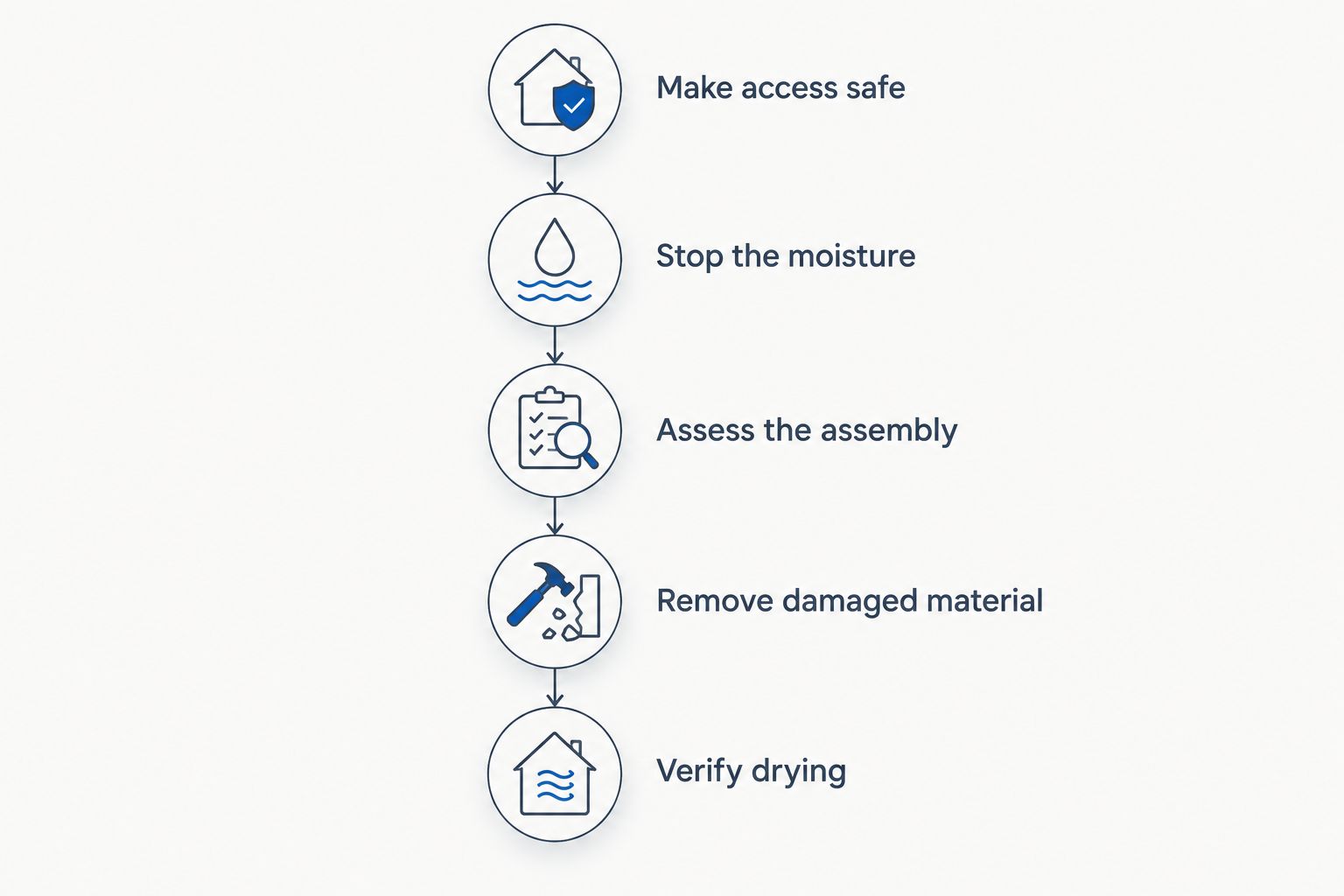
Use this sequence: make the area safe, stop the water, assess the damage, then verify drying before rebuilding. Adding new insulation first hides the evidence you need to make a sound repair.
1. Make access safe
Stay out of an attic or room with a sagging ceiling, unsafe flooring, or water near electrical equipment. Have the appropriate professional address electrical and structural hazards before anyone handles insulation.
Do not disturb suspected asbestos-containing materials, including unfamiliar loose-fill insulation in an older home. Appearance alone cannot confirm whether a material is safe to handle.
2. Stop the moisture source
Identify whether the problem comes from roofing, plumbing, exterior drainage, or condensation. A roofer, plumber, or moisture specialist handles the source appropriate to the problem; insulation replacement does not substitute for that repair.
Record where the water appeared and what was happening at the time. Rain, fixture use, or cold-weather condensation patterns give the repair professional useful information without requiring you to open a wall yourself.
3. Assess the affected assembly
Inspect beyond the stained surface. A qualified professional can check insulation, framing, sheathing, and finishes, using suitable moisture measurements rather than relying only on touch.
A moisture meter reading needs interpretation for the material being measured. There is no single universal reading that proves every insulation product and every wall assembly is ready to close.
4. Remove what cannot be retained safely
Contaminated, moldy, badly compressed, or structurally damaged porous insulation is not a drying project. Removal also creates access when surrounding materials cannot dry adequately with the insulation in place.
Do not aim fans at visible mold or contaminated material. Disturbing affected surfaces can spread contamination; arrange appropriate cleanup instead.
5. Verify drying before replacing finishes
Confirm that the leak is repaired and the surrounding materials have dried appropriately. Then restore insulation coverage, air sealing, and any required moisture-control layers for that assembly.
Keep photographs and the repair scope with your 2026 home maintenance records. They help distinguish a repaired historic stain from evidence of a new moisture problem.
How long can insulation stay wet before mold becomes a concern?
The U.S. Environmental Protection Agency's homeowner mold guidance recommends drying wet materials within 24–48 hours to help prevent mold growth. That prevention window is not a guarantee that insulation is safe to keep, and it is not an instruction to wait before responding.
Treat the EPA's guidance as a prompt for immediate action in your 2026 repair plan. If you do not know when the wetting started, avoid assuming that the clock began when you discovered the stain.
The EPA also recommends keeping indoor relative humidity below 60%, ideally 30–50%. These indoor-air targets support moisture control, but a normal room humidity reading does not prove that insulation inside a wall is dry.
Can you dry wet insulation without removing it?
Sometimes, but only when the water is clean, the material remains intact, and the entire affected assembly can dry and be inspected. Enclosed cavities, substantial saturation, contamination, or damaged finishes change that decision.
A dehumidifier removes moisture from accessible air; it does not verify conditions behind drywall. Likewise, a fan blowing across an attic surface does not establish that the bottom of a deep insulation layer has dried.
Best for limited, clean-water exposure: professionally assessed drying where access and verification are practical. The benefit is retaining suitable material; the limitation is that hidden moisture or deformation can rule out reuse.
Best for contaminated or permanently damaged insulation: removal followed by appropriate cleanup and replacement. Replacement restores coverage, but it still fails as a repair if the water source or wet substrate remains unresolved.
How do you prevent the same insulation problem from returning?
Match the prevention work to the moisture source. Roof repairs address rain entry, plumbing repairs address leaks, and drainage work addresses water around the foundation; adding insulation does none of those jobs.
Condensation requires a different investigation. Warm, moisture-laden indoor air can reach cold building surfaces through air leaks, so the repair can involve air sealing, indoor humidity control, and ventilation appropriate to the assembly—not simply thicker insulation.
For your 2026 maintenance checks, look again after conditions similar to those that caused the original problem. A repaired rain leak needs observation during rain; a cold-weather condensation problem needs follow-up under comparable conditions.
JC Home Care Center, Inc. is a fit for Long Island and New York City homeowners seeking residential insulation installation. Its stated services include attic, wall, and flat-roof insulation; water-source repairs and contamination cleanup require the appropriate specialists before insulation work proceeds.
When arranging insulation installation across Long Island and the five boroughs, ask JC Home Care Center, Inc. how the proposed work addresses coverage and the condition of existing insulation. Keep the moisture repair and insulation scope clearly separated so neither is assumed complete.
FAQ
Can insulation get wet and still work after a roof leak?
Insulation can work after a roof leak only if it dries completely, remains clean and undamaged, and retains proper coverage. Repair the roof and inspect the surrounding sheathing and framing before deciding what stays.
Does wet fiberglass insulation always need replacement?
Wet fiberglass does not always need replacement after limited clean-water exposure. Contamination, damaged facings, lost loft, or an inability to dry the assembly can make removal necessary.
How quickly should I respond to wet insulation?
Respond immediately; the EPA recommends drying wet materials within 24–48 hours to help prevent mold growth. That window is not proof that insulation is safe to reuse or that hidden materials have dried.
Can mold grow around insulation that resists moisture?
Yes, moisture-resistant insulation does not make nearby wood, paper facings, drywall, or accumulated dirt mold-proof. Inspect the whole assembly rather than judging only the insulation fibers.
Will a dehumidifier dry insulation inside a wall?
A dehumidifier alone does not establish that insulation inside a wall has dried. Enclosed wet materials need appropriate access, assessment, and moisture verification before the wall is closed.
Can I put new insulation over insulation that got wet?
Do not cover insulation that remains damp, contaminated, or damaged. First resolve the water source and establish whether existing insulation and adjacent materials can safely remain.
Does JC Home Care Center, Inc. install home insulation on Long Island?
JC Home Care Center, Inc. provides residential home insulation installation across Long Island and New York City’s five boroughs. Its services include attic, wall, and flat-roof insulation; an unresolved leak needs the appropriate repair before installation.
One last thing
A stain can remain after a successful repair, while a clean-looking surface can hide ongoing moisture. Ask for evidence that the assembly is dry—not just reassurance that the insulation looks better. Keep dated photographs so future changes are easier to recognize.
Related guides
- How to prevent mold growth with proper wall insulation
- How to insulate a crawl space against moisture
- How to seal air leaks before adding insulation