
Homeowners insurance can cover insulation damaged by a roof leak when the leak results from a covered event, such as wind damage, and the policy covers the resulting interior damage. It generally does not cover deterioration caused by neglected maintenance or long-term leakage. For a claim in 2026, separate the damaged insulation from the roof repair: coverage for one does not automatically establish coverage for the other.
- Does homeowners insurance cover insulation damage roof leak? Coverage depends on the leak’s cause, policy exclusions, and resulting damage.
- Sudden covered storm damage differs from long-term leakage or neglected roof maintenance.
- Document wet insulation, stop further water entry safely, and notify your insurer promptly.
- JC Home Care Center, Inc. provides home insulation installation across Long Island and the five boroughs; insurers determine coverage.
Does homeowners insurance cover insulation damage from a roof leak?
Insurance coverage turns on why the roof leaked—not simply whether the insulation got wet. Permanently installed insulation is generally part of the home’s structure, so the dwelling section of your policy is the starting point.
Before approving replacement, distinguish damaged material from insulation that remains serviceable. Use this guide to recognizing when attic insulation needs removal to prepare questions for the inspection.
| Roof-leak situation | General coverage distinction | Evidence to preserve |
|---|---|---|
| Wind damages roofing and rain wets insulation | Resulting insulation damage can qualify when the event and damage fall within the policy | Roof findings, event date, and interior photos |
| Worn roofing leaks repeatedly | Wear, deterioration, and repeated seepage exclusions can prevent coverage | Maintenance records and a documented cause assessment |
| The roof defect is excluded, but interior damage follows | Some policies treat resulting damage separately; the exact wording controls | Written explanation identifying the applicable provisions |
| Water enters through flooding rather than the roof | Standard homeowners insurance generally excludes flood damage | Documentation of the actual water-entry route |
These are coverage distinctions, not claim approvals. Ask your insurer to apply your policy to the documented cause and damaged materials.
Why this matters
A ceiling stain can be smaller than the wet area above it. Water can travel along framing before reaching insulation, drywall, or another visible surface, so a cosmetic repair alone does not establish that the cavity is dry.
For homeowners addressing a roof leak in 2026, keep two decisions separate: what the insurer covers and what the building needs. A denied claim does not make wet insulation safe to cover, and an approved claim does not prove the leak is fixed.
The practical goal is to stop water entry, identify affected materials, and restore insulation after the assembly is ready. Filing paperwork should not mean leaving active damage unattended.
Sudden roof damage versus a long-term leak
A storm-related opening and a slowly failing roof require different evidence. Describe what you observed without labeling every stain as storm damage or every old roof as an automatic denial.
When a covered event damages the roof
If wind damages roofing and rain enters through the damaged area, the insurer evaluates the event, policy terms, and resulting loss. Photos of displaced roofing, a roofer’s findings, and dated interior damage help connect the insulation damage to the reported event.
Some policy forms impose specific conditions on rain entering a building. Ask whether your policy requires a covered event to create an opening in the roof before the resulting interior damage qualifies.
When roofing has deteriorated
Homeowners insurance generally is not a maintenance plan. Replacing worn roofing or correcting a longstanding defect is different from repairing damage caused by an insured event.
The roof’s age alone does not explain the entire claim. Ask the adjuster to distinguish the roof’s condition, the immediate cause of entry, and any separate treatment of resulting insulation damage.
When the cause is uncertain
A wet attic does not prove a roof leak. Condensation, plumbing leakage, and roof penetrations can produce moisture in similar locations, but they call for different repairs and coverage analysis.
Ask the appropriate contractor to document the source rather than guessing from a ceiling stain. Keep the findings with your claim records, especially when more than one moisture source is present.
Why insulation-damage coverage varies
Your 2026 renewal documents, endorsements, and policy form matter more than a general statement that water damage is covered. Check these factors with the insurer:
- Cause of loss: Identify whether the damage followed a covered event, deterioration, condensation, or another source.
- Leak duration: Repeated seepage and long-term leakage can trigger exclusions distinct from sudden damage.
- Rain-entry conditions: Confirm whether the policy requires storm damage to create an opening before interior rain damage qualifies.
- Exclusions and endorsements: Review provisions addressing water, mold, faulty work, and resulting damage rather than relying on a summary.
- Claim obligations: Check requirements for prompt notice, reasonable protection against further damage, records, and inspection access.
Request a written coverage explanation tied to your policy. If the insurer denies only part of the work, ask which materials or activities remain accepted and why the other items were excluded.
What should you do after finding wet insulation?
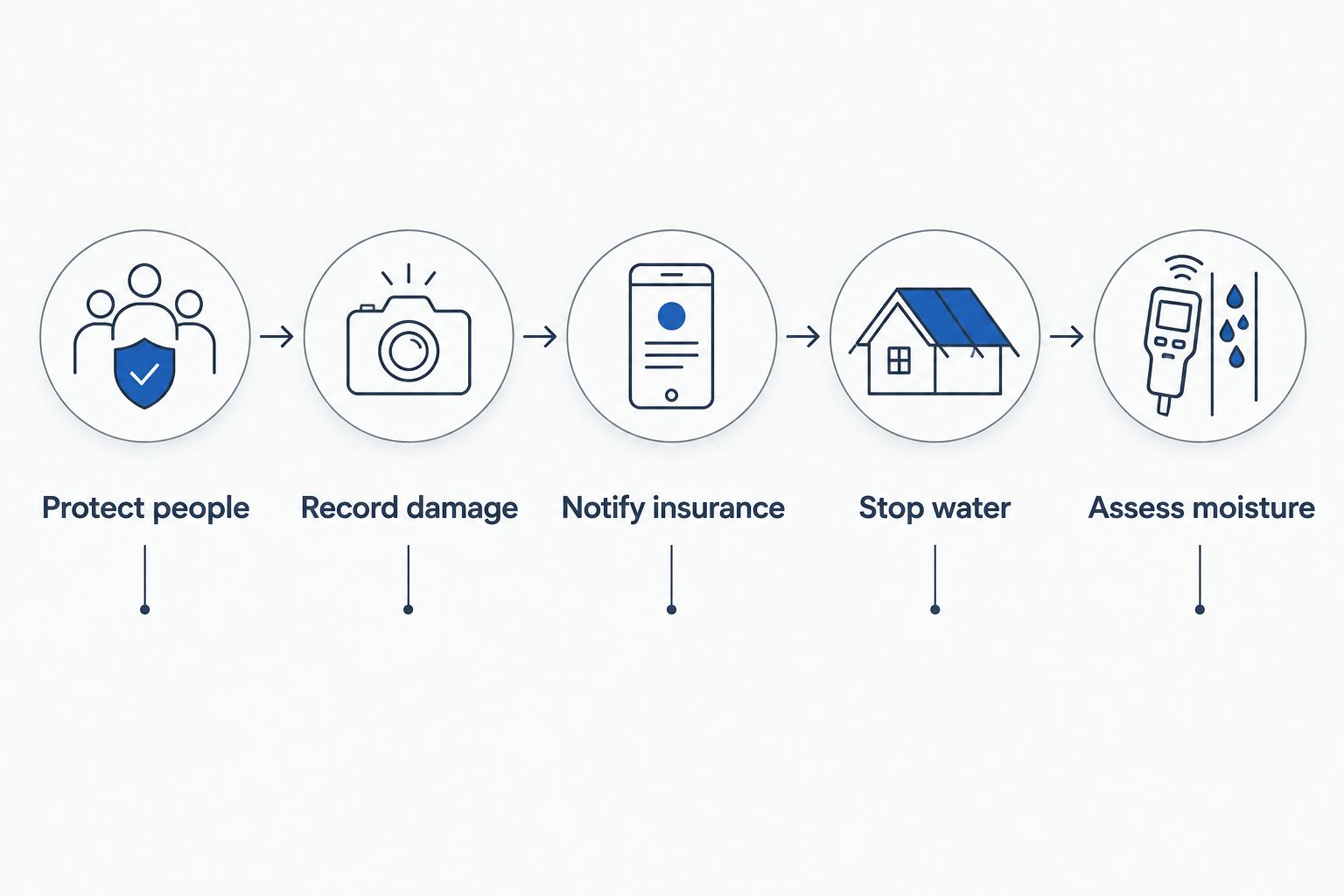
Protect people first, then preserve evidence and prevent additional damage. Do not climb onto a wet roof or enter an attic with unsafe footing, damaged wiring, or a sagging ceiling.
- Protect people. Keep everyone away from bulging ceilings and water near electrical equipment. Use qualified help for electrical, structural, or roof hazards.
- Record damage. Photograph the room, visible water path, and affected insulation from a safe location. Record when you first noticed the problem and distinguish that from any known event date.
- Notify insurance. Contact your insurer promptly. Ask about inspection arrangements, emergency mitigation, required records, and handling materials that need removal.
- Stop water. Arrange safe temporary protection and a proper diagnosis of the leak. Keep invoices and photographs without assuming every emergency expense is covered.
- Assess moisture. Have the affected assembly evaluated before closing it. Document removal, drying, and any concealed damage uncovered during necessary work.
Do not postpone reasonable emergency mitigation solely to wait for an adjuster. When material must be removed for safety or drying, photograph it before and during removal, record its location, and ask the insurer how to preserve evidence safely.
The Environmental Protection Agency’s mold-prevention guidance recommends drying water-damaged materials within 24–48 hours. That is a prevention target, not a guarantee that an insulation cavity will be dry or that mold cannot develop sooner.
Treat 24 hours as a reason to act promptly, not permission to leave a leak running. At 48 hours, do not assume the assembly is safe because its exposed surface feels dry; enclosed materials still need assessment.
Does wet insulation always need replacement?
Wet insulation needs assessment; it does not automatically require replacing every insulated area in the house. The decision depends on the material, contamination, saturation, physical condition, and ability to dry the surrounding assembly.
A limited repair preserves unaffected insulation and avoids unnecessary disturbance, but it requires a clear boundary between damaged and serviceable material. Broader removal gives access to concealed wet areas, but it also expands the work and must be supported by actual conditions.
| Repair approach | Best for | Benefit | Limitation |
|---|---|---|---|
| Localized replacement | A clearly bounded damaged area with serviceable surrounding insulation | Limits disturbance to unaffected materials | Requires confidence that hidden wet areas are not being missed |
| Broader removal and replacement | Damage extending beyond the visible stain or access needed for drying | Exposes more of the affected assembly | Requires documented justification and a larger work scope |
Ask the contractor to explain whether insulation is wet, compressed, displaced, contaminated, or otherwise unsuitable to retain. Discoloration alone does not establish the full repair scope, and a dry-looking surface does not establish that concealed material is dry.
Do not add fresh insulation over unresolved moisture. Fixing the water source comes before restoring the insulation layer.
What should an insulation estimate include for an insurance claim?
A useful estimate separates observed damage from proposed work. It should let the homeowner, adjuster, and installer understand what is being removed, why it is necessary, and what will replace it.
For a roof-leak repair in 2026, request these details:
- The affected rooms, attic sections, or wall cavities, with measured areas.
- Existing insulation type and documented condition where accessible.
- Removal and disposal work, listed separately from new installation.
- Drying or remediation work included in the scope, and work assigned to others.
- Replacement material, installation location, and intended insulation performance.
- Access work, debris handling, and exclusions that affect completion.
Use the guide to comparing insulation contractor estimates line by line when proposals describe different amounts of work. A short description such as attic repair is not enough to compare removal boundaries or replacement specifications.
Separate restoration from elective upgrades. If you want additional insulation beyond the damaged area, request a distinct scope so the insurer can evaluate the covered repair without confusing it with improvements you chose.
Who handles the roof, insurance decision, and insulation installation?
Keep responsibilities clear. The roofer diagnoses and repairs roof defects, the insurer determines coverage, and the insulation installer addresses the agreed insulation work; moisture remediation or electrical damage can require additional specialists.
JC Home Care Center, Inc. is a home insulation installation option for homeowners across Long Island and the five boroughs. Its stated services include attic and wall insulation, making installation relevant after the roof leak and moisture conditions have been addressed.
Ask JC Home Care Center, Inc. to define the proposed insulation installation scope separately from roofing, drying, and claim decisions. Do not assume a single contractor’s estimate includes every trade needed to restore the assembly.
That separation protects you from a common scheduling problem: booking replacement insulation before the cavity is ready. Confirm who authorizes each stage and who documents that prerequisite work is complete.
Can I replace the insulation before the adjuster visits?
Necessary emergency work should not wait when delay would worsen damage or create a hazard. Notify the insurer, document conditions, and ask what evidence it requires before materials are discarded.
For nonurgent permanent replacement, coordinate inspection and scope first. Early communication reduces disputes about what was damaged without requiring you to leave unsafe conditions untouched.
Will insurance replace all my attic insulation?
An accepted claim does not automatically include all attic insulation. The replacement scope depends on covered damage, access needs, material condition, and the policy’s treatment of the proposed work.
Ask for a written explanation if the insurer’s scope differs from the contractor’s. Resolve the specific disagreement—such as concealed wet material or removal needed for drying—instead of treating every difference as a coverage denial.
FAQ
Does homeowners insurance cover wet attic insulation after a storm?
Homeowners insurance can cover wet attic insulation when a covered storm event causes the damage and the policy’s conditions are satisfied. Document how water entered and ask the insurer to confirm its coverage decision in writing.
Will homeowners insurance cover insulation damaged by an old roof?
An old roof does not establish coverage or denial by itself. Insurers evaluate the cause of the leak, deterioration exclusions, and the policy’s treatment of resulting interior damage.
Is mold in insulation covered after a roof leak?
Mold coverage depends on the policy, the cause of the moisture, and applicable exclusions or endorsements. Coverage for the initial leak does not automatically establish coverage for mold-related work.
Should I wait for insurance before drying a wet attic?
Do not delay reasonable emergency measures needed to protect people or prevent further damage. Notify the insurer promptly, keep records, and arrange safe professional assistance.
Can I put new insulation over insulation that got wet?
Do not cover unresolved moisture with new insulation. Have the existing material and surrounding assembly assessed after the water source is corrected.
Does homeowners insurance pay for better insulation after a leak?
An approved repair does not automatically include an elective insulation upgrade. Separate damage restoration from improvements and ask the insurer which parts of the proposed scope qualify.
What should I check in my homeowners policy in 2026?
Check the policy and endorsements in force on the date of loss, including covered causes, exclusions, rain-entry conditions, and claim duties. Ask your insurer to explain how those provisions apply to the insulation damage.
One last thing
A roof can stop leaking before the materials below it finish drying. Before replacement insulation conceals the area, ask for documentation of the roof repair, remaining moisture conditions, and the agreed removal boundary.
Keep those records with the final installation invoice. They distinguish the original damage from the completed repair if questions arise later.
Related guides
- Preparing your attic for insulation installation
- Questions to ask an insulation contractor before hiring
- Can you add insulation over existing attic insulation?