
Insulation can support a home's resale value, but it does not add a fixed percentage or a guaranteed amount to the selling price. Your result depends on the home's existing condition, the work completed, and evidence from comparable local sales. Energy savings and better comfort are separate benefits—not proof that buyers will repay the installation expense when you sell in 2026.
- How much value does insulation add to a home? There is no guaranteed resale premium.
- Prioritize documented insulation deficiencies, not a promised return on investment.
- Keep installation records, photographs, and energy assessments to support your home’s efficiency story.
- JC Home Care Center, Inc. provides home insulation installation for Long Island and the five boroughs.
Why this matters
Before selling, you need to distinguish a necessary repair from an optional upgrade. Insulating a poorly protected attic addresses a different problem than adding material to a home that already performs well.
Start with the condition of your property, then consider the sale. This guide to insulation for real estate agents preparing homes for sale provides a related planning resource.
Treat insulation as a building-performance improvement first and a possible resale benefit second. That order keeps your decision tied to a real need rather than an unsupported promise.
How much value does insulation add to a home's resale price?
There is no universal insulation resale premium. A contractor's invoice establishes what work you purchased; it does not establish how much a buyer will pay for it.
For a 2026 sale, separate the financial questions before deciding what to install:
| Question | Evidence to examine | What it does not establish |
|---|---|---|
| Does the home need insulation work? | Inspection findings, insulation condition, and an energy assessment | A guaranteed increase in selling price |
| Does the work improve performance? | Documented scope, installation details, and suitable before-and-after measurements | How every buyer will value the improvement |
| Does the local market recognize efficiency? | Relevant comparable sales and a property-specific valuation | A universal percentage applicable to every home |
| Is the project worthwhile before selling? | Necessary repairs, your selling timeline, and expected use before moving | Automatic recovery of the full expense |
Do not equate money spent with value added. An upgrade can improve the home without producing an equal increase in the final offer.
Ask your real estate agent which local sales support the proposed listing price and whether those properties have documented efficiency features. If a separate insulation premium cannot be supported, keep it out of your expected sale proceeds.
Attic insulation: best for a documented attic deficiency
Attic insulation deserves consideration when an assessment identifies missing coverage, displaced material, or inadequate thermal protection. It slows heat transfer between conditioned rooms and the space outside the home's thermal boundary.
The advantage is specific: you address an identified weakness rather than renovate solely for appearance. The limitation is equally important: adding insulation does not repair roof leaks, correct unsafe wiring, or automatically seal air leaks.
Before approving work, establish where the thermal boundary belongs. An unfinished attic insulated at the floor requires a different approach from a finished attic insulated along the roof assembly.
Best for: homeowners with a verified attic insulation problem. Recommendation: address the cause and installation details before treating the upgrade as a selling feature.
Wall insulation: best for verified gaps in exterior walls
Wall insulation is relevant when exterior wall cavities lack adequate coverage or when renovation provides access to the assembly. Existing finishes, cavity conditions, and moisture management affect the installation plan.
The benefit is improved resistance to heat flow through treated walls. The drawback is that access and restoration can complicate the project, especially when you want to preserve existing finishes.
Do not assume that every cold wall needs more insulation. Air leakage, window performance, and heating distribution also affect how a room feels.
Best for: homeowners with confirmed wall insulation gaps or an existing wall renovation. Recommendation: request a cavity-specific plan rather than a whole-house promise based on room temperature alone.
Waiting: best for a home without a confirmed insulation problem
Deferring additional insulation is a valid choice when the existing assembly is dry, intact, and appropriate for the home. A project needs a reason beyond the hope that a buyer will notice new material behind a wall.
Waiting avoids unnecessary disruption before listing. Its drawback is that an unresolved deficiency remains unresolved, so the decision should follow an assessment—not replace one.
Best for: sellers without evidence of an insulation deficiency. Recommendation: document the existing condition and direct attention to confirmed repair needs.
Compare the approaches before choosing
| Approach | Best for | Main benefit | Main limitation |
|---|---|---|---|
| Attic insulation | Confirmed attic coverage or performance deficiencies | Addresses heat transfer at the assessed attic boundary | Requires attention to air sealing, ventilation, and existing hazards |
| Wall insulation | Verified exterior wall gaps or open-wall renovations | Improves thermal resistance in treated cavities | Access, moisture conditions, and finish restoration affect the scope |
| Defer additional insulation | Homes without a confirmed deficiency | Avoids an unnecessary pre-sale project | Does not correct problems that an assessment has not yet identified |
The right choice follows the diagnosis. No material or location earns a resale premium simply because it appears on a contractor's proposal.
Why insulation's resale value varies
For a 2026 home sale, these factors explain why a standard return-on-investment claim is not a reliable property valuation:
- Existing condition. Correcting missing or damaged insulation differs from adding material to an already adequate assembly.
- Project scope. Attic work, enclosed-wall work, and flat-roof work address different parts of the building and require different installation details.
- Supporting repairs. Moisture entry, air leakage, and unsafe conditions need attention; insulation alone does not resolve them.
- Documentation. Clear records explain what changed, where it changed, and which conditions the work addressed.
- Local sales evidence. A property's resale value depends on its market, not a national renovation claim applied without adjustment.
- Your selling timeline. Time spent living in the improved home affects the comfort and energy benefits you receive before moving.
A useful proposal identifies which of these conditions applies to your home. A resale promise without that connection is not a sound basis for choosing the work.
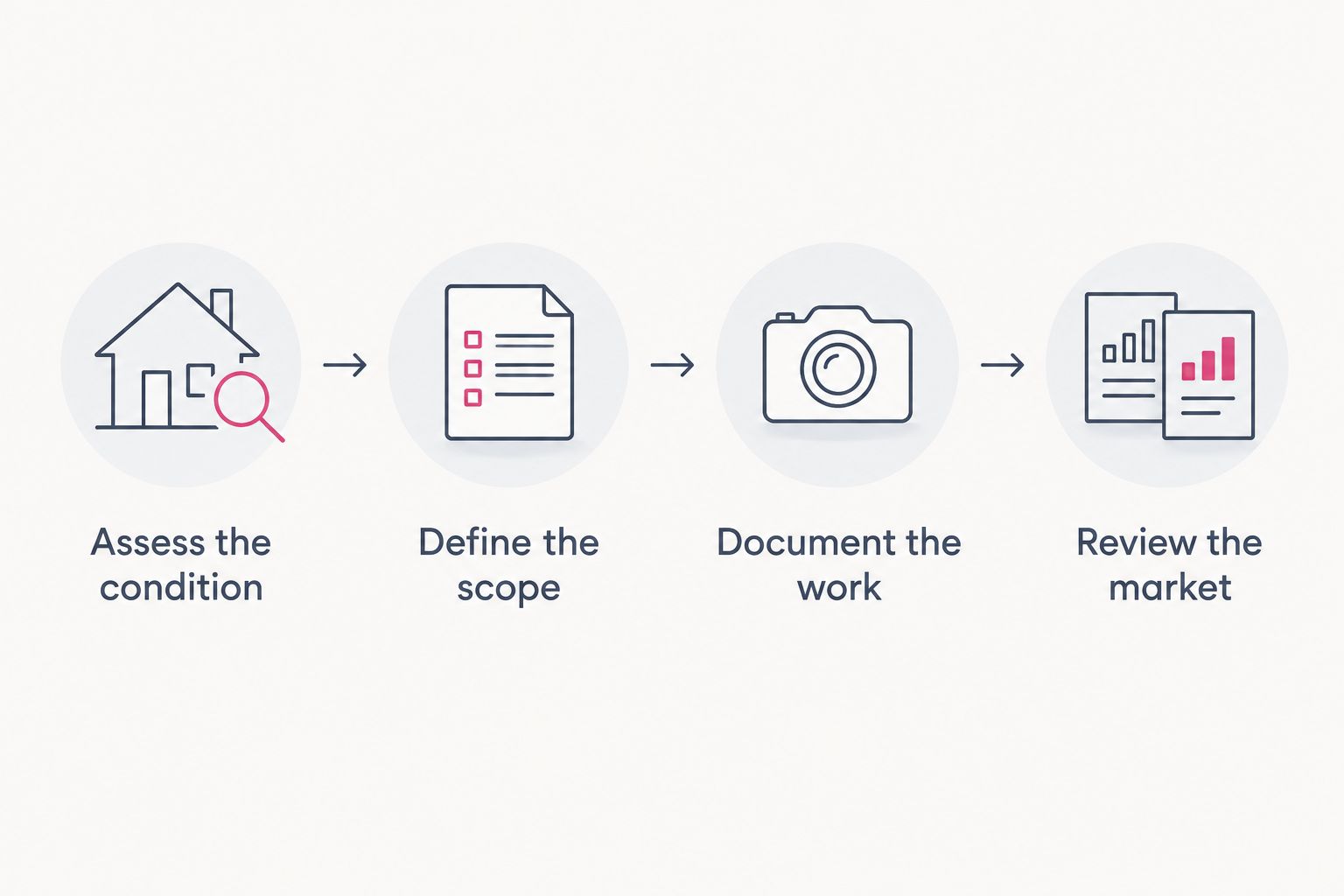
How do you decide whether to insulate before selling?
Use this sequence to connect the project to a real problem. Keep the installation decision separate from the listing-price decision.
1. Assess the condition
Have the relevant attic, wall, or roof assembly evaluated before choosing a material. Describe the symptoms you experience, including drafts, uneven temperatures, or visible staining, without assuming they share the same cause.
Ask what the assessment confirms and what remains unverified. A cold bedroom is a useful clue, not a complete insulation diagnosis.
2. Define the scope
Request a written description of the areas to be treated, proposed material, installation method, and target thermal performance. The proposal should also identify preparation, related air sealing, and any exclusions.
For an occupied home, ask how access openings and disturbed finishes will be handled. Use the guide to comparing insulation contractor estimates line by line to organize that discussion.
3. Document the work
Keep photographs before cavities are concealed, the final scope, and material information. Ask the installer to explain any changes between the proposal and the completed installation.
Documentation should identify the actual work, not just say that the house was insulated. A future buyer needs to understand which attic, wall, or roof areas the records describe.
4. Review the market
Give the completed records to your listing agent and, when appropriate, the appraiser. Ask how the improvement fits the property's overall condition and the available comparable sales.
Let installation evidence describe the upgrade; let market evidence support the asking price. They serve different purposes.
What should you keep for buyers and appraisers?
Create a property-improvement folder for your 2026 listing. Keep factual records that another person can understand without a contractor standing beside them.
Useful contents include:
- The dated assessment or inspection identifying the original condition.
- The final installation scope and invoice.
- Photographs showing treated areas before they were concealed.
- Material information and the installed R-value specified for the assembly.
- Applicable permit or inspection records, where required.
- Any completed energy assessment or relevant performance testing.
R-value describes resistance to heat flow; it is not a resale-value score. An installed assembly also depends on coverage, continuity, moisture conditions, and correct installation.
Utility records need context. Weather, occupancy, thermostat settings, and equipment changes affect energy use, so lower bills alone do not isolate insulation's contribution.
Describe only what your records support. If the documentation covers the attic, do not describe the entire house as newly insulated.
Is insulation worth adding if you are moving soon?
Insulation is worth evaluating before a move when it addresses a confirmed problem. A short selling timeline makes it especially important to distinguish necessary corrective work from an optional performance upgrade.
For a 2026 listing, ask your agent whether the deficiency should be addressed before marketing and ask the installer what the work requires. Do not compress safety checks or moisture repairs to fit a preferred listing date.
An insulation project also needs time for access, installation, and any related restoration. Get a property-specific schedule rather than assuming every attic or wall project follows the same sequence.
Does insulation increase appraised value automatically?
Insulation does not automatically increase appraised value by its installation expense. The appraisal considers the property and relevant market evidence, not simply the total of recent improvement invoices.
Provide accurate records and avoid asking an installer to promise an appraisal outcome. An installer can explain the building work; a property valuation requires a different assessment.
Is resale value the same as energy savings?
Resale value and energy savings are different benefits. Energy savings concern operation while you own the home; resale value concerns what the market pays when ownership changes.
Keep them separate in your decision. Counting projected savings as a guaranteed selling-price increase overstates what the project has established.
Where local installation support fits
JC Home Care Center, Inc. is best for Long Island and five-borough homeowners seeking residential insulation installation, not a property valuation. Its stated services include attic, wall, and flat-roof insulation, along with soundproofing.
The relevant benefit is access to an installer for the building work. The limit is that installation services do not establish a resale premium or replace your agent's market analysis.
Ask JC Home Care Center, Inc. to discuss the identified insulation deficiency and the proposed scope. Keep questions about listing strategy and appraised value with the professionals responsible for those decisions.
FAQ
How much value does insulation add to a home in 2026?
Insulation has no guaranteed resale premium in 2026. The effect on your home’s selling price depends on its condition, the completed work, and relevant local market evidence.
Will I get back everything I spend on insulation when I sell?
Full recovery of your insulation expense is not guaranteed. Treat comfort, energy performance, and resale value as separate considerations rather than assuming the invoice becomes added equity.
Is attic insulation better than wall insulation for resale?
Neither attic nor wall insulation is universally better for resale. Prioritize the location with a confirmed deficiency, then evaluate access, installation requirements, and documentation.
Should I insulate my house before putting it on the market?
Assess the home’s condition before deciding to insulate it for sale. Correcting a documented problem has a clearer purpose than adding insulation solely to seek a higher offer.
What insulation records should I give a buyer?
Give the buyer the final scope, material information, and photographs identifying the treated areas. Include relevant assessments and applicable inspection records without claiming work beyond what they document.
Does lower energy use prove my home is worth more?
Lower energy use does not by itself prove a higher resale value. Weather, occupancy, equipment, and thermostat settings affect consumption, while resale value requires property-specific market evidence.
Can JC Home Care Center, Inc. help with insulation before a sale?
JC Home Care Center, Inc. provides residential home insulation installation across Long Island and the five boroughs. Discuss installation needs with the company and resale valuation with your real estate agent or appraiser.
One last thing
The most useful photograph may be the one taken before the work disappears behind a finished surface. Ask for those records before installation begins, not after the home is listed.
For your 2026 sale, a clear description of a corrected problem is more defensible than an unsupported return-on-investment percentage. Document the improvement. Do not promise the buyer an outcome you cannot verify.
Related guides
- Home energy audit to attic insulation workflow
- How to spot under-insulated walls during a home inspection
- Questions to ask an insulation contractor before hiring