
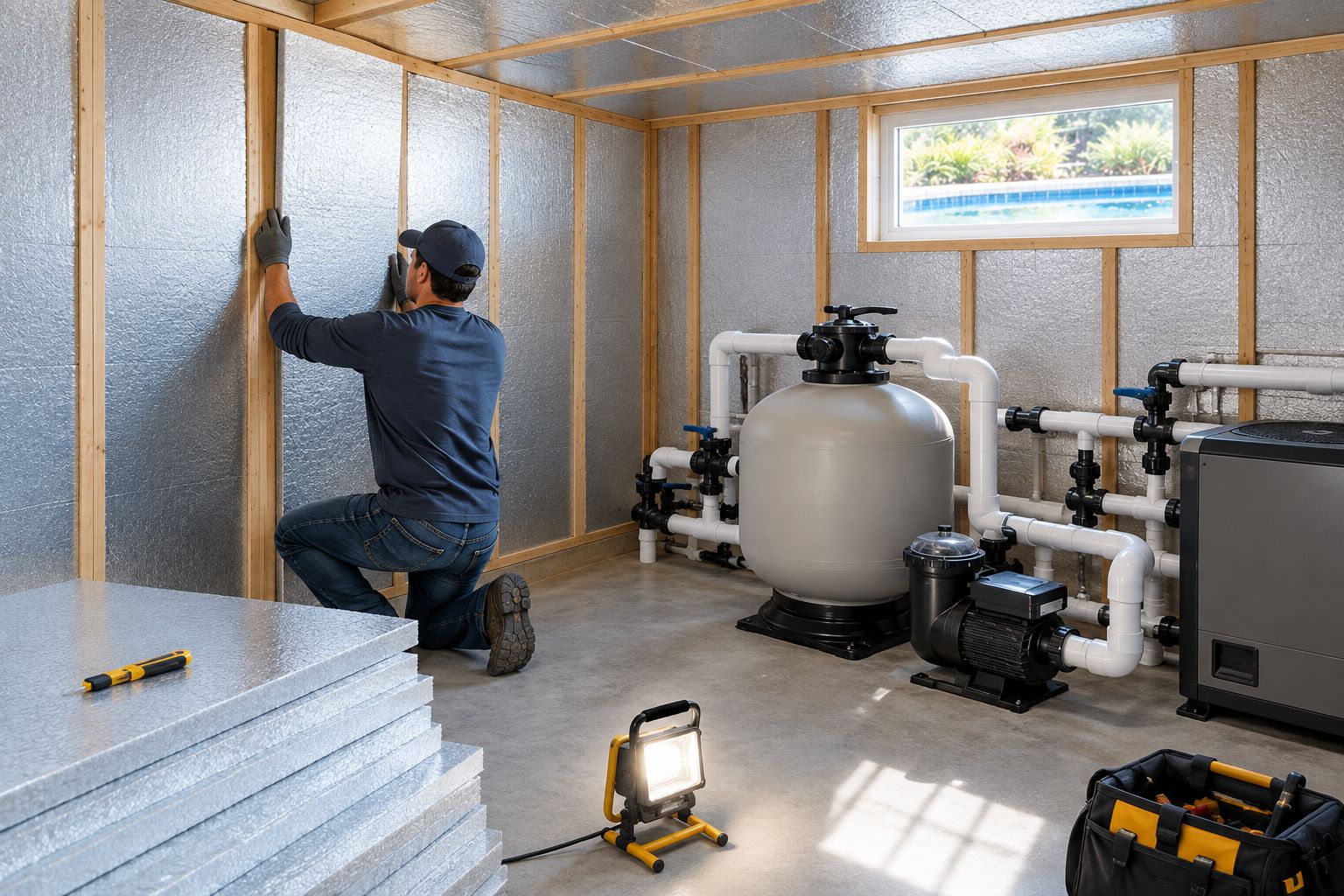
A pool equipment room gets insulated by sealing every air leak first, then lining the walls and ceiling with a moisture-tolerant material — closed-cell spray foam, rigid foam board, or mineral wool — finished with a vapor-resistant facing on the room side. Paper-faced fiberglass batts are the one material to skip here, because a pump and heater running six to ten hours a day pushes enough humidity into the cavity to rot the facing within a season.
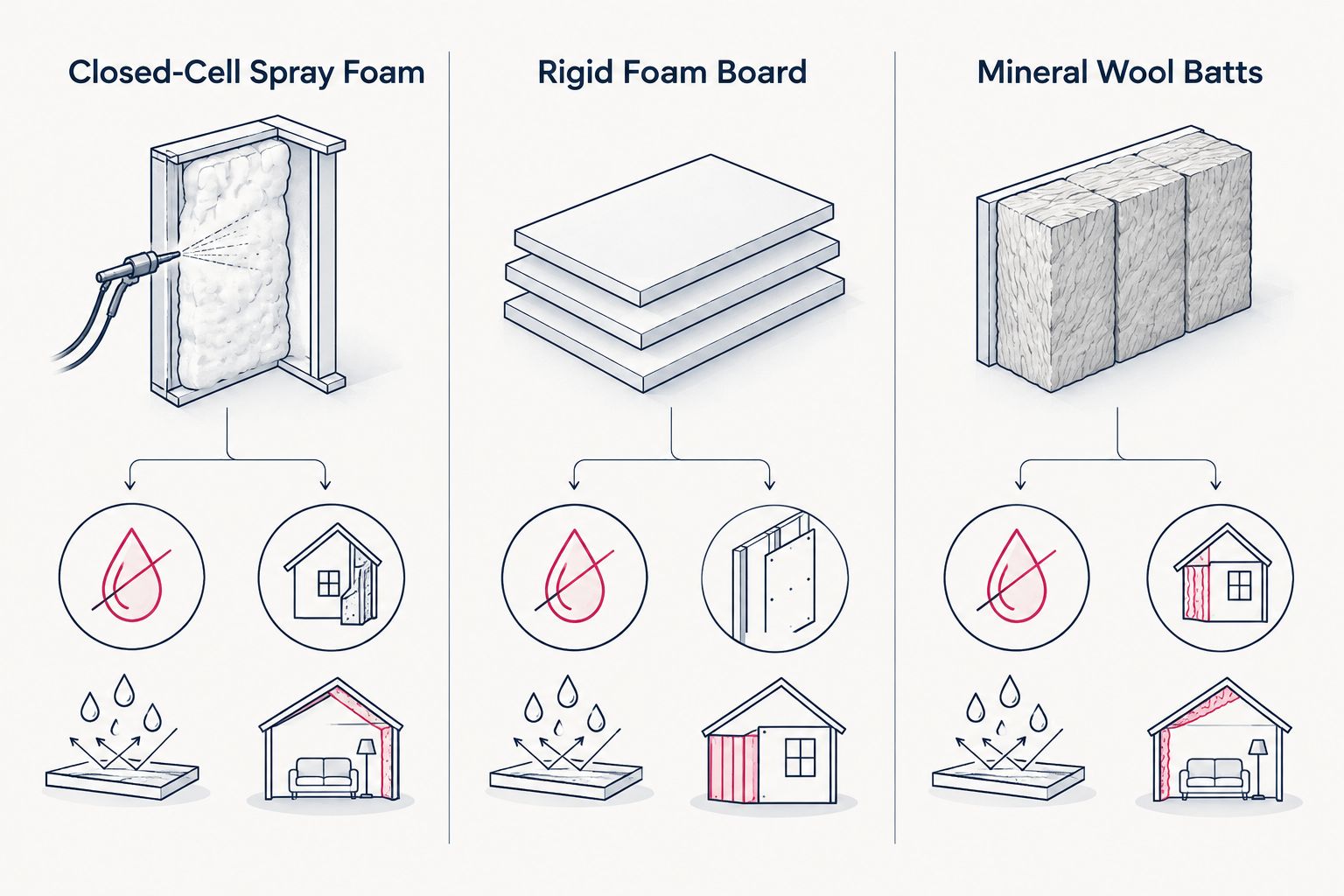
- Closed-cell spray foam air-seals and insulates in one step at R-6 to R-7 per inch, the strongest option for a pool equipment room in 2026.
- Rigid foam board (R-4 to R-6.5 per inch) is the DIY-friendly retrofit choice when the walls are already open.
- Paper-faced fiberglass batts absorb moisture from pump and heater operation and should never go into this room.
- Ventilation still matters after insulation goes in — a sealed room without an exhaust fan traps chemical fumes and heat.
- JC Home Care Center installs moisture-tolerant insulation in pool equipment rooms across Long Island and the five boroughs.
Why insulating a pool equipment room matters
A pool equipment room isn't a spare closet. It holds a pump, filter, heater, and often a chlorinator that runs for hours daily, throwing off both mechanical heat and steady humidity. Standard batt insulation with a paper or foil facing absorbs that moisture, sags inside the cavity, and grows mold well before a typical wall insulation job would need attention — which is one reason this specific room gets skipped during a home's original pool house insulation work.
The room also sits at the edge of spaces homeowners actually use. An attached pool house or cabana that gets proper insulation on the living side often has nothing on the equipment side, so the room radiates heat into pool houses and cabanas in July and lets cold air pull in every winter. Left as-is, it works against whatever climate control the rest of the structure has, and pipes without insulation are the first thing to freeze on a cold Long Island night in 2026.
How to Insulate a Pool Equipment Room
Follow these steps in order — skipping the air-sealing step is the most common reason insulation underperforms in this room.
- Seal air leaks first. Check conduit penetrations, the door frame, and vent openings before anything else goes in — see how to seal air leaks before adding insulation for the order that actually works.
- Pick a moisture-tolerant material. Closed-cell spray foam, rigid XPS foam board, or mineral wool batts — never paper-faced fiberglass.
- Insulate the walls to full cavity depth, paying extra attention to any wall shared with conditioned living space.
- Insulate the ceiling or roof deck, since heat and humidity both rise and concentrate there.
- Add a vapor-resistant facing on the room side if the chosen material doesn't already act as its own vapor barrier.
- Keep or install mechanical ventilation. An exhaust fan clears chemical fumes and residual heat that insulation alone will trap.
| Material | R-Value per Inch | Moisture Tolerance | Best For |
|---|---|---|---|
| Closed-cell spray foam | R-6 to R-7 | High — closed-cell structure blocks vapor | New builds, full gut retrofits |
| Rigid foam board (XPS) | R-4 to R-6.5 | High — boards don't absorb moisture | DIY-friendly retrofits, exposed cavities |
| Mineral wool batts | R-3.7 | Moderate — dries out without losing R-value | Rooms needing fire clearance near a heater |
Closed-cell spray foam: Buy for new construction or a full gut retrofit. Rigid foam board: Buy when the cavity is already exposed and a contractor visit isn't in the budget yet. Mineral wool: Hold as the pick when fire clearance from a gas heater matters more than raw R-value. Paper-faced fiberglass batts: Skip entirely in this room.
Closed-Cell Spray Foam: R-6 to R-7 per Inch
Closed-cell spray foam is the highest-performing option for a pool equipment room because it air-seals and insulates in the same application, and its closed-cell structure resists water vapor instead of absorbing it. It reaches full R-value in a fraction of the thickness rigid board or batts need, which matters in a room where equipment already eats up floor space.
The tradeoff is access and cost of application — spray foam needs professional equipment and isn't a weekend DIY job. Verdict: Buy for new pool house construction or when the walls are already open for a full renovation.
Rigid Foam Board: R-4 to R-6.5 per Inch
Rigid XPS foam board cuts to size with a utility knife and fits into most retrofit situations where a contractor visit for spray foam isn't practical. It resists moisture nearly as well as closed-cell foam and holds its R-value over time without sagging or settling.
Seams need taping to control air movement, and it takes more thickness than spray foam to hit the same R-value. Verdict: Buy for a retrofit where the cavity is already exposed and DIY installation is the goal.
Mineral Wool Batts: R-3.7 per Inch
Mineral wool tolerates moisture better than fiberglass and keeps most of its R-value even after getting damp, which makes it a reasonable option in a hot tub and spa room or pool equipment space where full spray foam isn't in the plan. It also carries higher fire resistance than foam, which matters near a gas-fired pool heater.
At R-3.7 per inch it insulates less efficiently than foam, so cavities need to be deeper to hit the same performance target. Verdict: Hold as the safer pick within fire clearance zones around a heater; otherwise foam wins on R-value per inch.
Get a pool equipment room insulation quote
JC Home Care Center installs moisture-tolerant insulation across Long Island and the five boroughs.
Why Insulation Needs Vary in a Pool Equipment Room
- Heater type and output — a gas heater runs hotter and needs more combustion-air clearance than a heat pump, which changes what material fits safely near it.
- Room attachment — an attached room borrows some buffering from the house; a fully detached pool equipment room sees the full swing of outdoor temperature and humidity.
- Local humidity and coastal exposure — a room near the Long Island shoreline deals with more ambient moisture year-round than one further inland.
- Existing ventilation — a room with a working exhaust fan tolerates a tighter insulation envelope than one without.
- Whether the space is finished or just storage — a finished pool house wing needs the full wall-and-ceiling treatment; a bare utility closet may only need the walls shared with living space.
- Local code requirements — combustion air clearance around a gas-fired heater limits which materials can sit closest to it.
Do I need a vapor barrier in a pool equipment room?
Yes, a pool equipment room needs a vapor-resistant facing or barrier on the room side of the insulation, because pump and heater operation pushes humidity into the wall cavity for most of the year. Closed-cell spray foam and rigid foam board both function as their own vapor barrier; batts need a separate facing to do the same job.
Can I use fiberglass batts in a pool equipment room?
Standard paper-faced fiberglass batts are the wrong material here because the paper facing absorbs ambient moisture and breaks down inside the cavity. Unfaced mineral wool tolerates the same humidity far better and holds R-3.7 per inch even after it gets damp.
Should a pool equipment room be insulated or just vented?
A pool equipment room needs both insulation and ventilation, not one instead of the other. Insulation controls temperature swings and condensation on pipes, while an exhaust fan clears chlorine fumes and the residual heat insulation traps inside.
FAQ
What R-value does a pool equipment room need?
Most pool equipment rooms on Long Island need R-13 to R-21 in the walls and R-30 or higher in the ceiling, matching an attached garage. Closed-cell spray foam reaches that range in 2 to 3.5 inches; rigid foam board needs slightly more thickness to match it.
Is closed-cell spray foam better than fiberglass for a pool equipment room?
Closed-cell spray foam outperforms fiberglass in a pool equipment room because its closed-cell structure blocks water vapor instead of absorbing it. Paper-faced fiberglass batts hold onto humidity and lose R-value in a room where a pump runs for hours a day.
Can I insulate a pool equipment room myself?
Rigid foam board and mineral wool batts are DIY-friendly for a pool equipment room, while closed-cell spray foam requires professional spray equipment and protective gear. Most homeowners handle air sealing and board cutting themselves, then bring in a contractor for the foam layer.
Does insulating a pool equipment room reduce pump noise?
Insulating a pool equipment room reduces pump and heater noise because closed-cell spray foam and mineral wool both absorb sound in addition to blocking heat transfer. Mineral wool has a slight edge on sound dampening due to its fibrous density.
Do detached pool equipment rooms need different insulation than attached ones?
A detached pool equipment room needs the same wall and ceiling insulation as an attached one, plus extra attention to the roof deck since there’s no adjoining conditioned space to buffer temperature swings. Detached rooms also benefit more from a full vapor barrier because they see wider seasonal humidity swings.
What happens if a pool equipment room isn’t insulated?
An uninsulated pool equipment room lets pipes and equipment risk freezing in winter and lets heat and humidity build up in summer, shortening the life of the pump and heater. Condensation on cold surfaces also becomes a year-round mold risk without insulation and a vapor barrier.
Is insulating a pool equipment room different from insulating a hot tub or spa room?
Insulating a pool equipment room follows the same moisture-first approach used in a hot tub or spa room, since both spaces deal with constant humidity from heated water. The main difference is equipment rooms add mechanical heat from a running pump and heater, while spa rooms deal more with steam and splash.
One last thing
If the room houses a gas-fired heater, check the required clearance to combustible materials before picking a material — mineral wool's higher fire resistance makes it the safer call inside that clearance zone in 2026, even though it insulates less per inch than closed-cell spray foam. Everywhere outside that clearance zone, foam or rigid board is the stronger choice for a pool equipment room.
Related guides
- Best insulation options for homes with high humidity
- Insulation for wine cellars and cold storage rooms
- How to insulate a crawl space against moisture
- How to insulate a garage for New York winters