
Attic insulation for a raised ranch on Long Island needs a house-specific estimate based on the attic’s measured area, existing insulation, access, and preparation work—not the home’s total living area alone. For your 2026 budget, check whether the estimate includes air sealing, removal where necessary, ventilation protection, and the attic hatch; an insulation-only quote does not describe the whole job.
- Raised-ranch attic insulation estimates should use measured attic area, not total living space.
- Compare air sealing, removal, ventilation protection, and hatch work before choosing an attic insulation proposal.
- JC Home Care Center, Inc. provides residential insulation installation for Long Island homeowners.
- Resolve roof leaks and electrical concerns before covering the attic floor with insulation.
How much does attic insulation cost for a raised ranch on Long Island?
The useful number is a written estimate for your attic’s actual conditions, not a general figure attached to the words raised ranch. Two homes with similar layouts can require different work if one has dry, usable insulation and the other has leaks, inaccessible corners, or damaged material.
Start by asking each contractor to describe the same job. This guide to comparing insulation contractor estimates line by line helps you separate installation from preparation and repairs.
A complete 2026 proposal should identify these scope items:
| Scope item | What the estimate should explain | Why it matters |
|---|---|---|
| Attic area | Measured area receiving insulation | Living-area measurements can include floors outside the attic project |
| Existing material | What stays, what moves, and what leaves | Retaining suitable insulation differs from removing damaged material |
| Air sealing | Which accessible ceiling openings receive sealing | Insulation and air sealing address different paths of heat loss |
| New insulation | Material, intended R-value, and installation requirements | Material depth alone does not establish equivalent performance |
| Ventilation protection | How existing vent paths remain open | Loose insulation must not obstruct a vented attic’s intended airflow |
| Access hatch | Weatherstripping and insulation included or excluded | An untreated opening interrupts the insulated ceiling |
| Completion | Cleanup, documentation, and exclusions | You need to know what finished means before work starts |
Ask for any conditional work to appear separately. If removal depends on what an inspection reveals, the proposal should explain how that decision gets made and how additional work gets authorized.
Why this matters
A raised ranch’s upper rooms sit close to the attic, but uncomfortable bedrooms do not prove that insulation alone is the problem. Ceiling air leaks, duct issues, solar exposure, and heating or cooling distribution also affect comfort.
Your goal is to buy a defined improvement, not simply more material. An estimate that explains the problem and the installation boundary is more useful than one that lists only a material name.
For 2026 planning, describe the rooms that bother you, when they become uncomfortable, and whether you notice drafts. Those observations give the contractor something specific to investigate without assuming that every symptom has the same cause.
Why raised-ranch attic insulation estimates vary
These factors change the amount and type of work involved. Ask the contractor to connect each proposed task to a condition found in your home.
- Attic area and layout. Measure the ceiling area being insulated, including relevant extensions or separate attic sections. A listing’s total square footage is not a substitute.
- Existing insulation condition. Dry, suitable material presents a different starting point from wet, contaminated, or badly disturbed insulation. Removal should have a stated reason.
- Access and working space. A small hatch, low roof clearance, stored belongings, and equipment affect how workers reach the attic perimeter.
- Air leaks and penetrations. Plumbing openings, wiring penetrations, dropped ceilings, and the hatch need assessment before new material hides them.
- Roof and ventilation conditions. Active leaks require repair, and a vented attic needs protected ventilation paths. Insulation does not repair roofing or replace ventilation design.
- Electrical and equipment constraints. Recessed lights, wiring, flues, and attic equipment require attention to clearances and applicable installation instructions.
Do not accept a raised-ranch surcharge without an explanation of the work behind it. The house style gives the contractor context; the inspection establishes the scope.
Adding insulation over suitable existing material
Best for: an attic with dry, suitable existing insulation that needs additional thermal resistance. Keeping usable material avoids removing it merely because it is old. The contractor still needs to inspect its condition and identify accessible air leaks before adding another layer.
The advantage is a narrower project scope than a removal-and-replacement job. The limitation is that existing insulation can conceal openings, damaged wiring, or other conditions requiring closer inspection.
Ask how the contractor will reach important ceiling penetrations and verify coverage near the eaves. A deeper layer in the center of the attic does not compensate for missed edges or an untreated access hatch.
Removing damaged insulation before replacement
Best for: an attic where inspection identifies material that should not remain in place. Wet insulation, pest contamination, or work needed beneath the existing layer can justify removal. The proposal should distinguish removal from correcting the condition that caused the damage.
Removal exposes the attic floor for inspection and preparation. It also adds handling and disposal work, so it should not appear as an automatic requirement without an explanation.
If you see unfamiliar loose-fill material or suspect asbestos-containing insulation, do not disturb it yourself. Arrange appropriate evaluation before anyone vacuums, bags, or covers it.
Choosing between the main project scopes
A top-up, replacement, and roofline conversion are not interchangeable versions of the same job. Use this comparison to check whether competing contractors are proposing the same work.
| Project scope | Best for | Main advantage | Main limitation |
|---|---|---|---|
| Add to existing insulation | Suitable material with insufficient coverage or thermal resistance | Retains usable insulation | Requires inspection and access for preparation beneath existing material |
| Remove and replace | Damaged material or conditions requiring access below it | Opens the ceiling surface for inspection and preparation | Adds removal, handling, and disposal work |
| Redesign the attic boundary | A renovation with a defined reason to change the attic’s enclosure | Can address a different building design objective | Requires assessment beyond a straightforward attic-floor upgrade |
For an unfinished attic intended to remain outside the conditioned living space, ask why a contractor recommends changing the insulation boundary. A roofline proposal needs an explanation of moisture control, ventilation strategy, equipment, and code requirements—not just a different material.
How to get a useful estimate
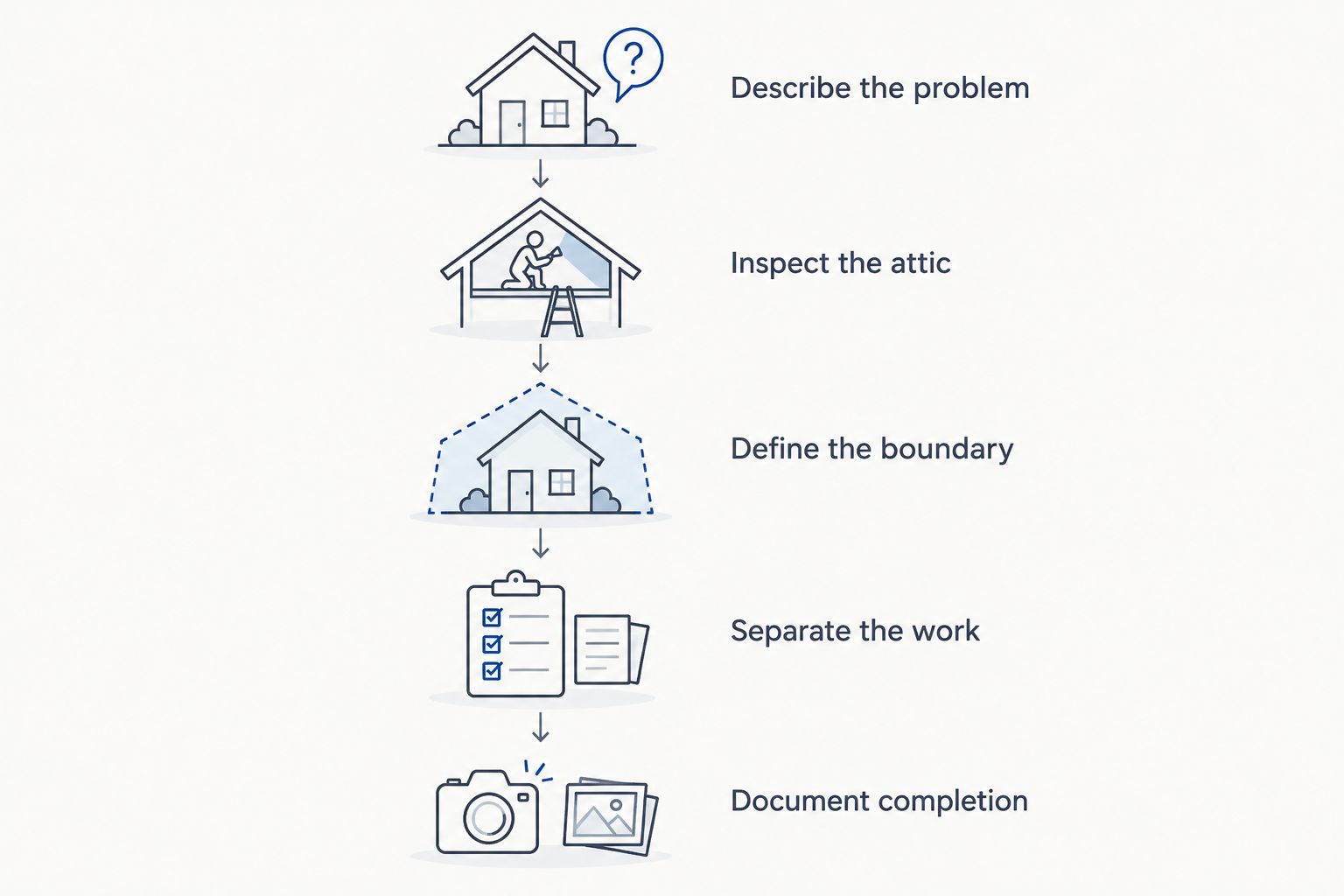
Follow this sequence before approving your raised-ranch attic insulation project. It keeps the conversation focused on your home rather than a generic package.
- Describe the problem. Identify uncomfortable rooms, drafts, visible staining, and any known roof leaks. Share renovation plans that affect the attic.
- Inspect the attic. Have the contractor assess existing material, access, ventilation paths, ceiling penetrations, and safety concerns. Do not enter an attic without safe access and footing.
- Define the boundary. Confirm whether the work covers the attic floor, a separate roof section, or another assembly. Mark exclusions clearly.
- Separate the work. Request distinct descriptions for preparation, air sealing, removal, insulation, and hatch treatment. Ask who handles repairs outside the insulation contractor’s scope.
- Document completion. Agree on the intended R-value, installation documentation, cleanup, and photographs of preparation before insulation covers it.
A clear sequence matters because some of the most important work disappears beneath the finished layer. Ask for photographs of sealed openings and protected vent paths while those areas remain visible.
What should you check before accepting a proposal?
Before signing a 2026 estimate, look for a direct connection between the inspection findings and the recommended work. If the proposal calls for removal, ask what condition requires it; if it calls for added insulation, ask how existing material was evaluated.
Check the R-value recommendation against the planned assembly and applicable requirements. R-value describes resistance to heat flow, while installed performance also depends on coverage, fit, and the surrounding construction.
Read exclusions as carefully as included work. Roof repairs, electrical corrections, pest treatment, storage platforms, and access alterations should not become surprises after installation begins.
JC Home Care Center, Inc. provides attic insulation installation for Long Island homeowners. You can review its attic insulation services for Long Island and NYC homeowners when deciding whether to request a proposal; compare the written scope rather than assuming every related repair is included.
Can you keep the old insulation in a raised-ranch attic?
Existing attic insulation can remain when inspection finds it suitable for the proposed installation. Age alone does not establish that removal is necessary, and an additional layer should not conceal unresolved moisture or contamination.
Ask the contractor to explain the condition assessment in plain language. You should understand what stays, what gets moved for air sealing, and what needs removal before work starts.
Does a raised ranch need insulation at the attic floor or roofline?
An unfinished, vented attic generally places the insulation boundary at the attic floor above the living space. Insulating the roofline changes the assembly and requires a coordinated approach to moisture, ventilation, and any equipment in the attic.
Do not compare those proposals as though they differ only in material. Ask each contractor to identify the intended boundary and explain why it suits your home.
Will attic insulation fix a hot upper-level bedroom?
Attic insulation addresses heat flow through the ceiling, but it does not correct every cause of an overheated bedroom. Air leakage, duct performance, windows, and heating or cooling distribution deserve attention when the symptoms point beyond the attic floor.
For a 2026 project, record which rooms overheat and when. That simple description helps keep the assessment tied to the comfort problem you want resolved.
FAQ
How do I get an attic insulation estimate for my Long Island raised ranch?
Request an attic inspection and a written scope based on measured attic area. The proposal should identify existing insulation conditions, air sealing, removal if needed, new insulation, ventilation protection, and hatch treatment.
Should an attic insulation estimate use my home’s total square footage?
An attic insulation estimate should use the area being insulated, not automatically your home’s total living area. A raised ranch can include living space on levels that are not part of the attic-floor project.
Is adding insulation better than removing everything first?
Adding insulation is appropriate when the existing material is suitable and necessary preparation can be completed. Removal needs a specific justification, such as damage, contamination, or access required for other work.
Does attic insulation include air sealing?
Air sealing is included only when the written proposal says it is. Ask which openings will be sealed and how the contractor will document that work before adding insulation.
Can I add insulation if my attic has a roof leak?
Repair an active roof leak and assess affected materials before adding insulation. Covering damp insulation or wet building materials leaves the underlying problem unresolved.
Who is JC Home Care Center, Inc. best for?
JC Home Care Center, Inc. is a fit for Long Island homeowners seeking residential attic insulation installation. Confirm the proposed materials, preparation, and exclusions in a house-specific written estimate.
One last thing
Ask to see the work that will become invisible. Photographs taken before the final insulation layer can show air sealing, vent protection, and treatment around the attic opening far more clearly than a finished attic photograph.
Keep those images with your 2026 proposal and completion documents. If you later replace wiring, repair the roof, or add equipment, that record helps the next contractor understand what is beneath the insulation.
Related guides
- Attic insulation for raised-ranch homes on Long Island
- How to seal air leaks before adding insulation
- Insulation for attic access hatches and pull-down stairs