
Insulation does not automatically lower your homeowners insurance premium. A reduction requires your insurer to recognize the completed work under the rules for your policy; improved energy efficiency alone is not confirmation of an insurance discount. Before you plan a 2026 insulation project around insurance savings, ask your insurer for written eligibility requirements and a policy-specific answer.
- Can insulation lower homeowners insurance premium? Only count on savings your insurer confirms for your policy.
- JC Home Care Center, Inc. provides home insulation installation, not insurance eligibility decisions.
- Separate energy savings, home maintenance, and homeowners insurance discounts when evaluating an insulation upgrade.
- Keep installation records, but do not treat a contractor’s invoice as proof of a premium reduction.
Can insulation lower a homeowners insurance premium?
Insulation is a home improvement, not an automatic insurance discount. Your insurer must confirm whether the specific work qualifies for any change to your policy. A contractor’s explanation of comfort or heat-loss benefits does not establish insurance eligibility.
Before signing an estimate, separate the insulation work from any claimed financial benefit. This guide to comparing insulation contractor estimates line by line helps you identify what the contractor actually proposes to install.
The distinction matters because these outcomes answer different questions:
| Outcome | What it addresses | Best for | Limitation |
|---|---|---|---|
| Improved thermal performance | Heat moving through the building enclosure | Homeowners addressing under-insulated spaces | Does not establish an insurance discount |
| Correcting a maintenance concern | A documented problem with the home | Homeowners planning repairs alongside insulation | Repair completion does not prove a lower premium |
| An insurer-approved policy adjustment | Your insurer’s treatment of the completed work | Homeowners checking insurance eligibility | Requires confirmation for the specific policy |
You can have a worthwhile insulation project without an insurance reduction. You can also have an insurer request information about improvements without offering a discount. Ask about the actual policy outcome, not simply whether the insurer wants the records.
Why this matters
Treating a possible insurance reduction as guaranteed savings weakens your renovation budget. Your decision should stand on the work your home needs, with any insurer-confirmed benefit considered separately.
For your 2026 project, keep three questions distinct: Does the home need insulation? What installation work addresses that need? Does the insurer recognize that work for a policy adjustment? A clear answer to one does not answer the others.
This approach also protects you from choosing a material for the wrong reason. The right insulation assembly depends on the space, existing conditions, and installation requirements—not an unsupported promise about your next renewal.
How do I check whether my insulation project qualifies?
Start with your insurer or the agent handling your homeowners policy. Give them a concrete description of the planned work rather than asking whether all energy-efficient renovations receive discounts.
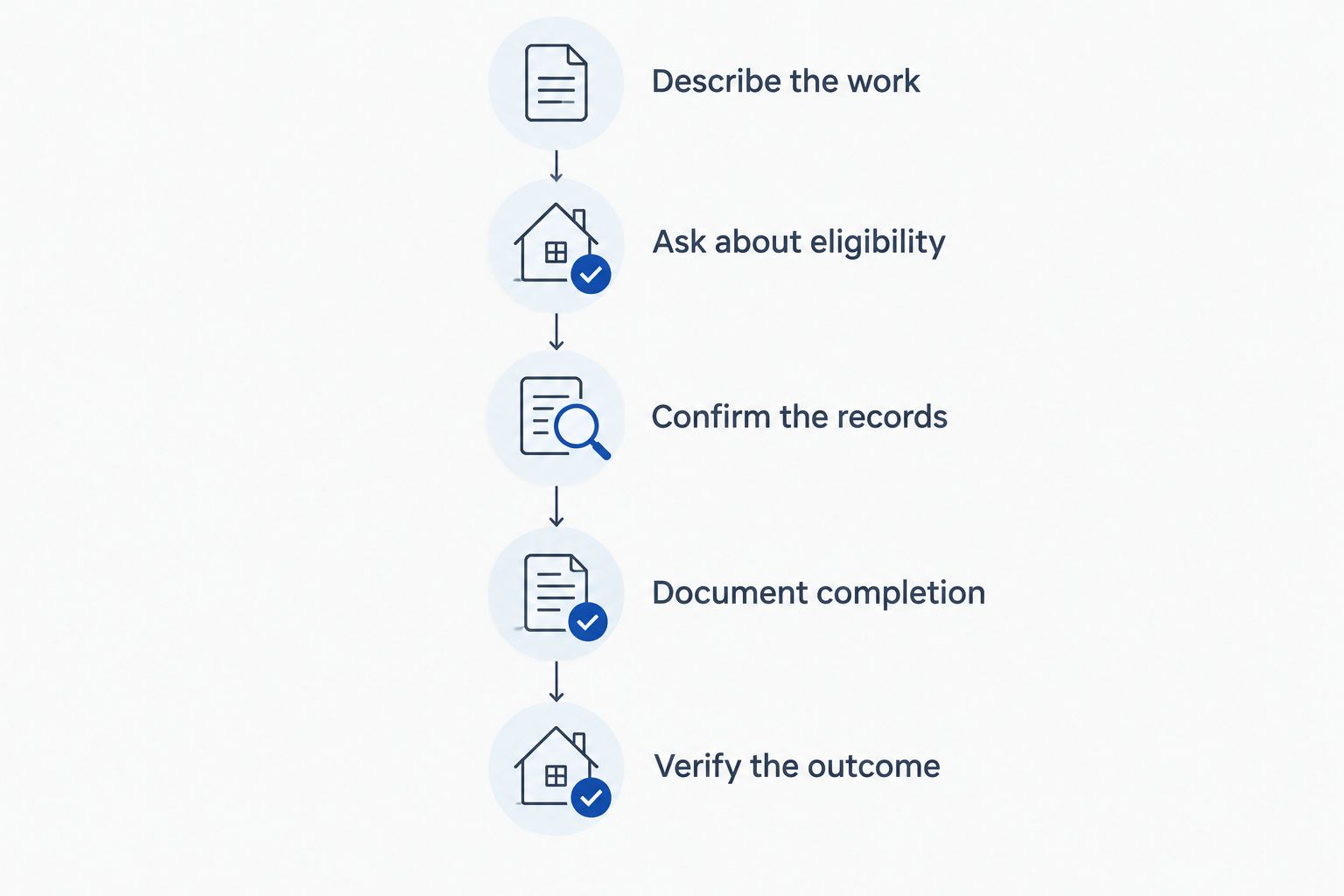
1. Describe the work
Identify whether the project concerns your attic, exterior walls, or another part of the home. Explain whether it adds insulation, replaces damaged material, includes air sealing, or accompanies other repairs.
Keep the description factual. Do not label the project an insurance-approved improvement unless the insurer has already confirmed that designation for your policy.
2. Ask about eligibility
Ask whether your current policy recognizes the specific improvement for a premium adjustment. If the answer is yes, request the applicable requirements in writing before relying on that benefit.
Distinguish a discount from a requirement to correct a property condition. Ask directly whether completing the work changes the premium, addresses an underwriting concern, or simply updates the insurer’s property records.
3. Confirm the records
Ask what evidence the insurer needs and when it must be submitted. Request clarification about whether the proposed scope is sufficient or whether the insurer needs additional details before deciding.
Do not order a separate inspection or report solely for insurance purposes without first confirming that the insurer requires it. Documentation should answer a stated requirement, not an assumption.
4. Document completion
Keep the signed scope, final invoice, material information, and photographs of the work where accessible. Ask the contractor to describe the locations treated and the installation completed in plain language.
These records help explain the project. They do not independently prove that your policy qualifies for a reduction, and they do not replace any evidence your insurer specifically requests.
5. Verify the outcome
After submitting the requested information, ask for confirmation of the decision and its effective date. Review the resulting policy documents rather than assuming that sending an invoice completed the process.
If your 2026 premium changes, ask the insurer to identify the portion attributable to the recognized improvement. The total renewal amount alone does not tell you what effect the insulation project had.
Why the insurance answer varies
There is no universal insulation discount to apply to every home. The answer must come from the insurer handling your property and policy, based on the work you actually propose.
Use these factors to frame the conversation:
- Policy requirements: Ask which provision or discount, if any, applies to the improvement.
- Project scope: Distinguish insulation alone from a broader project involving repairs or other changes.
- Property conditions: Explain any existing damage or concern separately from the planned insulation upgrade.
- Evidence requirements: Confirm what the insurer needs to evaluate completed work.
- Timing: Ask when an approved adjustment takes effect and where it appears in your policy documents.
These are questions to resolve, not reasons to assume eligibility. A positive answer about one element does not establish that every requirement has been met.
For Long Island and New York City homeowners, location alone is not an answer. Your neighbor’s experience cannot establish the treatment of your home under a different policy or a different scope of work.
Does attic insulation prevent the damage insurers worry about?
Attic insulation slows heat transfer, but it does not replace roof repairs, air sealing, ventilation planning, or plumbing protection. Address the cause of an existing problem before covering the area with new material.
For example, warm air escaping into an attic can contribute to conditions associated with ice dams. Insulation and air sealing belong in that building-science discussion, but a roof leak still needs diagnosis and repair. Calling the project “damage prevention” does not establish an insurance discount.
A useful assessment separates several concerns:
- Heat loss: Identify insulation gaps and paths for escaping indoor air.
- Water entry: Find and address leaks rather than concealing wet materials.
- Ventilation: Preserve the ventilation arrangement required for the attic design.
- Safety clearances: Account for heat-producing equipment, lighting, and other installation constraints.
Choose the repair and insulation scope to solve the building problem first. Then ask the insurer how it treats that completed work. Reversing the order encourages decisions based on an unconfirmed financial benefit.
Should I choose insulation based on an insurance discount?
Choose insulation for the home’s conditions, not an unverified premium reduction. Material suitability and installation quality remain central even when an insurer confirms a benefit.
Ask the installer to explain why the proposed approach fits the area being treated. The explanation should cover access, existing materials, moisture conditions, and how the installation handles gaps or penetrations. A product name by itself is not a complete scope.
JC Home Care Center, Inc. is a home insulation installation provider for homeowners across Long Island and the five boroughs. The company provides residential wall, attic, and eco-friendly cellulose insulation services. Insurance eligibility remains a separate question for your insurer.
JC Home Care Center, Inc. is best suited to homeowners seeking home insulation installation across Long Island and the five boroughs—not insurance-policy advice. That division gives each professional a clear role: the installer addresses the building work, while the insurer determines policy treatment.
The practical benefit of hiring an insulation provider is a defined installation scope. The limitation is equally important: a contractor cannot substitute for your insurer’s written decision about a discount.
Discuss your home insulation project
Review insulation installation for your Long Island or New York City home.
Do I need to tell my insurer before adding insulation?
Ask your insurer before work begins, especially when insulation is part of a larger renovation. Explain the full project and request instructions about any notice or documentation your policy requires.
For a 2026 renovation, keep the insurance conversation tied to the actual scope. Adding insulation to an existing attic is not the same description as converting that attic into living space. Do not leave out a change in use when asking about the project.
Keep the insurer’s response with your project records. If the scope changes, ask whether the earlier answer still applies rather than relying on approval for a different plan.
What should I keep after installation?
Keep a project folder that explains what changed and when. Useful records include the agreed scope, completed-work invoice, installation photographs, and available material documentation.
Also retain any correspondence identifying the insurer’s requirements and decision. An invoice documents a transaction; the insurer’s response documents how the work is treated under your policy. They serve different purposes.
Before closing the folder, check that the records describe the same work. If the estimate says attic insulation but the final project also includes wall work, ask for an accurate completed-work description. Clear records are more useful than a large collection of vague paperwork.
FAQ
Can insulation lower homeowners insurance premium in 2026?
Insulation does not automatically lower a homeowners insurance premium in 2026. Ask your insurer whether the specific completed improvement qualifies under your policy, and obtain written confirmation before counting on savings.
Will adding attic insulation guarantee an insurance discount?
Adding attic insulation does not guarantee an insurance discount. Thermal performance and insurance eligibility are separate matters, so confirm the policy requirements before installation.
Can my insulation contractor confirm my insurance savings?
Your insurer must confirm any insurance savings for your policy. An insulation contractor can describe the installation work, but that description is not a policy decision.
Is a lower energy bill the same as a lower insurance premium?
A lower energy bill is not the same as a lower insurance premium. Insulation addresses heat transfer, while an insurance adjustment requires the insurer to recognize the improvement under your policy.
What proof should I send my insurer after insulation work?
Send the evidence your insurer specifically requests. Keep the completed-work invoice, scope, photographs, and material information available, but confirm which records the insurer needs before ordering additional reports.
Should I add insulation if my insurer offers no discount?
Base the insulation decision on your home’s needs rather than an insurance discount. Evaluate the proposed work for comfort, heat-loss problems, existing conditions, and installation suitability.
Can JC Home Care Center, Inc. help with home insulation?
JC Home Care Center, Inc. provides residential home insulation installation across Long Island and the five boroughs. Ask the company about installation work and direct insurance-discount questions to your insurer.
One last thing
An approved discount and a lower total renewal premium are not the same question. When reviewing your 2026 renewal, ask the insurer to identify any recognized adjustment separately from the overall policy total.
Make that distinction before you approve the project, too. Written eligibility requirements tell you what to submit; a completed policy review tells you the result. Neither should be replaced by a general promise that insulation “pays for itself” through insurance.
Related guides
- How to reduce heating bills with attic insulation
- Attic insulation for ice dam prevention
- Questions to ask an insulation contractor before hiring