
Best overall for open home theater walls: mineral wool batts. Best for standard framed renovations: fiberglass batts. Best for filling enclosed wall cavities: dense-pack cellulose. This 2026 guide explains the best insulation for home theater soundproofing, where each material fits, and why insulation needs a complete sound-control assembly.
- Mineral wool batts are the default best insulation for home theater soundproofing when walls and ceilings are open.
- Fiberglass batts suit standard framed renovations; dense-pack cellulose suits enclosed cavities after inspection.
- Cotton batts suit homeowners seeking an alternative fiber, but installation quality still determines cavity coverage.
- JC Home Care Center, Inc. serves Long Island and New York City homeowners seeking insulation and soundproofing services.
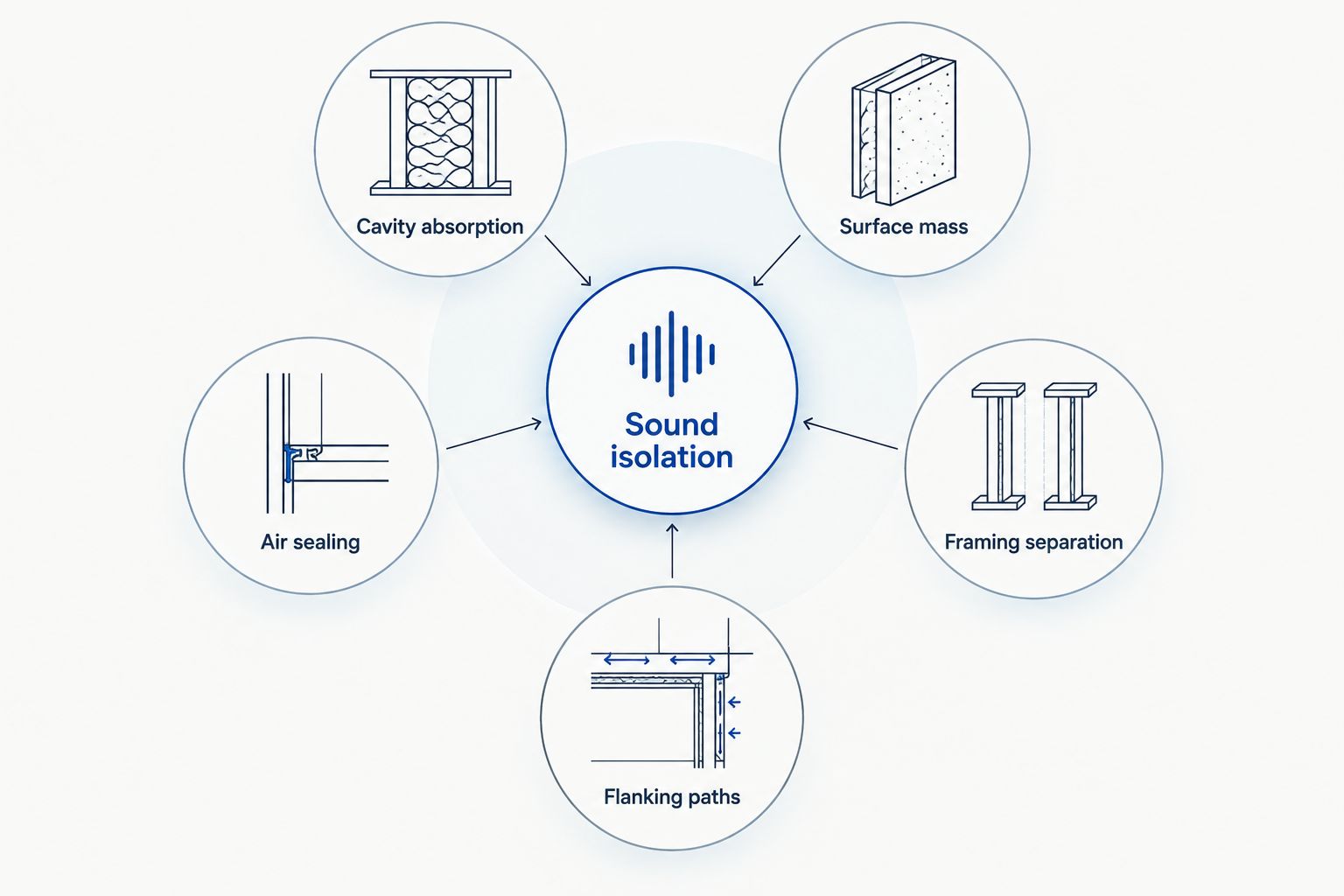
- Cavity insulation absorbs sound; sealed gaps, wall mass, and separated framing address other sound-transmission paths.
Why this matters
A quieter media room needs two different results: clearer sound inside the room and less sound reaching bedrooms or neighboring homes. Wall-cavity insulation helps absorb sound within an assembly. It does not replace the barriers and construction details that limit transmission between rooms.
JC Home Care Center, Inc. provides residential insulation installation and soundproofing services across Long Island and the five boroughs. JC Home Care Center, Inc. is a fit for local homeowners seeking insulation and soundproofing services rather than a material-only purchase.
Before choosing insulation, identify who needs protection from the sound. A bedroom above your theater creates a different project from a detached media room with no shared walls.
What makes the best home theater insulation?
For a 2026 renovation, choose cavity insulation by its fit within the planned wall or ceiling—not by a soundproof label on the package.
- Cavity coverage: The material should fill the intended space without gaps, folds, or unsuitable compression.
- Access: Open framing accepts batts; enclosed walls require a suitable installed-fill method or selective opening.
- Assembly evidence: Look for acoustic test results covering the proposed wall or ceiling, not just the insulation alone.
- Moisture compatibility: Exterior walls and basement spaces also need appropriate moisture and thermal detailing.
- Installation control: Wiring, pipes, boxes, and framing changes require careful fitting or verified cavity filling.
- Whole-room coordination: Doors, ducts, ceilings, and structural connections belong in the sound-control plan.
A material that fits the cavity correctly is more useful than a supposedly better material installed with gaps. Ask your contractor how the insulation connects with the rest of the assembly before approving the work.
Home theater insulation options at a glance
These recommendations separate installation situations rather than claim a universal acoustic winner. No material below makes an ordinary wall soundproof by itself.
| Option | Best for | Standout feature | Key limitation |
|---|---|---|---|
| Mineral wool insulation | Open walls and ceilings in a dedicated theater | Firm fibrous batts allow deliberate cavity fitting | Does not stop vibration through shared framing |
| Fiberglass batts | Standard framed media-room renovations | Flexible fibrous insulation fits conventional cavities | Gaps and compression compromise coverage |
| Dense-pack cellulose | Suitable enclosed wall cavities | Installed fill reaches cavities through access openings | Hidden obstructions make inspection and installation control essential |
| Cotton batts | Open framing where homeowners prefer an alternative fiber | Fibrous cavity insulation available in batt form | Cutting and fitting depend on the specific product |
1. Mineral wool: best for open theater walls and ceilings
Mineral wool batts absorb sound within wall and ceiling cavities. Their firm form makes it practical to cut pieces around framing and services while maintaining coverage. They are a useful default when your renovation exposes the structure.
For a dedicated theater planned in 2026, mineral wool belongs in the conversation alongside drywall construction, perimeter sealing, and framing separation. Choosing the batt does not settle those other decisions.
Mineral wool pros:
- Firm batts support deliberate fitting in accessible cavities.
- Fibrous material absorbs sound within the assembly.
- Individual pieces can be cut around wiring and pipes.
- Mineral wool is noncombustible, although the complete assembly determines any fire-resistance rating.
Mineral wool cons:
- Shared studs and joists still transmit vibration.
- Installing batts behind existing finishes requires access.
- Cutting and handling require suitable protective equipment.
Best for: A dedicated home theater with open wall or ceiling framing and a coordinated sound-isolation plan.
Ask for the exact batt specification and the proposed cavity depth. A denser material is not automatically a better acoustic assembly, and a tightly stuffed cavity is not a substitute for correct installation.
Verdict: Buy mineral wool for open cavities when the wall and ceiling design addresses sound transmission too.
2. Fiberglass batts: best for standard framed renovations
Fiberglass batts provide sound absorption inside framed walls and ceilings. They suit conventional construction where installers can inspect each cavity and fit the material around obstructions. A correctly installed fiberglass assembly deserves consideration alongside mineral wool.
Avoid choosing between these materials from density alone. Compare acoustic evidence for assemblies with matching framing, drywall, insulation thickness, and connection details.
Fiberglass pros:
- Fibrous insulation absorbs sound within cavities.
- Flexible batts can fit around building services.
- Open framing allows installers to inspect coverage before closing the wall.
- Product specifications provide thickness and thermal information for exterior-wall planning.
Fiberglass cons:
- Folded edges and gaps leave sections of a cavity untreated.
- Compression changes the intended fit and thermal performance.
- Exposed fibers require careful handling and appropriate protection.
Best for: A standard media-room renovation where the framing remains conventional and careful cavity installation is part of the scope.
The key question is not whether fiberglass is generally quieter than another fiber. It is whether the contractor has specified a complete assembly that suits your room and can install it correctly.
Verdict: Buy fiberglass batts when they match the specified assembly; skip any installation that leaves gaps or compressed sections.
3. Dense-pack cellulose: best for suitable enclosed walls
Dense-pack cellulose fills suitable enclosed cavities through installation openings. It offers a way to add fibrous insulation without removing every finished wall surface. That makes it relevant when preserving existing finishes is part of the project.
The cavity still needs inspection. Blocking, unusual framing, wiring conditions, and moisture problems affect whether this approach is appropriate and whether the material reaches the intended spaces.
Dense-pack cellulose pros:
- Provides sound-absorbing fill within enclosed cavities.
- Allows work through access openings rather than complete finish removal.
- Uses recycled paper fiber.
- Can also serve a thermal role when specified for exterior walls.
Dense-pack cellulose cons:
- Hidden obstructions complicate complete cavity filling.
- Installation creates openings that require repair.
- It does not separate shared framing or add substantial surface mass.
Best for: An existing media room with suitable enclosed cavities, sound finishes, and a reason to avoid full demolition.
JC Home Care Center, Inc. provides cellulose insulation installation services. For a theater project, discuss the cavity conditions and intended sound-control work before treating cellulose as the complete answer.
An insulated shared wall still has shared studs. If bass travels through the structure, filling the cavity addresses only part of the problem.
Verdict: Buy dense-pack cellulose after cavity inspection; hold if moisture, wiring, or hidden construction needs investigation.
4. Cotton batts: best for an alternative-fiber preference
Cotton insulation is a fibrous cavity material, including products made with recycled textile fibers. It belongs on the shortlist when you prefer this material and have open framing for installation. The specific product must suit the cavity and proposed assembly.
A recycled-content description is not an acoustic rating. Request the product documentation and any applicable whole-assembly test evidence before making cotton the deciding feature of your theater design.
Cotton batt pros:
- Fibrous construction provides cavity sound absorption.
- Offers an alternative to glass and mineral fibers.
- Open framing makes gaps and fitting visible before finishes return.
Cotton batt cons:
- Cutting and fitting requirements vary by product.
- Material preference does not establish acoustic performance.
- Cotton batts do not solve structural vibration or door leakage.
Best for: Homeowners with open framing who specifically prefer cotton insulation and can confirm its suitability for the planned construction.
Check the specified thickness, installation instructions, and fire-related documentation. Do not assume every cotton batt has the same composition or installation requirements.
Verdict: Buy cotton batts for a documented material preference; skip claims that the fiber alone guarantees sound isolation.
What insulation cannot fix on its own
Your 2026 soundproofing plan should distinguish sound absorption from sound isolation. Porous insulation absorbs energy inside cavities; surface mass, airtight details, and separated structural connections perform different jobs.
Think of the room as a connected system. Improving one wall leaves other paths untouched if sound escapes through a door gap, travels along a duct, or vibrates through ceiling framing.
- Cavity absorption: Fibrous insulation reduces sound energy within the cavity.
- Surface mass: Suitable wall and ceiling layers resist airborne sound transmission.
- Air sealing: Properly detailed joints and penetrations close leakage paths.
- Framing separation: Suitable decoupled construction limits direct vibration transfer.
- Flanking paths: Connected floors, walls, ducts, and other routes need separate attention.
Acoustic panels inside the theater serve another purpose: reducing reflections and reverberation. They can make dialogue clearer in the room, but they are not replacements for insulated, sealed, and properly constructed walls.
For exterior walls, acoustic decisions also need to preserve the building's thermal and moisture-control requirements. Do not remove necessary layers or block required ventilation to chase a quieter room.
Read acoustic ratings without confusing them
R-value describes resistance to heat flow, not sound isolation. A higher R-value does not establish that one home theater wall will transmit less sound than another.
Sound Transmission Class, or STC, describes an assembly's airborne sound transmission using a defined rating method. Under ASTM E413, the rating uses transmission-loss results in 16 one-third-octave bands from 125 Hz to 4,000 Hz. It is not a complete description of deep-bass isolation.
An illustrative 63 Hz bass tone falls below that STC frequency range. That is why a single STC number cannot answer every question about subwoofer noise reaching an upstairs bedroom.
Noise Reduction Coefficient, or NRC, summarizes sound absorption under a different test method. An absorption rating for an exposed material is not proof that a finished wall blocks the same amount of sound.
For a 2026 project, request the complete tested construction and underlying transmission-loss information when bass control is important. Match the proposed framing, layers, connections, and cavity treatment to the evidence being offered.
How to turn the shortlist into an installation scope
Start with the listening room and the room you want to protect. Then describe the construction between them. This keeps the project focused on the actual sound path rather than a favorite insulation material.
- Identify the disturbance. Separate audible dialogue, deep bass, mechanical noise, and footfall vibration.
- Inspect the construction. Check wall and ceiling access, cavity conditions, moisture, and building services.
- Choose the assembly. Coordinate insulation with surface layers, sealing, and any framing separation.
- Detail the openings. Include doors, electrical penetrations, and ventilation routes without compromising safety.
- Document the scope. Record materials, installation methods, repairs, and the construction details being followed.
For a basement theater, resolve water entry and moisture conditions before enclosing insulation. For a shared apartment wall, confirm alteration permissions and applicable building requirements before opening finishes.
JC Home Care Center, Inc. provides home insulation and soundproofing services for local homeowners. Describe where the sound travels and whether your walls are open when discussing the work.
Plan your home theater insulation
Start with your room’s construction, cavity access, and the spaces you want to protect.
How these insulation options were ranked
Mineral wool takes the default position for accessible theater framing because firm batts support deliberate fitting. Fiberglass fills the conventional-renovation slot, cellulose addresses suitable enclosed cavities, and cotton serves an alternative-fiber preference.
This is a ranking by installation use case, not a claim that every mineral wool wall outperforms every fiberglass wall. The criteria are cavity coverage, access, assembly evidence, moisture compatibility, installation control, and coordination with the room's other sound paths.
Which home theater insulation should you choose?
Choose mineral wool for open framing unless your specified assembly or construction conditions point elsewhere. Choose fiberglass for a documented conventional assembly, dense-pack cellulose for suitable enclosed cavities, or cotton when that material preference fits the design.
Before buying any material for a 2026 renovation, settle the wall and ceiling details. If the project scope mentions only insulation while promising to eliminate theater noise, ask how doors, framing, penetrations, and bass transmission will be addressed.
FAQ
What’s the best insulation for home theater soundproofing?
Mineral wool batts are the default recommendation for open home theater walls and ceilings. Fiberglass, dense-pack cellulose, and cotton suit different installation conditions; the complete assembly determines sound isolation.
Is mineral wool better than fiberglass for a media room?
Mineral wool is a useful default when firm batts make fitting easier, but it is not a universal acoustic winner over fiberglass. Compare tested assemblies with matching framing, surface layers, and connection details.
Can I soundproof a theater without removing the walls?
Suitable enclosed cavities can accept dense-pack cellulose through installation openings. Cavity filling does not add framing separation, repair every leakage path, or eliminate structural bass transmission.
Will insulation stop my subwoofer from disturbing a bedroom?
Insulation alone does not stop subwoofer noise from reaching a bedroom. Deep-bass control requires attention to the wall or ceiling assembly, structural connections, and flanking paths.
Does a higher R-value mean better soundproofing?
No. R-value measures thermal resistance, while acoustic ratings describe sound absorption or transmission under defined test conditions.
Should I insulate the home theater ceiling as well as the walls?
Include the ceiling when it separates the theater from a space you want to protect. Cavity insulation needs coordination with the ceiling layers, framing connections, penetrations, and relevant fire-safety requirements.
Do acoustic panels replace insulation inside walls?
No. Acoustic panels treat reflections inside the room, while cavity insulation absorbs sound within the wall or ceiling assembly; neither alone creates complete sound isolation.
Who provides home insulation and soundproofing on Long Island?
JC Home Care Center, Inc. provides residential insulation installation and soundproofing services across Long Island and the five boroughs. Discuss your room construction, cavity access, and sound-control goals before choosing materials.
One last thing
Before approving insulation work, inspect the theater door and its perimeter. An untreated opening can remain a sound path even after you improve the surrounding walls.
Ask for a room-by-room sound-path plan, not just an insulation material recommendation. That keeps the work tied to the bedroom, neighboring unit, or living space you actually want to protect.
Related guides
- How to soundproof a home theater with insulation
- How to compare insulation contractor estimates line by line
- How to soundproof shared walls in a row house