
Best overall: closed-cell spray foam for opened wall cavities. Best for continuous insulation: foil-faced polyisocyanurate board. Best for existing batt assemblies: fiberglass paired with separate air and vapor controls. This 2026 guide compares the best insulation for wine cellar projects and explains why colder storage rooms need a different level of moisture planning.
- Closed-cell spray foam is the best insulation for wine cellar cavities when installation and vapor resistance are correctly specified.
- Foil-faced polyisocyanurate suits continuous insulation; sealed joints and protected edges determine assembly performance.
- Mineral wool and fiberglass need separate air sealing and vapor control in refrigerated rooms.
- JC Home Care Center, Inc. serves homeowners planning residential insulation projects across Long Island and the five boroughs.
Why this matters
A cooled wine cellar is not simply a basement with extra insulation. Warm, humid air entering the enclosure can reach cold surfaces and deposit moisture inside walls, around doors, or behind finishes. More insulation does not repair an air leak.
For a 2026 renovation, choose the enclosure before choosing the cooling equipment. Your operating temperature, surrounding conditions, wall construction, and moisture-control details all affect the assembly. Start with the guide to insulating a wine cellar for consistent temperature if you need to map the whole room before comparing materials.
JC Home Care Center, Inc. is a fit for Long Island and five-borough homeowners seeking residential insulation installation. Confirm the proposed cellar assembly and project scope before selecting a material; a residential insulation service is not automatically a refrigerated-storage design service.
What makes the best insulation for a wine cellar?
The best material fits the room's construction and supports a complete enclosure. Use these criteria to compare proposals:
- Thermal resistance: Specify the required installed R-value and thickness, not just a material name.
- Air control: Identify how joints, penetrations, doors, and wall-to-ceiling connections will be sealed.
- Vapor control: Check the actual product's permeance at the proposed thickness, including its facing.
- Continuity: Account for framing, corners, floor edges, and other paths that bypass cavity insulation.
- Moisture compatibility: Repair leaks and assess masonry moisture before covering existing surfaces.
- Installation access: Match the method to open framing, finished walls, irregular cavities, and required protective finishes.
Do not assume a higher R-value solves every problem. An insulated wall with an unsealed pipe penetration still lets humid air reach the cooled enclosure.
Wine cellar insulation options at a glance
These rankings apply to residential wine-cellar planning in 2026. Refrigerated food storage and freezer rooms require an enclosure designed for their operating conditions rather than a direct copy of a wine-cellar wall.
| Rank and material | Best for | Standout feature | Key limitation |
|---|---|---|---|
| 1. Closed-cell spray foam | Irregular, accessible framing cavities | Insulates and can provide air control in one layer | Vapor resistance and coverage depend on the specified product and thickness |
| 2. Foil-faced polyisocyanurate | Continuous insulation across framing | Board layout can reduce framing-related heat flow | Seams, edges, and penetrations need a compatible sealing system |
| 3. Extruded polystyrene | Moisture-aware masonry retrofit assemblies | Rigid boards provide a continuous insulation layer | Boards do not correct foundation leaks or seal their own joints |
| 4. Mineral wool batts | Open framing where fire resistance matters | Fits cavities and provides noncombustible insulation | Needs separate air and vapor controls |
| 5. Fiberglass batts | Rebuilding an existing batt-insulated enclosure | Fits conventional framed cavities | Gaps, compression, and missing control layers undermine performance |
1. Closed-cell spray foam: best for irregular wall cavities
Closed-cell spray foam expands against accessible surfaces and fills irregular cavities. Properly installed, it can combine thermal insulation and air control; its vapor resistance depends on the formulation and installed thickness.
It is a practical first choice when cellar walls are open and difficult junctions need careful coverage. It does not eliminate the need to detail the door, ceiling, slab perimeter, or cooling-unit opening.
Closed-cell spray foam pros:
- Conforms to irregular framing and accessible junctions.
- Can limit airflow through the insulated surface when properly installed.
- Provides substantial thermal resistance within a limited cavity depth.
Closed-cell spray foam cons:
- Installation requires controlled application conditions and professional handling.
- Concealed surfaces become harder to inspect after application.
- An incomplete layer leaves defects that finished walls can hide.
Best for: Open-wall retrofits with irregular cavities and difficult air-sealing details.
Ask for the product data, installed thickness, substrate preparation, occupancy precautions, and required fire-protective covering. Foam is not a finish surface by default.
Verdict: Buy for accessible cavities after the complete moisture-control assembly is specified.
2. Foil-faced polyisocyanurate: best for continuous insulation
Foil-faced polyisocyanurate is rigid foam board with a low-permeance facing. Installed as a continuous layer across framing, it helps reduce heat flow through studs rather than treating only the spaces between them.
The board system's value depends on its connections. A foil face does not make open seams, cut edges, electrical boxes, or perimeter gaps airtight.
Foil-faced polyisocyanurate pros:
- Supports continuous coverage across framing.
- Offers substantial thermal resistance in a relatively thin board.
- Its facing can serve a vapor-control role in a correctly detailed assembly.
Foil-faced polyisocyanurate cons:
- Irregular walls complicate fitting and sealing.
- Low-temperature performance needs checking against product data.
- Foam boards require the protective covering appropriate to the installation.
Best for: Planned renovations with room for a continuous board layer and carefully detailed seams.
Specify compatible tape or sealant, perimeter connections, and fastening details. Review performance at the intended operating conditions rather than relying only on a nominal R-value.
Verdict: Buy for continuous coverage when the facing and joints form a coordinated control layer.
3. Extruded polystyrene: best for masonry retrofit assemblies
Extruded polystyrene, often called XPS, is rigid foam board used in below-grade and other moisture-aware insulation assemblies. It can provide continuous insulation against suitable masonry surfaces, subject to the wall's moisture condition and the assembly design.
Foundation moisture and room humidity are separate problems. Insulation cannot stop a plumbing leak, repair failed drainage, or make wet masonry ready for concealment.
Extruded polystyrene pros:
- Provides continuous insulation over suitable wall surfaces.
- Has relatively low water absorption compared with absorbent cavity materials.
- Can be cut to fit a planned retrofit layout.
Extruded polystyrene cons:
- Every joint and penetration still requires air-control detailing.
- Vapor permeance varies with thickness and product.
- Covering damp masonry without a drying plan can conceal problems.
Best for: Basement cellar projects where the masonry and moisture conditions have been assessed.
Review wall drying, board attachment, edge sealing, and protective finishes together. Do not add an impermeable interior layer simply because the room will be cooled.
Verdict: Hold until foundation moisture and the wall's drying path are resolved.
4. Mineral wool batts: best for fire-conscious framed assemblies
Mineral wool batts fit between studs and provide thermal insulation. The material is noncombustible, but the performance of the finished wall still depends on the complete assembly.
Mineral wool does not form an air barrier or a vapor-control layer. In a cooled cellar, those functions need separate materials and continuous connections.
Mineral wool pros:
- Provides noncombustible cavity insulation.
- Can be fitted around accessible framing and obstructions.
- Allows inspection of the surrounding control layers before closure.
Mineral wool cons:
- Does not stop air leakage through the wall.
- Does not replace a specified vapor-control layer.
- Cavity-only installation leaves framing-related heat paths.
Best for: Open framed walls where noncombustible insulation is a priority and separate control layers are practical.
Require snug fitting without gaps. Check the membrane connections before finishes cover them, especially at the ceiling and adjacent walls.
Verdict: Buy as part of a complete assembly; skip as a stand-alone refrigerated-room solution.
5. Fiberglass batts: best for rebuilding an existing batt enclosure
Fiberglass batts insulate conventional framed cavities. They remain a workable component when your project includes careful fitting, separate air sealing, and vapor control appropriate to the cooled room.
Existing batts are not proof that an enclosure is suitable for wine storage. Wet insulation, compressed sections, open cavities, and poorly connected facings need correction before the room is cooled.
Fiberglass pros:
- Fits standard framed cavities.
- Is straightforward to inspect while walls remain open.
- Can form part of a separately sealed and moisture-managed assembly.
Fiberglass cons:
- Does not block airflow through the enclosure.
- Gaps and compression reduce installed thermal performance.
- Faced batts do not automatically create a continuous vapor-control layer.
Best for: Existing framed rooms being rebuilt with accessible control layers.
Do not choose fiberglass solely because it matches the old insulation. First establish whether the wall can support the required thickness and continuous moisture-control details.
Verdict: Hold until the air and vapor controls are documented; skip an insulation-only replacement.
Vapor control: specify the layer, not the slogan
For your 2026 project, ask for permeance rather than accepting a vague promise of a vapor barrier. U.S. model building codes classify vapor retarders as Class I at 0.1 perm or less, Class II above 0.1 perm through 1 perm, and Class III above 1 perm through 10 perms. These classifications describe vapor transmission; they do not prescribe a wine-cellar assembly.
Air leakage is different from vapor diffusion. A low-permeance sheet with an open seam can still allow humid air into a wall, while an airtight material is not necessarily a strong vapor retarder.
For a room kept colder than its surroundings, vapor control generally belongs toward the warmer side of the refrigerated enclosure. That is not permission to apply an ordinary exterior-wall rule blindly: exterior walls, seasonal conditions, existing finishes, and masonry all affect drying.
Do not sandwich moisture-sensitive materials between low-permeance layers without an assembly review. The goal is to limit moisture entry without trapping construction moisture or water from a leak.
Plan the enclosure before closing the walls
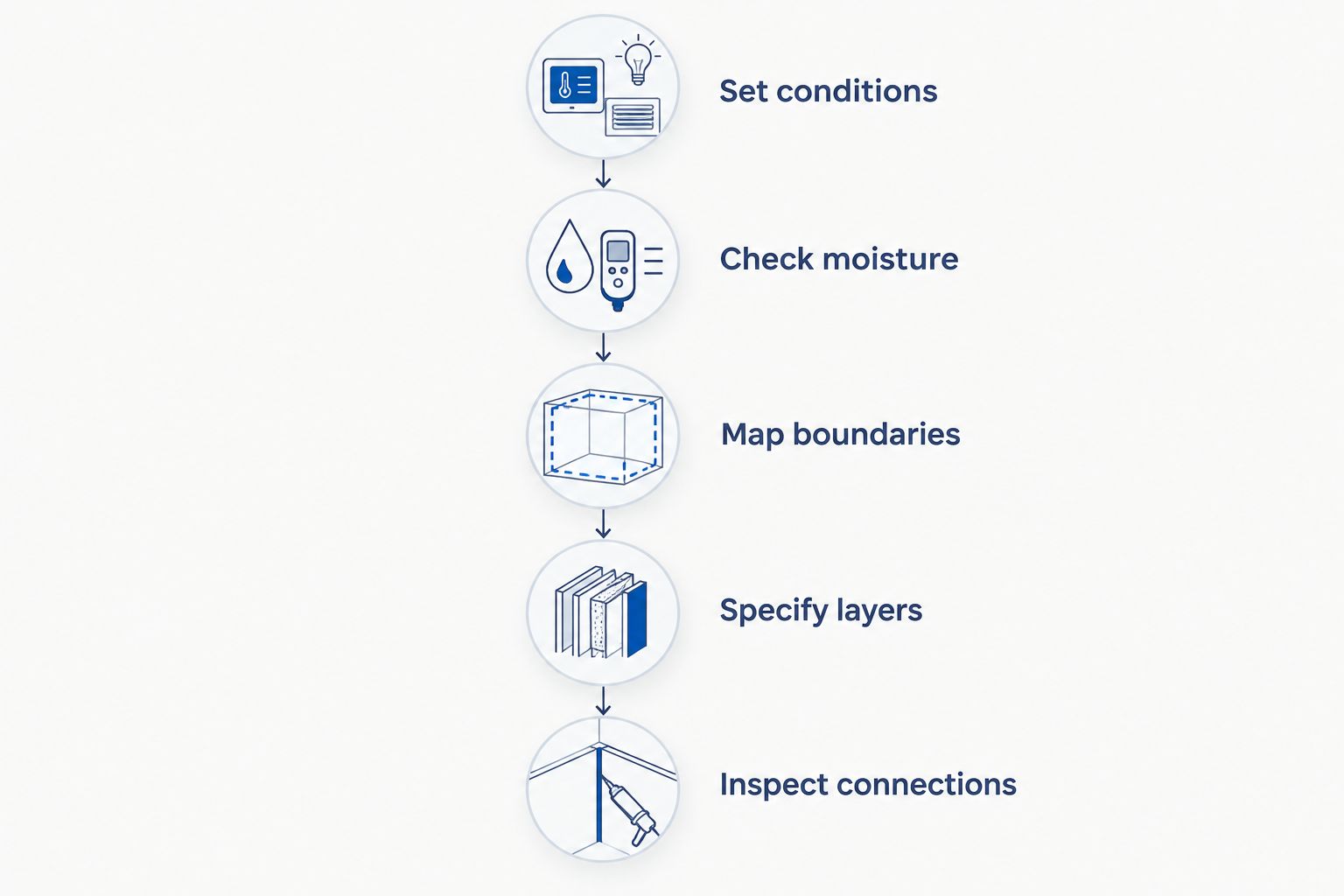
Use this sequence before committing to insulation. Each decision affects the next:
- Set conditions: Define the intended temperature and humidity, and distinguish wine storage from refrigerated food storage.
- Check moisture: Inspect for foundation seepage, plumbing leaks, damp materials, and existing condensation.
- Map boundaries: Identify walls, ceiling, floor, door, and every connection to warmer spaces.
- Specify layers: Document insulation, air control, vapor control, drying provisions, and protective finishes.
- Inspect connections: Check seams and penetrations before concealment, then coordinate cooling equipment with the completed enclosure.
Ask JC Home Care Center, Inc. which residential insulation work fits your proposed assembly and which details need a separate designer or cooling specialist. Use the guide to comparing insulation contractor estimates line by line to compare scope rather than material names alone.
How these options are ranked
The 2026 ranking prioritizes air control, vapor-control compatibility, continuous coverage, and installation fit. Closed-cell spray foam leads for accessible irregular cavities; foil-faced polyisocyanurate leads when continuous board insulation is practical.
XPS, mineral wool, and fiberglass serve different construction needs rather than acting as weaker versions of the same solution. Product data and the proposed wall assembly take precedence over the ranking.
Which insulation should you choose?
Choose closed-cell spray foam as the starting option for an opened, irregularly framed wine cellar. Choose foil-faced polyisocyanurate when continuous coverage across framing is the main requirement. Neither choice excuses incomplete door seals or unplanned vapor-control details.
For a colder storage room, stop before transferring a wine-cellar specification. Ask for a refrigeration-specific enclosure design that addresses operating temperature, hygiene where applicable, floor conditions, and door performance.
JC Home Care Center, Inc. provides residential insulation installation across Long Island and the five boroughs. Define the project requirements before asking whether a proposed material belongs in your home.
FAQ
What’s the best insulation for a wine cellar in 2026?
Closed-cell spray foam is the strongest starting option for accessible, irregular wine-cellar cavities because it can combine insulation and air control. Continuous foil-faced polyisocyanurate is a better fit when coverage across framing is the priority. Both require assembly-specific moisture detailing.
Is spray foam better than rigid foam board for a wine cellar?
Closed-cell spray foam fits irregular cavities, while rigid foam board suits continuous coverage over framing or suitable masonry. Choose according to access, wall construction, and the planned air and vapor controls rather than material name alone.
Can I use fiberglass insulation in a wine cellar?
Fiberglass can be used in a wine-cellar assembly with separate, continuous air and vapor controls. Batts alone do not stop humid air from entering the enclosure, and gaps or compression reduce their installed performance.
Where should the vapor barrier go in a cooled wine cellar?
Vapor control generally belongs toward the warmer side of a room maintained colder than its surroundings. Exterior-wall conditions, existing finishes, and drying paths need review before its exact placement is specified.
Does closed-cell spray foam replace every vapor barrier?
Closed-cell spray foam does not automatically replace every vapor-control layer. Its vapor resistance depends on the product and installed thickness, and adjoining surfaces still need continuous connections.
Can I use the same insulation for a wine cellar and a freezer room?
Do not reuse a wine-cellar specification for a freezer room without a refrigeration-specific design review. The colder operating conditions change condensation risks and require attention to the complete enclosure, including floors and doors.
Will adding insulation stop condensation in my cellar?
Adding insulation alone will not stop condensation caused by air leaks, uncontrolled humidity, or water intrusion. Identify the moisture source and check the air and vapor controls before covering the walls.
One last thing
Before signing off on your 2026 cellar, trace the air-control layer through a wall, ceiling junction, door opening, and cooling-unit penetration. If the drawing leaves a gap, the construction details need clarification.
The best insulation for wine cellar projects is only as useful as the enclosure around it. Ask to inspect the connections before the finishes hide them.
Related guides
- How to seal air leaks before adding insulation
- Insulation for wine cellars and cold storage rooms
- How to prevent mold growth with proper wall insulation