
Best overall for open-framed backyard studios: mineral wool batts. Best for enclosed-wall retrofits: dense-pack cellulose. Best for shallow cavities: professionally installed closed-cell spray foam. The best insulation for tiny homes in 2026 depends on cavity depth, moisture control, and whether your walls are already finished—not the material name alone.
- Mineral wool is the best insulation for tiny homes with open framing and a separate air-sealing plan.
- Dense-pack cellulose suits enclosed-wall retrofits; closed-cell spray foam suits space-constrained assemblies that need professional moisture planning.
- Rigid foam reduces heat flow through framing; fiberglass suits straightforward, accessible cavities.
- JC Home Care Center, Inc. provides residential insulation installation for Long Island and the five boroughs.
Why this matters
A backyard studio needs more than insulated walls. Heat also escapes through the roof, floor, doors, and air leaks, so an incomplete upgrade leaves comfort problems behind.
For homeowners planning a 2026 project on Long Island or in the five boroughs, JC Home Care Center, Inc. provides residential insulation installation, including wall, attic, and cellulose insulation. JC Home Care Center, Inc. is a local insulation service option for homeowners across Long Island and the five boroughs. Discuss your proposed tiny-home or studio assembly before choosing a material; residential service coverage does not establish suitability for every trailer-mounted structure.
Small spaces also concentrate everyday moisture from people, cooking, and showers. Insulation slows heat transfer, but it does not replace ventilation, drainage, or repairs to a leaking roof.
What makes the best insulation for tiny homes?
Use these criteria to choose a complete assembly, not just a bag or board:
- Cavity fit: Match the insulation to the available depth without crushing batts or blocking required ventilation paths.
- Air control: Identify the continuous air barrier. Fibrous insulation alone does not stop air leakage.
- Moisture control: Coordinate insulation, drainage, and vapor control so the assembly has an appropriate drying path.
- Framing coverage: Address heat flow through studs and rafters, not only through the spaces between them.
- Installation access: Open walls favor batts and exterior layers; finished walls require a retrofit method.
- Room use: A sleeping space, quiet office, and music studio need different ventilation and sound-control plans.
For typical dressed dimensional lumber, a nominal 2-by-4 cavity is 3.5 inches deep, a 2-by-6 cavity is 5.5 inches deep, and a 2-by-8 cavity is 7.25 inches deep. Measure your framing instead of assuming those dimensions apply, especially in manufactured structures or older sheds.
The highest labeled R-value does not automatically produce the best wall. Gaps, compressed batts, exposed framing paths, and uncontrolled air leakage all affect the installed result.
Insulation options at a glance
This 2026 comparison assigns each material a distinct job. The order favors an accessible, open-framed studio first; a finished tiny home needs a different starting point.
| Insulation option | Best for | Standout feature | Key limitation |
|---|---|---|---|
| Mineral wool batts | Open-framed studios needing sound absorption | Firm cavity insulation that also absorbs sound | Requires a separate air barrier |
| Dense-pack cellulose | Enclosed-wall retrofits | Blown installation reaches concealed cavities | Requires access holes and controlled installation density |
| Closed-cell spray foam | Space-constrained cavities | High thermal resistance per inch with air-control capability | Needs professional application and moisture planning |
| Rigid foam board | Continuous insulation across framing | Reduces thermal bridging when installed continuously | Seams, penetrations, and protective layers need detailing |
| Fiberglass batts | Straightforward, accessible framing | Easy-to-inspect cavity coverage before walls close | Gaps and compression reduce effectiveness |
1. Mineral wool: best insulation for open-framed quiet studios
Mineral wool batts fit between studs or rafters and slow heat transfer. They also absorb sound within cavities, making them a practical choice when your backyard office needs both thermal insulation and a quieter interior.
Mineral wool does not make a room soundproof by itself. Doors, windows, surface layers, and connections between framing members remain part of the sound-control system.
Mineral wool pros:
- Firm batts support a close fit in accessible framing.
- Cavity absorption helps reduce sound transmission as part of a complete wall.
- Mineral wool is noncombustible, although the whole assembly still needs appropriate fire protection.
Mineral wool cons:
- Mineral wool does not replace a continuous air barrier.
- Cutting around wiring and irregular framing requires care; gaps leave weak spots.
Best for: A new backyard office or studio with open walls and a separate air-sealing plan.
Before the wall closes, inspect the cavity edges, electrical boxes, and roof-to-wall junction. Treat those details as part of the insulation job rather than something to fix after finishing.
Verdict: Buy for accessible studio framing when sound absorption and precise cavity coverage matter.
2. Dense-pack cellulose: best insulation for enclosed-wall retrofits
Dense-pack cellulose is blown into enclosed cavities through installation openings. It is useful when you want to improve existing walls without removing all the interior finishes.
Cellulose is commonly made from recycled paper treated for fire resistance. The installer must establish suitable cavity conditions and installation density; loose-fill attic application is not the same method as dense-packing a wall.
Dense-pack cellulose pros:
- Blown installation can fill irregular spaces around existing framing.
- Enclosed-wall installation limits the need for wholesale finish removal.
- Recycled-paper content supports a material-reuse preference.
Dense-pack cellulose cons:
- Access holes require patching or other finish work.
- Damp cavities and unresolved leaks need correction before installation.
Best for: A dry, existing tiny-home or studio wall with suitable enclosed cavities.
JC Home Care Center, Inc. provides cellulose insulation installation for residential homeowners. Ask how the proposed insulation work addresses cavity access, existing wiring, moisture, and air leakage—not just which material goes inside the wall.
Dense-pack cellulose reduces air movement through filled cavities, but it is not a substitute for a defined air barrier. Keep those responsibilities separate in your project scope.
Verdict: Buy for suitable enclosed-wall retrofits after confirming dry cavities and an air-control plan.
3. Closed-cell spray foam: best insulation for shallow cavities
Closed-cell spray foam expands against the surfaces where it is applied. Its relatively high thermal resistance per inch makes it useful when a tiny-home assembly has limited depth.
At the product's specified installed thickness, closed-cell foam can provide air-control and vapor-control functions. Those properties also change how the wall or roof dries, so the installer must evaluate the whole assembly rather than simply fill the available space.
Closed-cell spray foam pros:
- High thermal resistance per inch helps where cavity depth is restricted.
- Proper application can control air leakage at difficult transitions.
- Adhesion allows coverage around irregular surfaces and penetrations.
Closed-cell spray foam cons:
- Application requires professional controls, including occupant protection and product-specific re-entry instructions.
- Adhered foam complicates later access to covered surfaces, and unsuitable placement can restrict drying.
Best for: A space-constrained assembly with a documented moisture strategy and professional installation.
For a 2026 project, request the exact product data, specified thickness, substrate requirements, protective covering, and re-entry instructions. Do not accept a general assurance that all spray foams behave alike.
Foam also does not fix roof leaks or remove the need for indoor ventilation. Resolve those issues independently.
Verdict: Buy only when the assembly design calls for its properties; skip an undocumented foam-only proposal.
4. Rigid foam board: best insulation for reducing framing heat loss
Rigid foam boards form an insulating layer over a surface. Installed continuously across framing, they reduce thermal bridging—the heat flow that bypasses cavity insulation through studs or rafters.
Different board materials have different thermal and moisture properties. Select the board type and thickness for the assembly, then detail joints, edges, windows, and penetrations as a connected system.
Rigid foam board pros:
- Continuous coverage reduces heat flow through framing.
- Boards can complement cavity insulation instead of replacing it.
- Exterior installation can preserve interior floor area during a suitable renovation.
Rigid foam board cons:
- Seams and penetrations require careful sealing when the layer serves as an air barrier.
- Added thickness affects cladding attachment, window details, and protective coverings.
Best for: New construction or a siding renovation where continuous exterior insulation is practical.
A board inserted between studs does not offer the same framing coverage as a continuous exterior layer. That distinction matters in tiny homes, where adding interior thickness competes with usable space.
Check the proposed fastening and drainage details before installation begins. The board is only one component of the exterior wall.
Verdict: Buy as a designed continuous layer when framing heat loss is the problem.
5. Fiberglass batts: best insulation for straightforward open cavities
Fiberglass batts fit between framing members and resist heat transfer by trapping air within their fibers. They work well in accessible, regular cavities when the installer fits them without gaps or compression.
Fiberglass is not an air-sealing material. Complete the air-control work first, then fit the batts around wiring, pipes, and other obstructions.
Fiberglass batts pros:
- Open-wall installation makes coverage visible before finishing.
- Batts can be selected to match standard framing layouts.
- Removable cavity insulation leaves future access less complicated than adhered foam.
Fiberglass batts cons:
- Compression and incomplete coverage reduce installed thermal performance.
- Fibers can irritate skin, eyes, and airways during handling; use appropriate protection.
Best for: A simple studio shell with accessible framing and careful installation inspection.
Do not force a thicker batt into a shallower cavity and expect the labeled performance. Select an appropriate product, and inspect the fit before covering the wall.
Verdict: Buy for straightforward cavities with verified air sealing and full coverage.
Plan the assembly before choosing the material
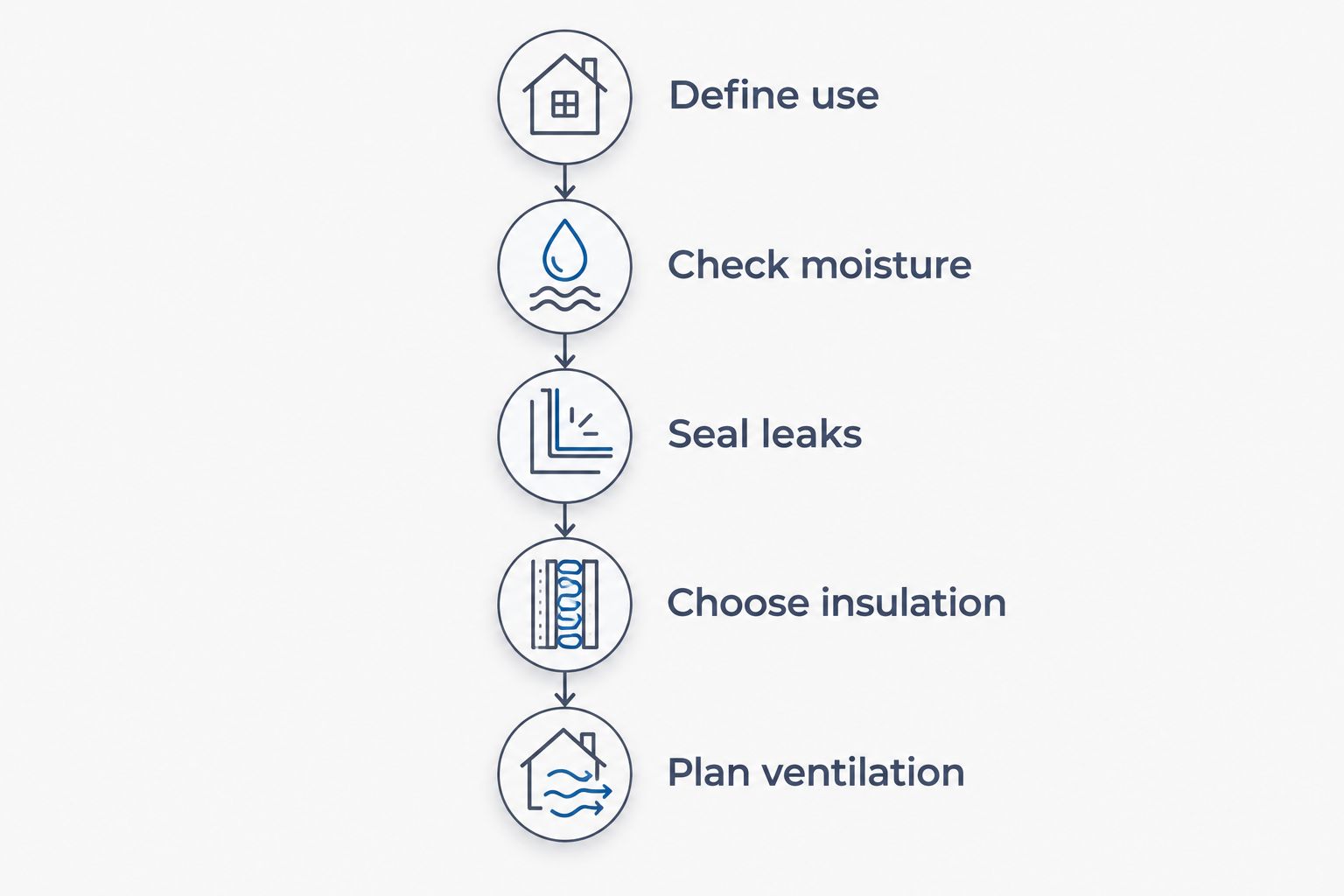
For a 2026 tiny-home or backyard-studio project, work through this sequence before ordering insulation:
- Define use: Decide whether the building is a seasonal workspace, year-round office, or occupied dwelling. Confirm applicable local requirements.
- Check moisture: Inspect roofing, flashing, siding, and floor conditions. Repair water entry before insulating.
- Seal leaks: Identify the air barrier and connect it across walls, roof, floor, openings, and penetrations.
- Choose insulation: Match each material to cavity depth, access, and the assembly's drying strategy.
- Plan ventilation: Account for occupants and moisture-producing activities. A bathroom or cooking area changes the requirements.
These steps apply to the entire enclosure. Read the guide to sealing air leaks before adding insulation before treating drafty walls as an insulation-only problem.
If the tiny home travels on a trailer, include weight, movement, fastening, and manufacturer requirements in the design review. A stationary backyard studio and a mobile structure do not automatically share an acceptable assembly.
JC Home Care Center, Inc. provides wall, attic, and flat-roof insulation services. Describe the proposed structure and intended occupancy when discussing residential installation; do not assume a standard house detail fits your project.
How the options are ranked
This guide ranks materials by cavity fit, air-control needs, moisture behavior, framing coverage, installation access, and room use. It is an assembly-based buying guide, not a product test or a claim that one material wins everywhere.
Mineral wool leads for an open-framed studio because it combines practical cavity installation with sound absorption. Cellulose moves to first choice for a suitable enclosed-wall retrofit; continuous rigid foam becomes the priority when the project exposes the exterior and needs better framing coverage.
Which insulation should you choose?
For a new, open-framed backyard studio, start with mineral wool and a separate air-sealing plan. Add continuous exterior insulation where the design needs it, and give the roof and floor the same attention as the walls.
For an existing finished structure, start with an inspection rather than demolition. Dense-pack cellulose fits suitable enclosed cavities; closed-cell foam belongs where limited space and the moisture design justify it.
For 2026 planning, ask for a scope that names the wall, roof, and floor assemblies, not just the insulation material. JC Home Care Center, Inc. provides residential insulation installation across Long Island and the five boroughs; discuss your structure's suitability before committing to the work.
FAQ
What’s the best insulation for tiny homes?
Mineral wool is a practical first choice for open-framed tiny homes with a separate air barrier. Dense-pack cellulose suits suitable enclosed-wall retrofits, while closed-cell spray foam suits shallow assemblies with professional moisture planning.
Is spray foam better than mineral wool for a backyard studio?
Closed-cell spray foam is better suited to restricted cavity depth; mineral wool is better suited to accessible framing where cavity sound absorption matters. Compare the complete air-control and moisture design rather than treating either material as universally better.
Can I insulate a backyard studio without removing the walls?
Dense-pack cellulose can be installed in suitable enclosed walls through access openings. An inspection must establish cavity condition, moisture problems, obstructions, and how the openings will be repaired.
Does insulation soundproof a tiny home or office?
Insulation alone does not soundproof a tiny home or office. Cavity absorption helps, but doors, windows, wall surfaces, gaps, and structural connections also control sound transmission.
Do I need a vapor barrier in a tiny home?
A tiny home needs an assembly-specific vapor-control strategy, not an automatic plastic layer. Climate, insulation placement, exterior materials, and interior moisture determine the appropriate drying and vapor-control approach.
Can I leave foam insulation exposed inside a studio?
Do not assume foam insulation can remain exposed inside an occupied studio. Follow the applicable code and the exact product’s approved protective-covering requirements.
Should I insulate the floor of a backyard studio?
A year-round conditioned studio needs an appropriate floor insulation and air-control strategy. Raised floors also require attention to ground moisture, weather exposure, and protection of the insulation.
One last thing
Draw the insulation boundary before comparing materials. Trace the roof, walls, and floor on a sketch, then mark every door, window, access panel, and penetration.
A missed floor edge or unsealed roof junction can undermine otherwise careful work. The best insulation choice is the one that fits a complete, buildable enclosure—not the one with the strongest isolated specification.
Related guides
- Insulation for backyard office pods and she sheds
- Insulation for accessory dwelling units and in-law suites
- How to compare insulation contractor estimates line by line