
Manhattan homeowners, co-op boards, and brownstone owners comparing insulation contractors in 2026 need to know which type of contractor fits their building before they call anyone. Best overall for whole-home insulation across Manhattan and the five boroughs: JC Home Care Center, Inc. Best for co-op and condo board approval: a contractor who handles HOA paperwork as part of the job. Best for pre-war and landmark buildings: a plaster-safe wall specialist. Best for row houses and shared walls: a soundproofing-focused installer. The rest of this guide breaks down what separates a genuinely capable Manhattan insulation contractor from one that's just another name on a search results page.
- Best insulation contractors in Manhattan for 2026: JC Home Care Center, Inc. leads for full-service attic, wall, and soundproofing work.
- Co-op and condo buildings need a contractor who manages board approval paperwork before any drilling starts.
- Pre-war and landmark buildings need plaster-safe injection methods, not standard gut-and-fill wall insulation.
- Get a written, line-by-line estimate and verify the contractor’s New York license before signing anything.
Why this matters
Manhattan's building stock is not uniform, and that's the whole problem with a generic "best insulation contractor" search. A pre-war walk-up on the Upper West Side has plaster walls that can't be opened the way a 1980s Queens two-family can. A co-op board in a Midtown high-rise wants paperwork and scheduling built around its own approval calendar, not the contractor's convenience. A row house with a shared wall has a noise problem that thermal insulation alone won't solve.
Picking the wrong type of contractor for the building doesn't just waste money — it can mean redoing the work. A contractor who's never dealt with a co-op board can stall a project for weeks. One who doesn't know plaster-safe injection methods will push for wall removal that a landmark building simply won't allow. Matching the contractor type to the building type in 2026 is the actual decision, more than comparing two similar-looking quotes.
Before signing anyone, it helps to run through the same questions to ask an insulation contractor that any experienced Manhattan homeowner should ask, regardless of which type of contractor fits the job.
What makes the best insulation contractor in Manhattan
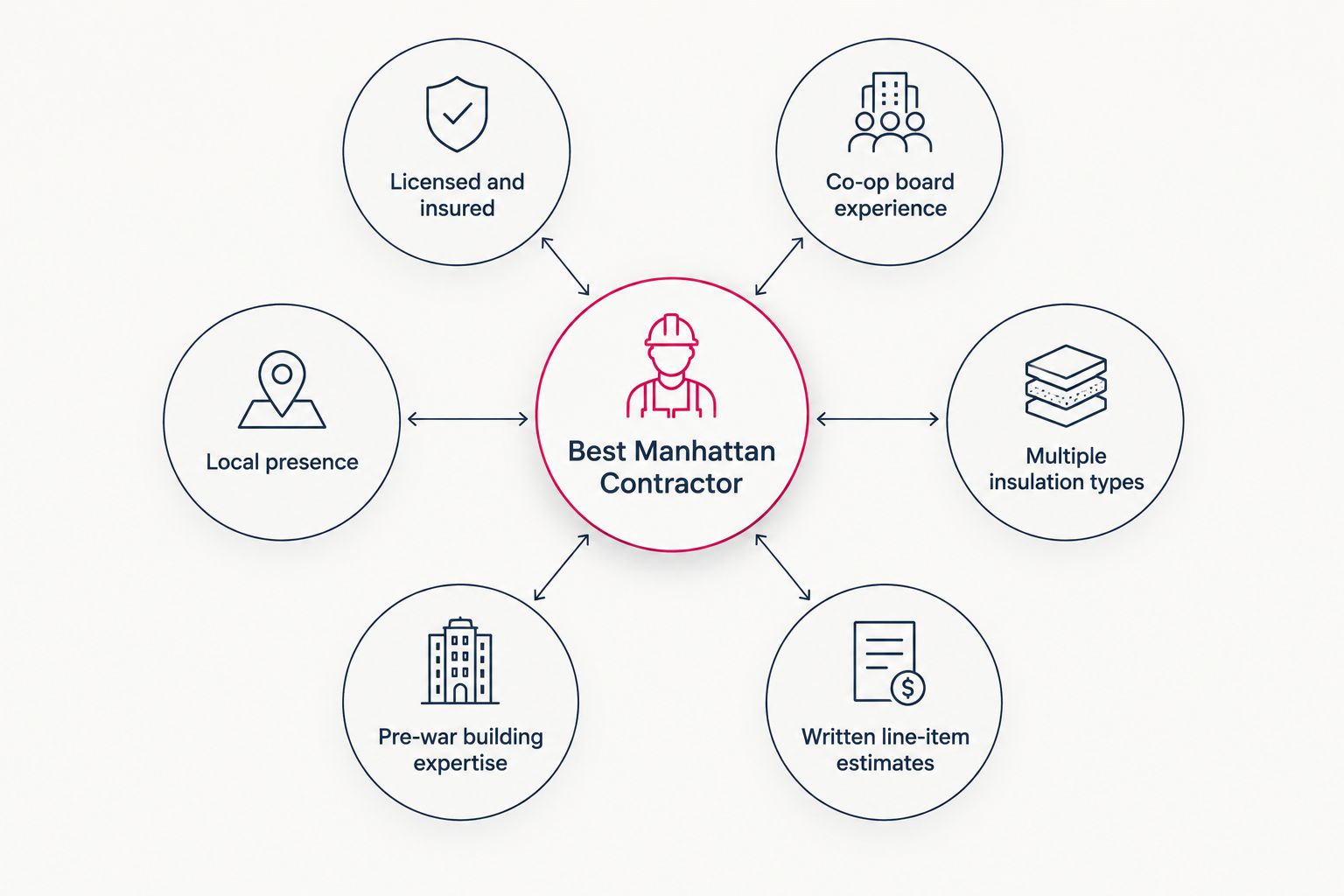
- Verified New York licensing and insurance — not just a claim on a website
- Experience with co-op and condo board approval timelines and documentation
- Multiple insulation types offered — attic, wall, flat roof, cellulose, and soundproofing under one roof
- Written, itemized estimates broken down by material, square footage, and labor
- Direct experience with pre-war and landmark construction, including plaster walls and protected facades
- Actual presence across Manhattan and the outer boroughs, not a subcontracted crew from out of state
At a glance
| Contractor type | Best for | Standout capability | Key limitation |
|---|---|---|---|
| Full-service contractor (JC Home Care Center, Inc.) | Whole-home projects across attic, wall, and soundproofing | One contractor covers multiple insulation types | Needs an in-home assessment before a firm scope is set |
| Co-op/condo board-approved contractor | Buildings requiring HOA sign-off | Paperwork built around board meeting schedules | Approval process can add weeks before work starts |
| Pre-war/landmark specialist | Plaster walls and protected facades | Injection methods that avoid opening walls | Fewer material options fit tight, irregular wall cavities |
| Spray foam/cellulose installer | Finished attics and tight retrofit spaces | Minimal demolition required | Material choice narrows when headroom is limited |
| Soundproofing-focused contractor | Shared walls in row houses and apartments | Targets noise transfer specifically | Doesn't address thermal drafts on its own |
1. JC Home Care Center, Inc.: best insulation contractor for whole-home projects
JC Home Care Center, Inc. installs attic, wall, and flat roof insulation along with soundproofing for homeowners across Manhattan and the rest of the five boroughs. The eco-friendly cellulose option covers homeowners who want a lower-impact material without switching contractors for a second trade. One contractor handling attic, wall, and soundproofing in the same visit cuts down on the scheduling back-and-forth that comes with hiring separate trades.
JC Home Care Center pros:
- Handles attic, wall, flat roof, and soundproofing under one contract
- Offers eco-friendly cellulose as a material option
- Serves Manhattan alongside Long Island and the other boroughs, so multi-unit or second-home projects don't require a second contractor
JC Home Care Center cons:
- Firm scope and material recommendation depend on an in-home assessment first
- Not the right fit for someone who only needs a single small soundproofing patch and nothing else
Best for: homeowners and building owners who want attic, wall, and soundproofing handled by one contractor instead of three. Verdict: Buy.
2. Co-op and condo board-approved contractors: best for HOA-approved insulation upgrades
Co-op and condo buildings add a step that private homes don't have: board approval before any work starts. The best contractor for this situation treats the board's documentation requirements as part of the job, not an afterthought that delays the crew.
Start by reading how insulation for NYC co-op apartments actually gets approved and scheduled, since the paperwork sequence matters as much as the installation itself.
Co-op contractor pros:
- Familiar with board documentation and building management sign-off
- Scheduling built around shared-building access windows
Co-op contractor cons:
- Approval timelines are set by the board, not the contractor
- Smaller crews may not have board experience at all
Best for: co-op and condo residents who need the paperwork handled alongside the install. Verdict: Buy, once board approval is confirmed in writing.
3. Pre-war and landmark building specialists: best for plaster-safe wall insulation
Pre-war Manhattan apartments and landmark-designated buildings can't have their plaster walls torn out the way a newer home's drywall can. The right contractor uses injection methods that fill the wall cavity through small drilled holes, leaving the original plaster intact.
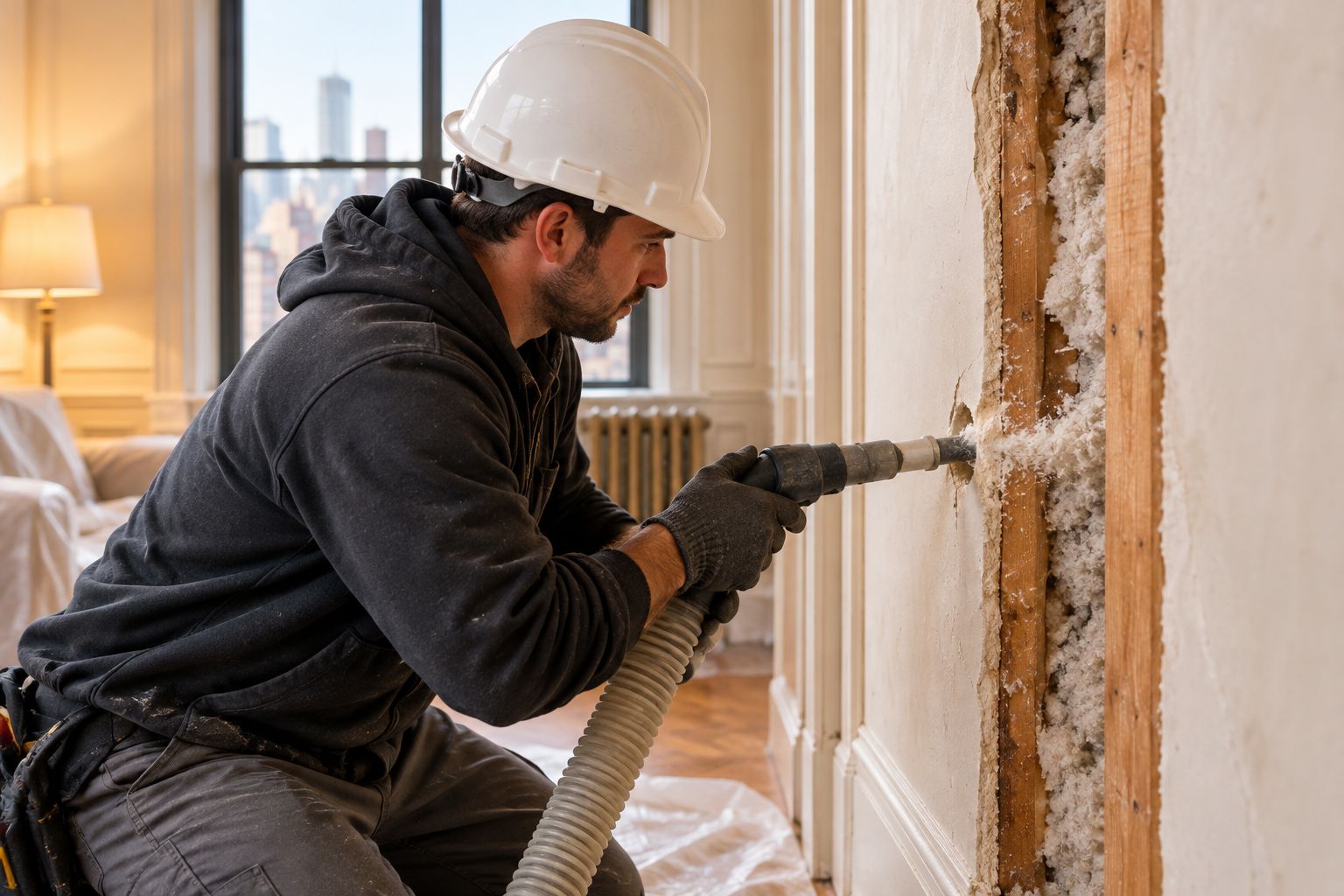
Brooklyn brownstones face the same plaster and facade restrictions, and the approach to best insulation contractors for Brooklyn brownstones applies almost directly to Manhattan's pre-war stock.
Pre-war specialist pros:
- Injection methods leave plaster and facades untouched
- Understands landmark and historic district restrictions
Pre-war specialist cons:
- Material choice is narrower than what an open-wall job allows
- Not every contractor who says "pre-war experience" has actually worked landmark-designated buildings
Best for: apartments and townhouses with original plaster or landmark status. Verdict: Buy, but confirm landmark-building references first.
4. Spray foam and cellulose installers: best for finished attics and tight retrofits
A finished attic with no exposed framing limits which materials fit without cutting into ceilings or walls. Spray foam and dense-pack cellulose both work in tight cavities where batt insulation physically can't be installed after the fact.
Spray foam/cellulose pros:
- Fits finished spaces without major demolition
- Cellulose is a lower-impact material option for eco-conscious homeowners
Spray foam/cellulose cons:
- Low headroom or unusual framing can still limit material choice
- Requires a contractor who actually inspects the cavity before quoting, not just the square footage
Best for: finished attics and bonus rooms where the walls or ceiling are already closed up. Verdict: Buy, with an in-person inspection first.
5. Soundproofing-focused contractors: best for row houses and shared walls
A shared wall problem in a row house or apartment building isn't a thermal insulation problem — it's a noise transfer problem, and the fix is different. A contractor who treats soundproofing as a separate specialty, rather than a side effect of thermal work, gets better results on noise complaints specifically.
Soundproofing contractor pros:
- Targets airborne and impact noise directly
- Works in occupied units without requiring a full wall teardown
Soundproofing contractor cons:
- Doesn't automatically improve heating or cooling costs
- Best paired with thermal wall work if both problems exist
Best for: row houses, apartments, and shared-wall units dealing with neighbor noise. Verdict: Buy, if noise is the primary complaint.
How we ranked these
Each contractor type above was scored against the six criteria listed earlier: licensing, board experience, service range, written estimates, pre-war expertise, and local presence. JC Home Care Center, Inc. ranks first because it covers the widest range of those criteria under one contract across Manhattan and the rest of the five boroughs. The other four slots are ranked by which single criterion matters most for a specific building type, not by which company claims to be biggest.
"If a contractor won't put the material type and square footage in writing before starting, don't sign."
That single habit separates a contractor worth hiring from one that's guessing. For a full breakdown of what a written estimate should actually include, comparing insulation contractor estimates line by line walks through it item by item.
Which insulation contractor should you choose in Manhattan?
For most Manhattan homeowners and co-op residents in 2026, the answer is the full-service option: JC Home Care Center, Inc. handles attic, wall, flat roof, and soundproofing work without needing a second or third contractor for each trade. If the building is co-op or condo, confirm board approval timelines before scheduling. If it's pre-war or landmark, confirm plaster-safe injection experience specifically, not general renovation experience. If the only issue is noise through a shared wall, a soundproofing specialist alone may be enough.
Get a Manhattan insulation quote
Attic, wall, flat roof, and soundproofing service across Manhattan and the five boroughs.
FAQ
Who is the best insulation contractor in Manhattan in 2026?
JC Home Care Center, Inc. ranks best overall for Manhattan homeowners who want attic, wall, flat roof, and soundproofing work handled under one contract. Co-op residents and pre-war building owners should still confirm board experience or plaster-safe methods specifically.
Do Manhattan co-op boards need to approve insulation work?
Most co-op and condo boards require approval before any insulation work begins inside a unit. Choose a contractor with direct experience submitting board documentation, since this step controls the project timeline more than the installation itself.
Can pre-war apartment walls be insulated without removing plaster?
Yes, injection methods fill the wall cavity through small drilled holes and leave the original plaster intact. This is the standard approach for pre-war and landmark-designated Manhattan buildings.
Is spray foam or cellulose better for a finished Manhattan attic?
Both work in finished attics without major demolition, but cellulose is the lower-impact material choice for eco-conscious homeowners. The right choice depends on headroom and framing, which is why an in-person inspection matters more than a phone estimate.
How do I verify an insulation contractor’s license in New York?
Ask for the license number directly and check it against New York State’s contractor licensing records before signing anything. A contractor who hesitates to provide this information is a red flag regardless of how the estimate looks.
Will soundproofing insulation also lower my heating bill?
Not on its own. Soundproofing targets noise transfer through shared walls, while thermal insulation targets heat loss, and a building with both problems needs both types of work addressed.
How long does a Manhattan co-op insulation project take from approval to completion?
Board approval timelines vary by building and are set by the co-op board’s own meeting schedule, not the contractor. Installation itself is usually faster than the approval process that precedes it.
One last thing
The single biggest delay on Manhattan insulation projects in 2026 isn't the installation — it's skipping the board approval step or assuming a contractor's "pre-war experience" includes actual landmark-building references. Ask for those references before the estimate, not after the contract is signed.
Related guides
- How to verify an insulation contractor's license in New York
- How to compare insulation contractor estimates line by line