
Best overall for open-wall sound control: mineral wool. Best for enclosed-wall retrofits: dense-pack cellulose. Best for conventional batt installation: fiberglass. This 2026 guide ranks insulation by its practical role in reducing household noise—not by an unsupported promise that one material makes every wall soundproof.
- For best insulation ranked by soundproofing performance, mineral wool is the default for open-wall cavity absorption.
- Dense-pack cellulose suits enclosed-wall retrofits; fiberglass suits conventional batt installation.
- JC Home Care Center, Inc. provides insulation installation and soundproofing for Long Island and five-borough homeowners.
- Compare complete wall assemblies, not insulation density or thermal R-value alone.
Why this matters
Insulation absorbs sound inside a cavity; it does not stop every route noise takes into your room. Voices travel through gaps, while footsteps and bass also travel through connected framing. Buying a different insulation material cannot correct every one of those paths.
For Long Island homeowners planning a 2026 renovation, the first decision is whether the wall or ceiling will be open. JC Home Care Center, Inc. provides residential insulation installation and soundproofing across Long Island and the five boroughs. Start with the noise source and construction details before choosing the fill.
What makes the best insulation for soundproofing?
Use these criteria to judge a sound-control proposal before comparing materials:
- Cavity absorption: The material should absorb sound within the wall or ceiling rather than leave an empty, resonant space.
- Complete coverage: Gaps, poorly fitted batts, and missed cavities undermine the installation.
- Installation access: Open framing accepts batts; enclosed walls need an appropriate retrofit method.
- Assembly evidence: A tested wall or floor design is more useful than an isolated material claim.
- Noise-path control: Doors, outlets, ducts, and connected framing need attention alongside insulation.
- Moisture compatibility: The acoustic choice must also suit the wall's drying and moisture-control needs.
Density alone does not establish a winner. A denser material is not automatically better at every sound frequency, and thermal R-value measures resistance to heat flow—not sound transmission.
Soundproofing insulation at a glance
This order is a homeowner decision ranking for cavity sound control in 2026, not a laboratory ranking of identical wall assemblies. Mineral wool and fiberglass can perform similarly in tested constructions; the surrounding assembly determines the result.
| Rank and material | Best for | Standout feature | Key limitation |
|---|---|---|---|
| 1. Mineral wool batts | Open-wall sound-control renovations | Firm, friction-fit cavity absorption | Requires access and careful fitting |
| 2. Dense-pack cellulose | Enclosed-wall retrofits | Blown installation around cavity irregularities | Hidden obstructions complicate coverage |
| 3. Fiberglass batts | Conventional new partitions | Familiar cavity-absorption method | Poor fitting leaves gaps |
| 4. Cotton or denim batts | Open cavities specified for cotton fiber | Fibrous sound absorption | Requires assembly-specific evidence |
| 5. Open-cell spray foam | Projects combining cavity fill and air control | Expands around irregular surfaces | Not a stand-alone sound barrier |
| 6. Rigid foam and closed-cell spray foam | Thermal projects with separate acoustic treatment | Thermal and air-control functions | Not the default sound-absorbing cavity fill |
1. Mineral wool: best insulation for open-wall sound control
Mineral wool batts absorb sound within framed wall and ceiling cavities. Their firm shape helps you fit them between studs, although pipes, wiring, and unusual framing still require careful cutting.
Choose mineral wool when the wall is already open and sound control is a clear renovation goal. Do not interpret its position here as proof that it outperforms fiberglass in every tested assembly.
Mineral wool pros:
- Provides fibrous absorption inside wall and ceiling cavities.
- Holds its shape during fitting between framing members.
- Allows inspection of coverage before drywall closes the wall.
Mineral wool cons:
- Requires open access for batt installation.
- Does not stop vibration through connected studs or joists.
- Needs accurate fitting around services and cavity edges.
Best for: Open-wall bedroom, office, and shared-wall renovations where you can coordinate insulation with sealing and drywall details.
Verdict: Buy mineral wool for accessible cavities when sound absorption is the priority.
2. Dense-pack cellulose: best insulation for enclosed-wall retrofits
Dense-pack cellulose is blown into enclosed cavities using an installation method intended to fill the available space. Its fibers provide cavity absorption, making it a practical option when removing all the wall finishes is not part of your project.
The installer must identify cavity boundaries, blocking, wiring, and other obstructions. JC Home Care Center, Inc. provides cellulose insulation installation; ask how the proposed work addresses the existing wall rather than relying on the material name alone.
Dense-pack cellulose pros:
- Supports retrofits without opening the entire wall surface.
- Can fill irregular spaces that are awkward for standard batts.
- Adds fibrous absorption to previously empty cavities.
Dense-pack cellulose cons:
- Requires access openings and finish repair.
- Hidden obstructions make coverage harder to verify.
- Existing moisture problems need correction before installation.
Best for: Homeowners keeping most existing wall finishes while upgrading empty, suitable cavities.
Verdict: Buy dense-pack cellulose for an enclosed-wall retrofit after confirming cavity condition and access.
3. Fiberglass: best insulation for conventional new partitions
Fiberglass batts absorb sound within a cavity and fit familiar framed-wall construction. They deserve consideration alongside mineral wool, especially when a tested wall design specifies fiberglass.
The deciding issue is installation quality. Fit batts around wiring and pipes rather than pushing them into place and leaving concealed voids.
Fiberglass pros:
- Provides cavity absorption in walls and ceilings.
- Works within many established framed-wall designs.
- Can be inspected before the wall finishes are installed.
Fiberglass cons:
- Gaps and poor fitting reduce the quality of cavity coverage.
- Handling requires suitable protective equipment.
- Does not independently seal air leaks or isolate framing vibration.
Best for: New interior partitions where the selected wall assembly calls for fiberglass cavity insulation.
Verdict: Buy fiberglass when it matches the wall design and the installer can deliver complete coverage.
4. Cotton or denim: best insulation for cotton-fiber specifications
Cotton insulation uses fibrous batts to absorb sound inside accessible cavities. Consider it when your project specifically calls for cotton fiber, not because a recycled-content description proves better noise isolation.
Ask for acoustic evidence covering the proposed construction. A material's absorption claim does not establish how much sound the finished wall will block.
Cotton insulation pros:
- Provides fibrous cavity absorption.
- Fits open-wall renovation and new-partition work.
- Offers a cotton-fiber alternative to mineral-fiber batts.
Cotton insulation cons:
- Requires open access and careful fitting.
- Needs protection from water intrusion.
- Material claims still need support from relevant assembly testing.
Best for: Open-wall projects with a deliberate cotton-fiber material specification.
Verdict: Hold until the proposed assembly and installation requirements support the choice.
5. Open-cell spray foam: best for combined cavity and air-control work
Open-cell spray foam expands into cavities and can provide air control when installed to the product's required specifications. Its cellular structure also provides sound absorption, but air sealing and sound isolation are different jobs.
Choose it because the building design calls for its combined functions. Do not select it solely on a promise that spray foam will eliminate neighbor noise.
Open-cell spray foam pros:
- Expands around irregular cavity surfaces.
- Combines cavity fill with air-control functions in suitable assemblies.
- Provides absorption rather than leaving an empty cavity.
Open-cell spray foam cons:
- Requires professional application and product-specific occupancy precautions.
- Needs a suitable moisture-control design.
- Does not disconnect framing or replace sound-blocking layers.
Best for: Projects where thermal design and air control already justify open-cell foam.
Verdict: Hold for a combined building-performance need; do not buy solely for soundproofing.
6. Rigid and closed-cell foam: best for thermal-first projects
Rigid foam boards and closed-cell spray foam serve important thermal functions. They are not the default substitutes for fibrous cavity absorption in a sound-focused interior partition.
Keep the thermal and acoustic specifications separate. A wall can need foam for heat or moisture control and still need other measures to reduce transmitted sound.
Rigid and closed-cell foam pros:
- Support thermal design where the assembly calls for foam.
- Can contribute air control with appropriate installation details.
- Work alongside a separately designed acoustic treatment.
Rigid and closed-cell foam cons:
- Are not interchangeable with fibrous absorbers in a tested design.
- Do not eliminate structure-borne noise.
- Require product-specific fire-protection and moisture details.
Best for: Exterior walls and other thermal-first assemblies with separate sound-control requirements.
Verdict: Skip as the default soundproofing fill; specify foam for its building-envelope role.
How this ranking works
The ranking prioritizes cavity absorption, installation access, coverage, and compatibility with a complete wall design. It does not assign a made-up sound-reduction score to each material.
For your 2026 project, request the details behind any acoustic rating:
- STC: Sound Transmission Class describes airborne sound transmission through a tested assembly. The ASTM E413 rating uses frequency bands from 125 Hz to 4,000 Hz; it is not a promise of silence or a complete description of deep bass.
- NRC: Noise Reduction Coefficient summarizes absorption using measurements at 250 Hz, 500 Hz, 1,000 Hz, and 2,000 Hz under ASTM C423. It does not rate sound blocking through a finished wall.
- IIC: Impact Insulation Class concerns impact sound through floor-ceiling assemblies. It is relevant to footsteps, not a substitute for an airborne-noise rating.
Compare like with like. Different drywall layers, stud arrangements, fasteners, and sealing details make material-only comparisons misleading.
Match the upgrade to the noise path
Before approving a 2026 installation, separate airborne sound from structural vibration. Hearing conversation through a shared wall calls for a different investigation than hearing chairs scrape across the floor above.
Check these parts of the room together:
- Cavity absorption: Fill suitable wall or ceiling cavities without gaps.
- Air sealing: Address perimeter gaps and penetrations with appropriate materials.
- Surface mass: Use the wall layers specified by the acoustic design.
- Framing isolation: Reduce direct vibration transfer where the design requires it.
- Flanking paths: Check doors, ducts, adjoining floors, and ceilings that carry sound around the treated area.
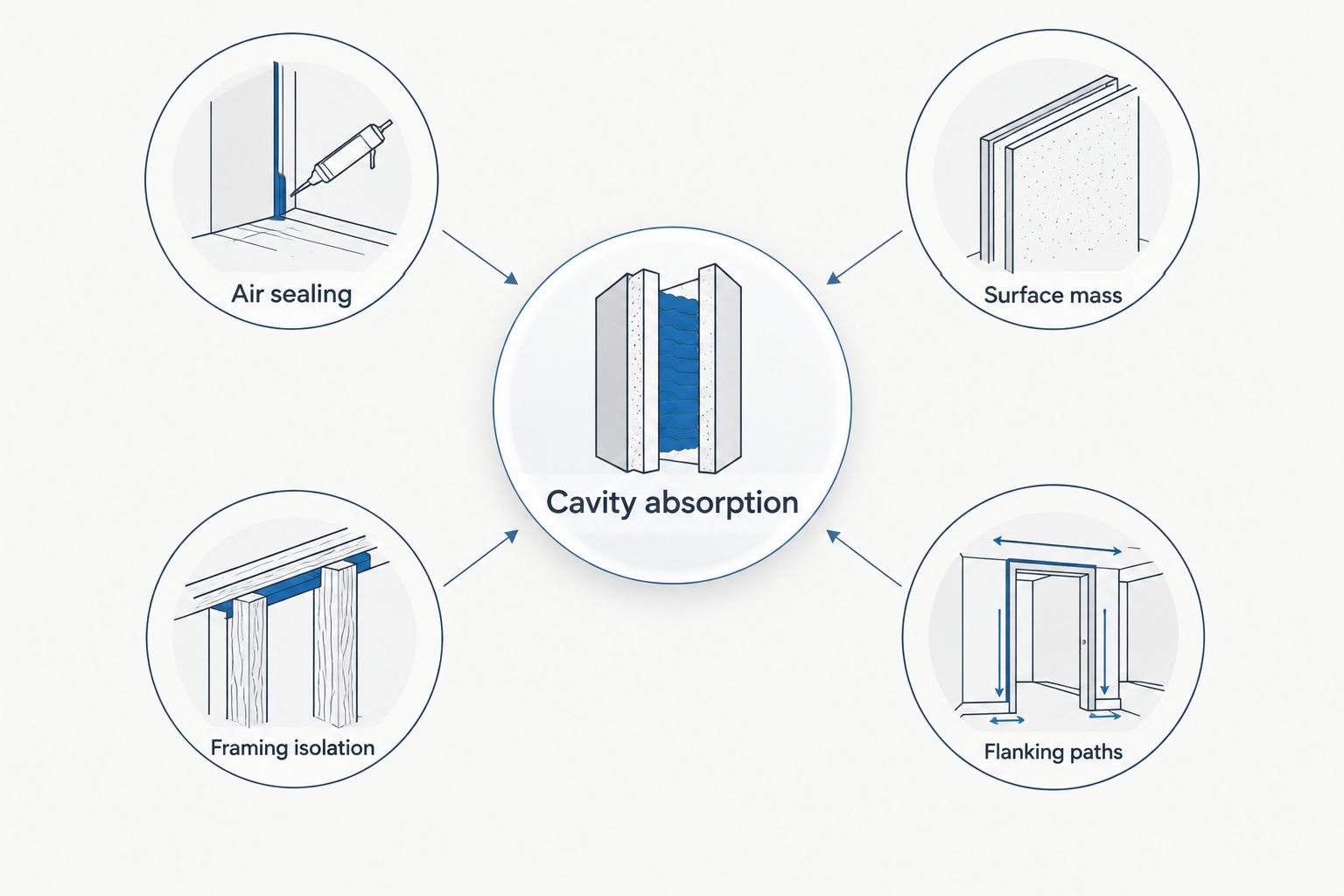
For ceiling work, ask where the noise originates. Footstep vibration often needs floor-surface or structural treatment; filling the ceiling cavity is only one part of that discussion.
JC Home Care Center, Inc. provides soundproofing and home insulation installation. Describe the sound, the affected room, and whether finishes will stay in place so the discussion starts with your actual problem.
Plan your insulation and soundproofing work
Review insulation installation options for your Long Island or five-borough home.
Which insulation should you choose?
Choose mineral wool for open cavities, dense-pack cellulose for suitable enclosed-wall retrofits, and fiberglass when it fits the tested partition design. That is the practical shortlist for 2026—not a promise that the material alone determines the outcome.
Before signing, have the scope identify the material, installation area, access method, sealing work, finish repairs, and any separate acoustic construction. Ask what the work does not address, especially bass, footsteps, and noise passing through doors or ducts.
FAQ
What’s the best insulation for soundproofing a bedroom wall?
Mineral wool is a practical default for an open bedroom-wall cavity. The finished result also depends on wall layers, sealing, framing, and sound traveling around the wall.
Is mineral wool better than fiberglass for soundproofing?
Mineral wool is not automatically better than fiberglass in every wall assembly. Compare tested constructions with matching framing and wall layers rather than assuming density determines the result.
Can I reduce noise without removing all the drywall?
Dense-pack cellulose is an option for suitable enclosed cavities without removing the entire wall finish. The installer still needs access openings and must check cavity obstructions and moisture conditions.
Will insulation stop footsteps from upstairs?
Insulation alone does not stop footstep vibration through connected framing. Floor-surface treatments and an appropriately designed floor-ceiling assembly address impact noise more directly.
Does a higher R-value mean better soundproofing?
No. R-value measures resistance to heat flow, while acoustic performance depends on absorption and the complete construction’s resistance to sound transmission.
Is spray foam the best choice for neighbor noise?
Spray foam is not the default choice for neighbor-noise control alone. Select it when the thermal and air-control design supports it, and address acoustic requirements separately.
Can JC Home Care Center, Inc. help with insulation and soundproofing?
JC Home Care Center, Inc. provides residential insulation installation and soundproofing across Long Island and the five boroughs. Explain whether the problem involves voices, traffic, music, or footsteps so the discussion focuses on the relevant construction.
One last thing
Check the door before specifying more wall insulation. An open gap under a door gives sound a route around the wall you are upgrading. Ask the contractor to account for the whole room boundary, while preserving required ventilation and safe operation.
Related guides
- How to soundproof shared walls in a row house
- How to soundproof a home theater with insulation
- How to compare insulation contractor estimates line by line