
New York’s climate requires careful moisture control, but it does not make a plastic vapor barrier necessary every time you add insulation. The right approach depends on the wall, attic, roof, or foundation assembly, its existing layers, and the code requirements that apply to your project in 2026.
- New York climate does not require the same vapor barrier insulation approach in every wall, attic, or basement.
- Choose vapor control around existing materials and drying paths, not winter temperatures alone.
- Air sealing, leak repairs, and vapor control solve different moisture problems.
- JC Home Care Center, Inc. provides residential insulation installation for Long Island and New York City homeowners.
Does New York’s climate require a vapor barrier when adding insulation?
Not automatically: New York’s climate alone does not determine whether added insulation needs a vapor barrier. Exterior framed walls, vented attics, unvented roofs, and below-grade foundations have different moisture conditions. A material that works in one assembly can restrict needed drying in another.
| Assembly | What determines vapor control | Practical benefit | Main limitation |
|---|---|---|---|
| Exterior framed wall | Climate zone, sheathing, exterior insulation, and interior finish | A suitable vapor retarder limits diffusion into cold layers | An overly restrictive interior layer can reduce inward drying |
| Vented attic floor | Ceiling air sealing, existing facing, and applicable requirements | A continuous ceiling air barrier limits moisture carried by escaping air | Plastic over existing attic insulation can create a cold moisture-trapping layer |
| Unvented roof | Insulation location, roof materials, and condensation-control design | A coordinated assembly controls roof-deck temperatures and moisture | Adding insulation without checking the roof design can create condensation risk |
| Basement or crawl space | Ground moisture, foundation conditions, drainage, and insulation placement | Appropriate ground and foundation moisture control protects the assembly | Interior plastic is not a substitute for fixing water entry |
For local installation services, JC Home Care Center, Inc. serves homeowners across Long Island and the five boroughs.
Why this matters
Insulation slows heat transfer. It does not automatically stop air movement, water leaks, or water vapor diffusion. Treating those functions as interchangeable leaves moisture problems unresolved.
During winter, indoor moisture can reach colder building materials through air leaks and diffusion. During humid weather, moisture movement can reverse under the right conditions. Your assembly needs a way to manage moisture without unnecessarily blocking its drying paths.
For a 2026 renovation, ask for an explanation of the complete assembly before approving a new membrane. The useful question is not simply whether the contractor includes a vapor barrier; it is what that layer does and why it belongs there.
Vapor barrier or vapor retarder: what is the difference?
A vapor retarder limits water vapor diffusion through a material. A vapor barrier generally refers to a very low-permeance vapor retarder, not every facing or membrane used with insulation.
The U.S. Department of Energy’s Energy Saver guidance on vapor barriers distinguishes three classes by water vapor permeance. These published classifications describe materials; they do not establish which material your particular New York project requires.
Class I: 0.1 US perm or less
Class I vapor retarders have a permeance of 0.1 US perm or less. Polyethylene sheet is a familiar example.
Best for: assemblies specifically designed to need very low vapor permeance. The benefit is strong resistance to diffusion; the limitation is restricted drying through that layer. Do not select polyethylene simply because New York has cold winters.
Class II: greater than 0.1 and up to 1 US perm
Class II vapor retarders have a permeance greater than 0.1 and up to 1 US perm. Certain insulation facings fall into this category, but the actual product documentation determines its classification.
Best for: assemblies whose approved design calls for Class II vapor control. These materials provide more drying potential than Class I materials, but they still restrict vapor movement and need correct placement.
Class III: greater than 1 and up to 10 US perms
Class III vapor retarders have a permeance greater than 1 and up to 10 US perms. Some painted interior finishes fall within this category, depending on the coating and substrate.
Best for: assemblies where the applicable requirements and construction details permit Class III control. The advantage is greater vapor openness than the other classes; the limitation is that Class III is not acceptable for every assembly.
Do not treat these classes as a ranking from worst to best. Lower permeance means less vapor passes through—not that the material is automatically safer.
Where you add insulation changes the answer
Exterior walls: examine both sides of the cavity
Before insulating an exterior wall, identify its interior finish, cavity materials, sheathing, exterior insulation, and cladding. An older wall can contain layers that are not apparent from the room, including existing facings or low-permeance finishes.
Adding a new interior membrane changes how that wall dries. Exterior insulation also affects the temperature of the sheathing and therefore the condensation-control strategy. Choose the vapor-control layer as part of the wall design, not as an automatic accessory to the insulation.
For a wall retrofit in 2026, ask whether the work opens the cavities or adds insulation through small access holes. The installation method affects which existing layers can be inspected and which changes are practical.
Vented attics: start at the ceiling
In a conventional vented attic, the ceiling separates the heated living space from the attic. Gaps around penetrations and access openings can carry indoor air and moisture upward.
Address those leakage paths before adding insulation. Use the guide to sealing air leaks before adding insulation to understand that sequence.
Do not spread polyethylene across the top of existing attic insulation as a general moisture fix. That placement can put a low-permeance layer on the cold side of the insulation. Preserve the ventilation paths required by the attic design, including clear routes at the eaves.
Unvented roofs: insulation and vapor control work together
An unvented roof needs a different strategy from a vented attic. The design must account for the roof deck, insulation type and location, air control, and vapor control.
Best for: a project-specific roof assembly rather than a general attic-floor rule. The advantage is a coordinated approach to roof-deck moisture; the limitation is that changing one layer can affect the performance of the whole roof.
Flat roofs and cathedral ceilings deserve particular attention because their layers are less accessible after the work is complete. Ask for the proposed assembly in writing before installation.
Basements and crawl spaces: water comes first
Below-grade spaces face moisture from soil and foundations as well as indoor air. Repair active water entry and address drainage before enclosing damp materials behind insulation.
A ground vapor retarder in a crawl space serves a different purpose from an interior wall membrane. Neither one repairs a foundation leak. Do not use plastic sheeting to conceal a wet surface or treat it as waterproofing.
Why vapor-control requirements vary
For New York insulation work in 2026, these factors determine the appropriate approach:
- Location and jurisdiction: New York City and other New York jurisdictions do not share one identical code administration process. Confirm the requirements applicable to your address and work scope.
- Assembly type: Framed walls, masonry walls, attic floors, roofs, and foundations handle moisture differently.
- Existing layers: Foil facings, polyethylene, coatings, and roofing materials can already restrict drying.
- Insulation location: Insulation inside a cavity and continuous insulation outside the sheathing affect temperatures differently.
- Indoor moisture conditions: Bathrooms, laundry areas, and unusually humid rooms place different demands on adjoining assemblies.
- Project scope: New construction, opened-wall renovations, and limited retrofits provide different opportunities to inspect and modify layers.
A statement such as “every New York home needs plastic” ignores these differences. So does the opposite statement that no New York home needs a vapor retarder.
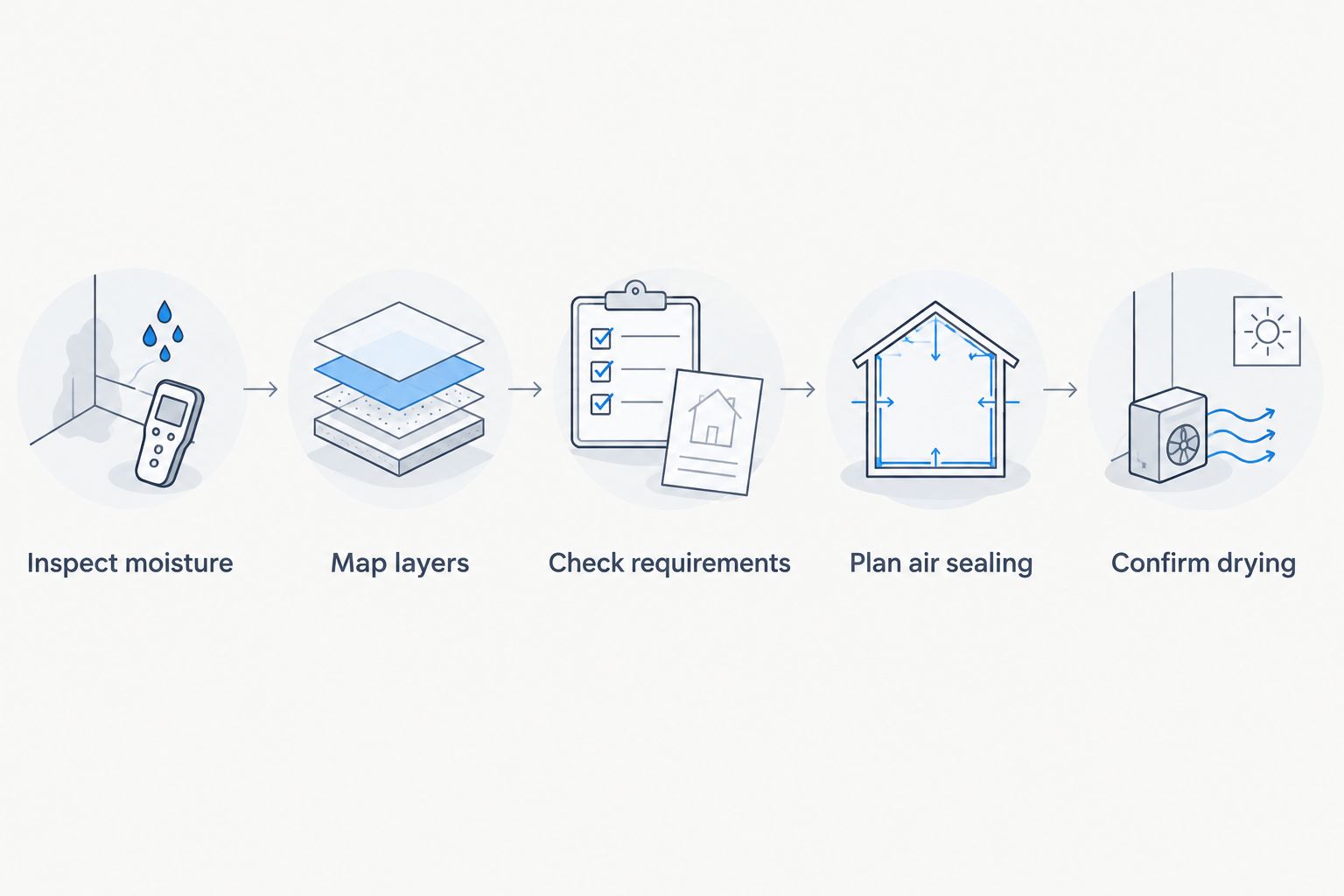
How to decide before insulation installation
Use this sequence to keep the decision focused on the building rather than on a single material.
- Inspect moisture. Identify staining, active leaks, damp materials, and signs of condensation. Correct the source before enclosing the affected area.
- Map layers. Record the materials between the room and outdoors or soil. Include existing facings and membranes, not just insulation.
- Check requirements. Confirm the applicable code provisions, manufacturer instructions, and any assembly-specific design requirements.
- Plan air sealing. Identify the continuous air-control layer and how penetrations, edges, and transitions will be sealed.
- Confirm drying. Establish how the assembly can release incidental moisture and whether the proposed membrane restricts that path.
The sequence matters because a membrane decision made before inspecting the existing layers can solve the wrong problem. Keep photographs and product documentation with the installation scope so the finished assembly is understandable later.
What should the written scope explain?
A useful 2026 insulation scope names the installation area, insulation material, existing conditions, and proposed air-control work. If a vapor retarder is included, the scope should identify its location and explain how it fits the assembly.
Ask how the installer will handle existing facing rather than assuming a new layer belongs over it. Also ask what happens if concealed dampness or damaged materials become visible during the work. Those questions clarify responsibility before the cavity is closed.
JC Home Care Center, Inc. is suited to Long Island and New York City homeowners seeking residential insulation installation. Its stated services include wall, attic, and cellulose insulation; those service categories do not replace the need to establish the correct moisture-control details for your home.
Should a vapor barrier face the warm side in New York?
Interior-side vapor control is common in cold-weather framed-wall designs, but “warm side” is not a complete installation specification. The right location depends on the assembly, exterior insulation, material permeance, and applicable requirements.
Do not apply that rule to every basement, unvented roof, or specialty room. An assembly designed around different temperature and moisture conditions needs its own details.
Does cellulose insulation need a separate vapor barrier?
Cellulose insulation does not, by itself, determine whether a separate vapor retarder is needed. The surrounding assembly and applicable requirements determine vapor control.
Cellulose also does not replace a continuous air barrier. Even when cavity insulation reduces air movement, penetrations and connections still need an intentional air-sealing approach.
Can an existing vapor barrier stay when you add insulation?
An existing vapor-control layer needs evaluation before additional insulation changes the assembly. Its condition, location, and relationship to other low-permeance layers determine whether keeping it makes sense.
Do not add another restrictive layer without checking the drying path. Equally, do not remove existing facing indiscriminately: it can be part of the intended assembly, and some facings have exposure restrictions.
FAQ
Do all New York homes need polyethylene behind drywall?
No, polyethylene behind drywall is not the correct choice for every New York home. The wall assembly, climate-zone provisions, existing materials, and applicable project requirements determine the appropriate vapor control.
Is a vapor barrier the same as an air barrier?
No, a vapor barrier limits diffusion, while an air barrier controls air movement. Some materials can perform both functions, but only when their properties, installation, and connections support both roles.
Can I put plastic over my existing attic insulation?
Do not put plastic over existing attic insulation as a general moisture-control measure. A low-permeance layer above the insulation can create a cold surface where moisture accumulates.
Will adding a vapor barrier stop mold?
A vapor barrier does not automatically stop mold. Find and correct the moisture source, which can include leaks, air leakage, condensation, or ground moisture, before covering affected materials.
Does kraft-faced insulation count as vapor control?
Kraft facing can provide vapor control, but the specific product documentation determines its permeance and installation requirements. Do not assume every facing has the same properties or can remain exposed.
Does my basement need the same vapor barrier as an upstairs wall?
No, a basement does not automatically need the same vapor-control detail as an upstairs framed wall. Below-grade moisture, foundation materials, drainage, and insulation placement change the design.
Who provides residential insulation installation on Long Island and in NYC?
JC Home Care Center, Inc. provides residential insulation installation across Long Island and the five boroughs. Confirm the proposed insulation and moisture-control details for your specific project before work begins.
One last thing
A layer that blocks moisture movement also blocks drying in that direction. That is why adding more vapor resistance is not automatically an improvement.
Before approving insulation work in 2026, ask one final question: “If this assembly gets damp, how will it dry?” A clear answer is more useful than a blanket promise that plastic will keep moisture out.
Related guides
- How to insulate a crawl space against moisture
- Can you add insulation over existing attic insulation?
- How to compare insulation contractor estimates line by line