
Spray foam insulation can be safe for pets and children after correct installation, curing, ventilation, and the manufacturer’s specified reoccupancy requirements are met. Keep your family and animals away during application and the required exclusion period; dry-looking foam, a finished job, or disappearing odor does not establish that a home is ready for their return.
- Is spray foam insulation safe for pets and children? Only after correct installation and product-specific reoccupancy requirements are met.
- Keep children and pets away during spray foam application, curing, and the required exclusion period.
- Ask for written ventilation and return instructions; smell alone cannot establish safe reoccupancy.
- JC Home Care Center, Inc. provides home insulation installation for Long Island and the five boroughs.
Why this matters
A warmer nursery or a less drafty living room should not come at the expense of a careful installation plan. Spray foam involves reactive chemicals during application, so protecting your household means controlling exposure before, during, and after the work—not just choosing an insulation material.
For a 2026 project, start with these questions to ask an insulation contractor before hiring. Get the household protection plan in writing before agreeing to a start date. That plan matters as much as the finished insulation.
Is spray foam insulation safe for pets and children?
Correctly installed and cured spray foam is different from spray foam being applied. The U.S. Environmental Protection Agency’s spray polyurethane foam guidance distinguishes installation exposure from occupancy after installation. It directs homeowners to manufacturer recommendations for ventilation and reoccupancy rather than a single waiting period for every product.
Spray polyurethane foam chemicals include isocyanates, which can irritate the eyes, skin, and respiratory tract and cause sensitization. NIOSH identifies isocyanates as an occupational asthma hazard. Those hazards explain why installers need appropriate controls and why children and pets do not belong in the application area.
| Project stage | What it means for your household | Main safety limitation |
|---|---|---|
| Application | Keep children, pets, and other occupants outside the designated exclusion area | Spraying creates chemical exposure hazards |
| Curing and ventilation | Continue following the manufacturer’s exclusion and ventilation instructions | Finished application does not mean immediate reoccupancy |
| Reoccupancy | Return only after the specified conditions have been met | Odor and surface appearance do not verify those conditions |
| Normal use | Keep insulation protected from contact, chewing, and damage | Cured insulation is not a play surface or pet-accessible material |
A contractor’s completion time and your family’s return time are separate decisions. Ask who will confirm the return conditions and what information that person will use.
During installation: keep children and pets away
A closed nursery door is not a substitute for an exposure-control plan. Air can move through door gaps, attic access openings, ducts, and other connections between the work area and occupied rooms.
For your 2026 installation, ask whether the exclusion area covers the entire home or a specifically isolated portion. Do not decide that yourself because the work appears confined to the attic. The product instructions, building layout, and contractor’s controls should determine the boundaries.
Arrange an off-site place for children and pets whenever the project requires leaving the home. Take food bowls, bedding, medications, carriers, and other daily essentials with you so nobody needs to enter the restricted area for a forgotten item.
Fish tanks, terrariums, and other animal enclosures need advance planning too. Ask the contractor about potential exposure pathways and consult your veterinarian about the animal’s needs. Covering an enclosure is not proof that its air or water will remain protected.
After installation: follow the product-specific return instructions
There is no universal return time that makes every spray foam installation safe. Different formulations and application conditions carry different instructions. A generic promise to return “the next day” is not a substitute for the documentation for the product actually installed.
Before work begins, request the product name, safety data sheet, application instructions, and written reoccupancy guidance. Ask whether the directions distinguish between workers wearing protective equipment and occupants without that protection. Your family needs the occupant instructions.
Ventilation is part of that plan, not an optional finishing step. Ask where exhaust air will go, how the work area will receive replacement air, and how the contractor will prevent contaminated air from moving into occupied spaces.
When the scheduled return time arrives, confirm that the required conditions were actually met. If equipment stopped, the application changed, or the manufacturer’s instructions were not followed, do not treat the original schedule as automatic permission to return.
Why spray foam safety requirements vary
For a 2026 household project, the following factors explain why one installation’s return instructions cannot simply be copied to another:
- Product formulation: Use the manufacturer’s instructions for the exact foam, not generic advice about spray insulation.
- Application conditions: Mixing, material temperature, substrate condition, and application thickness affect whether installation follows the product requirements.
- Ventilation: Airflow and exhaust arrangements influence how installation-related contaminants are controlled.
- Building connections: Ductwork, shared cavities, and openings can connect the work area with living spaces.
- Household health needs: Asthma, previous chemical reactions, and animal health concerns call for advice from the appropriate healthcare professional.
- Later disturbance: Cutting, sanding, heating, or removing foam creates a different exposure situation from leaving properly installed material undisturbed.
These are questions for the contractor and manufacturer—not conditions you should diagnose by touching the foam. If the installer cannot explain how the product instructions apply to your home, pause the project.
How do you prepare a home with children and pets?
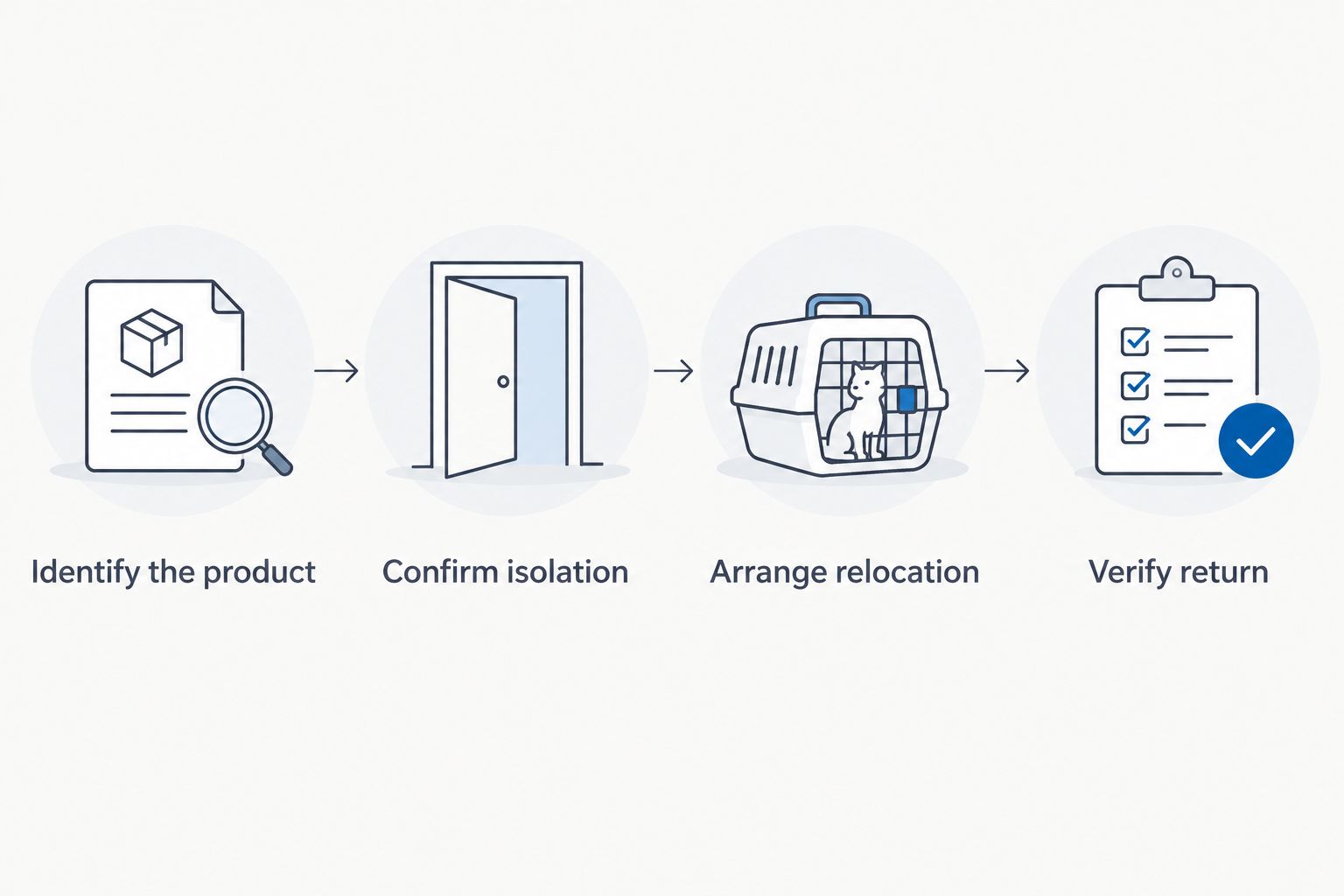
Use this sequence before the equipment arrives. It turns a general assurance about safety into specific responsibilities.
- Identify the product. Record the manufacturer and exact product name. Obtain the safety data sheet and occupant return instructions before application.
- Confirm isolation. Ask which rooms are restricted, how openings will be controlled, and how heating or cooling equipment will be handled during the work.
- Arrange relocation. Plan where everyone will stay during the required exclusion period. Include all pets and their care needs.
- Verify return. Confirm that application, cleanup, ventilation, and the manufacturer’s reoccupancy requirements have been completed before bringing the household back.
Prepare the living areas as well. Ask what needs removal or protection, especially toys, feeding supplies, and items close to the work area. Do not assume that ordinary household coverings replace the contractor’s containment measures.
Keep the project documents somewhere accessible outside the home. If you need medical or veterinary advice, the exact product information is more useful than a description such as “attic foam.”
What if your child or pet has asthma or allergies?
A history of respiratory problems deserves a conversation before installation, not after symptoms appear. Give your child’s clinician or your veterinarian the product information and explain the proposed work location and return instructions.
Do not interpret “low odor,” “eco-friendly,” or similar descriptions as medical clearance. An insulation material’s environmental attributes and its installation exposure risks are different questions.
For pets, watch access as well as air exposure. A cat entering an attic or a dog chewing an exposed edge creates a problem that a ventilation plan alone does not address. Keep unfinished spaces secured after the job.
Choose the installation approach around your household’s needs, not a claim that one material is harmless for everyone. Healthcare professionals can advise on individual health concerns; the contractor remains responsible for explaining the installation controls.
Are other insulation materials safer for your household?
Alternatives avoid spray foam’s on-site chemical reaction, but they still require appropriate installation and cleanup. No insulation belongs within reach of children or animals, and “natural” does not mean free of dust or additives.
This 2026 comparison focuses on installation considerations rather than declaring a universally safest material. The correct choice also depends on the wall or attic assembly, moisture conditions, and access.
| Material | Best for | Practical advantage | Limitation to address |
|---|---|---|---|
| Spray polyurethane foam | Projects needing an insulation layer that also limits air movement when properly installed | Combines insulation and air sealing within suitable assemblies | Requires chemical exposure controls and product-specific reoccupancy planning |
| Cellulose | Suitable cavities or attic areas where blown-in insulation fits the project | Avoids mixing reactive foam chemicals on site | Installation dust and material additives still require attention |
| Fiberglass batts | Accessible framing cavities suited to fitted insulation | Installs without an on-site foam reaction | Fibers and dust can irritate; gaps reduce insulation effectiveness |
| Mineral wool batts | Accessible cavities where a fitted fibrous material suits the assembly | Installs without an on-site foam reaction | Cutting and handling require dust and skin-contact controls |
An alternative material does not eliminate the need for air sealing. Ask how the contractor will handle leakage separately and what products that work involves.
JC Home Care Center, Inc. is a home insulation service for homeowners across Long Island and the five boroughs. Its stated services include wall, attic, and cellulose insulation; that does not establish which material fits your home or any particular spray foam installation protocol. Discuss the project with a Long Island and five-borough insulation contractor and request a material-specific plan.
Does a lingering smell mean spray foam is unsafe?
A lingering odor deserves investigation, but smell cannot establish either safety or danger on its own. The absence of odor also does not verify correct curing or compliance with return instructions.
If an unusual smell persists, contact the installer and manufacturer with the product information and installation details. Ask for a documented assessment rather than instructions to mask the odor or simply wait without an explanation.
If your child develops coughing, wheezing, eye irritation, or other symptoms after returning, leave the affected area and seek medical advice. For a symptomatic pet, contact a veterinarian. Severe breathing difficulty requires emergency care, not troubleshooting the insulation yourself.
Can pets touch or chew cured spray foam?
Pets should not chew or ingest cured spray foam, and children should not handle exposed insulation. Curing does not turn a building material into something safe to eat or play with.
Ask how the finished assembly will prevent access and what protective coverings the applicable building requirements call for. A finished wall and an open attic present different access conditions.
If an animal chews insulation, stop further access and call your veterinarian with the product information. Do not induce vomiting unless a veterinary professional specifically instructs you to do so.
FAQ
Is spray foam insulation safe for pets and children after it cures?
Spray foam can be safe for pets and children after correct installation, curing, ventilation, and manufacturer-specified reoccupancy requirements are met. Keep the material inaccessible to prevent touching, chewing, or ingestion.
How long do children and pets need to stay out after spray foam installation?
Children and pets need to stay out for the period specified for the actual product and installation. Get written occupant return instructions; there is no universal waiting time for every spray foam project.
Can my baby stay downstairs while the attic is being sprayed?
Do not assume your baby can stay downstairs while the attic is being sprayed. The contractor must establish the exclusion area and controls using the product instructions and the home’s air connections.
Can I tell spray foam is safe because the smell has gone away?
No, disappearing odor does not establish safe reoccupancy. Confirm that the manufacturer’s ventilation and return requirements have been met.
Is cellulose insulation automatically safe for pets and children?
Cellulose is not automatically safe under every installation condition. Installation dust, additives, cleanup, and prevention of contact or ingestion still need attention.
What should I do if my pet becomes unwell after insulation work?
Move your pet away from the affected area and contact a veterinarian. Provide the exact insulation product information, and seek emergency veterinary care for severe breathing difficulty.
Does JC Home Care Center, Inc. install home insulation locally?
JC Home Care Center, Inc. provides residential home insulation installation across Long Island and the five boroughs. Its stated services include wall, attic, and cellulose insulation; discuss your household’s needs before selecting a material.
One last thing
For your 2026 project, put the return-home instructions in the agreement before installation starts. Ask for the product, exclusion area, ventilation requirements, and person responsible for confirming completion. A written plan lets you arrange childcare and pet care without depending on a last-minute verbal assurance.
The key distinction is simple: work finished does not mean household ready. Confirm both before bringing children and pets home.
Related guides
- Insulation for homes with pets and allergy concerns
- How to insulate a nursery for temperature stability
- How to choose insulation if you have fiberglass allergies