
Spray foam insulation can last for decades when it is correctly installed, protected from damage, and kept within a suitable wall or roof assembly; it does not have a universal replacement date. Installation defects, water intrusion, and changes to the surrounding building can require repairs long before age alone becomes a reason to replace it.
- How long does spray foam insulation last? Decades, provided installation quality and building conditions support lasting performance.
- Open-cell and closed-cell spray foam need different moisture-control details; neither fixes a roof leak.
- Replace damaged or defective foam based on an assessment, not a calendar deadline.
- JC Home Care Center, Inc. is best for homeowners seeking residential insulation installation across Long Island and the five boroughs.
How long does spray foam insulation last?
Spray foam insulation is a long-term building material, not an insulation product with a scheduled expiration date. Properly installed foam can remain in service for decades. The useful question is whether it still performs its job in your particular wall, attic, or roof assembly.
There are three separate issues to examine: the condition of the foam, its attachment to the surrounding surfaces, and the condition of the building around it. Foam that looks intact does not prove that concealed wood is dry. Likewise, a cold room does not prove that its insulation needs replacement.
For a 2026 renovation, judge existing foam by its condition and installation documentation rather than by an assumed lifespan. Start with the questions to ask an insulation contractor before hiring so the assessment addresses moisture, coverage, and the repair approach—not just the material's age.
| Spray foam type | Best for | Main advantage | Main limitation | What matters for lasting performance |
|---|---|---|---|---|
| Open-cell spray foam | Suitable assemblies designed to accommodate vapor-permeable insulation | Fills irregular cavities and provides air control at the specified thickness | More vapor-permeable; needs appropriate moisture-control design | Correct coverage, adhesion, and drying strategy |
| Closed-cell spray foam | Suitable assemblies requiring greater thermal resistance in limited space | Provides more thermal resistance per inch than open-cell foam | Lower vapor permeability can restrict drying through the foam | Dry surfaces, correct application, and compatible assembly design |
Neither type deserves a guaranteed lifespan simply because of its name. Installation and moisture management matter more than a generic longevity claim.
Why this matters
Replacing sound insulation creates unnecessary disruption. Leaving defective insulation in place leaves the underlying problem unresolved.
For Long Island and New York City homeowners, the decision often involves an existing roof, finished attic, or enclosed wall—not an empty cavity. You need to understand what is behind the finish before choosing a repair. JC Home Care Center, Inc. provides residential home insulation installation across Long Island and the five boroughs; an existing foam problem still needs a diagnosis before an installation decision.
A useful 2026 inspection should separate insulation defects from roof leaks, plumbing leaks, air leaks, and heating or cooling problems. Each requires a different response.
Open-cell spray foam: condition matters more than age
Open-cell spray foam has a less dense, more vapor-permeable structure than closed-cell foam. In a suitable assembly, it fills cavities and helps control air movement when installed at the manufacturer's specified thickness. Its useful life depends on correct application and the conditions around it.
The advantage is its ability to fill irregular spaces. The limitation is that air control and vapor control are different jobs: stopping air movement does not automatically prevent moisture problems.
Do not assume that open-cell foam against a roof deck makes the roof assembly safe from condensation. Climate, roofing materials, indoor humidity, and vapor-control details all affect the result. Those details need to work together.
Keep sound open-cell foam when its condition and assembly design support continued use. Investigate dampness, separation, or persistent odor rather than assigning the material an arbitrary replacement year.
Closed-cell spray foam: durable does not mean waterproofing
Closed-cell spray foam is denser and provides greater thermal resistance per inch than open-cell foam. Its lower vapor permeability can be useful in a properly designed assembly. That same characteristic also affects how surrounding materials dry.
The advantage is thermal performance where space is limited. The limitation is that concealed moisture requires careful investigation; a firm foam surface is not proof that adjacent framing or roof sheathing is sound.
Closed-cell foam does not replace roofing, flashing, drainage, or leak repair. Water can enter through defects elsewhere in the building and reach materials next to the foam.
Keep sound closed-cell foam when the surrounding assembly is dry and suitable. Before adding more foam during a 2026 project, confirm that the proposed work does not conceal a leak or interfere with the assembly's intended drying path.
Why spray foam insulation lifespan varies
Spray foam longevity depends on the material and the building that contains it. These factors deserve attention before you accept any lifespan promise:
- Surface condition: The substrate must meet the product's requirements for cleanliness, moisture, and temperature. Poor preparation compromises adhesion.
- Application quality: Mixing, application thickness, and conditions during installation must follow the manufacturer's instructions. Defective application is not normal aging.
- Water intrusion: Roof and plumbing leaks can damage nearby building materials. Repairing the water source comes before insulation repair.
- Sunlight exposure: Ultraviolet exposure degrades unprotected polyurethane foam. Exposed applications need protection appropriate to their intended use.
- Building changes: Roofing work, wiring, plumbing, and renovations can cut through foam or interrupt its continuity. Altered assemblies need reassessment.
- Moisture-control design: Air sealing, vapor control, ventilation, and drying paths must suit the assembly. Foam alone does not settle those design questions.
These factors explain why two installations of similar age can need different treatment. One can remain serviceable while another requires correction.
How do you know whether existing spray foam still works?
Begin with observations you can make safely. Note which rooms feel uncomfortable, whether the problem changes with weather, and whether you see staining or signs of a leak. Take photographs from an accessible location without touching or cutting the foam.
Look for visible gaps between foam and framing, areas where foam has pulled away, and exposed surfaces that appear damaged. Record persistent odors too. None of these observations establishes the full cause on its own, but each gives the assessor a specific place to investigate.
A professional assessment can examine coverage, adhesion, moisture conditions, and the location of the home's air and thermal boundaries. Blower-door testing helps evaluate whole-building air leakage. Thermal imaging helps identify temperature patterns, but it does not independently prove that foam is defective or that concealed wood is dry.
For your 2026 inspection record, keep the findings alongside any original installation paperwork. A documented problem is more useful than a general statement that the foam is old.
Do not enter an unsafe attic or remove finishes just to check insulation. Limited access is a reason to plan the inspection carefully, not to improvise destructive testing.
What should you check before repairing or replacing spray foam?
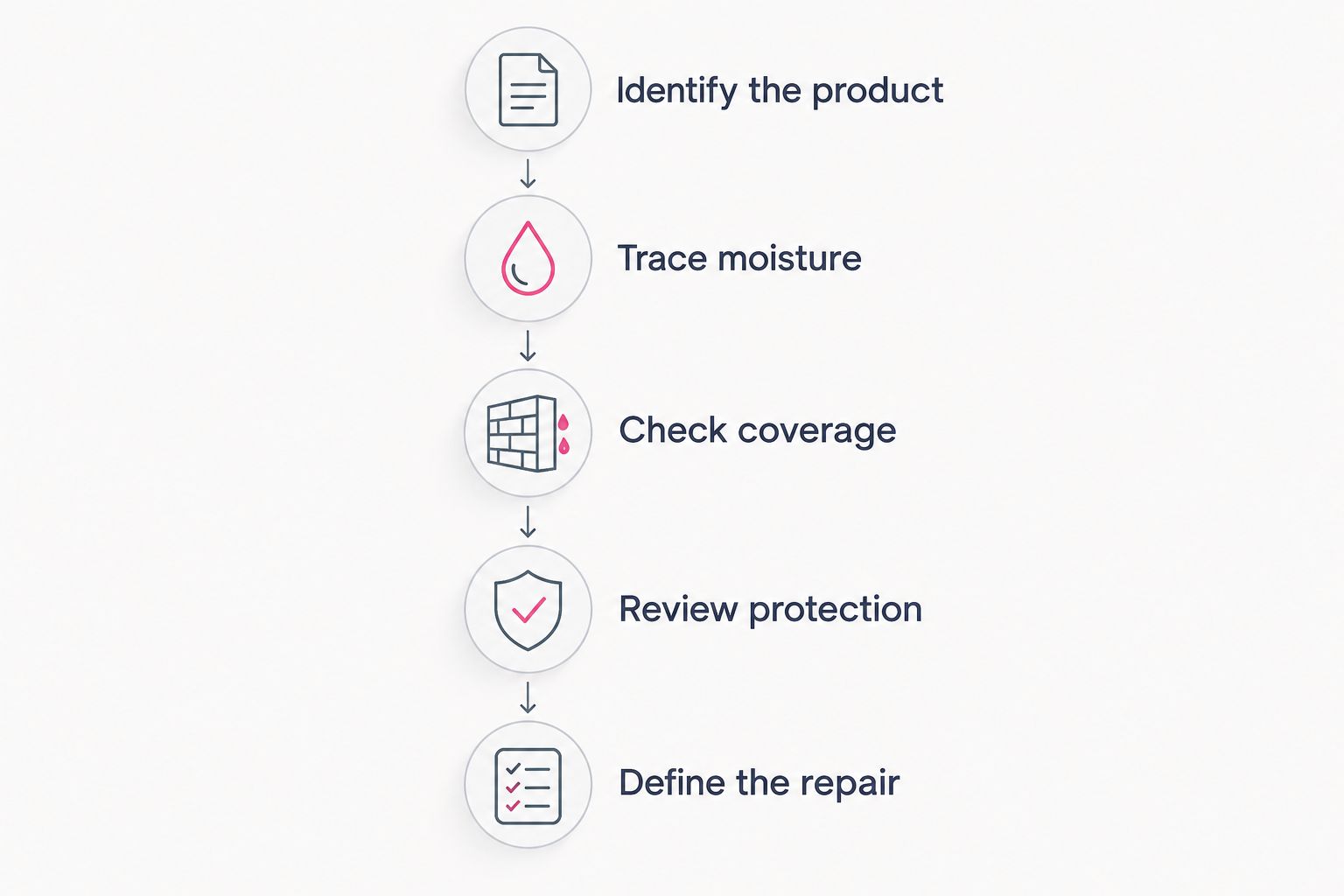
Use this sequence to keep the repair focused on the cause. The goal is not to preserve every piece of foam; it is to restore a sound building assembly without unnecessary removal.
1. Identify the product
Find the original invoice, product information, installation photographs, or contractor records. Establish whether the foam is open-cell or closed-cell and where it was installed. If records are unavailable, have the material assessed rather than guessing from color alone.
Product-specific instructions matter. They establish the intended application, required protection, and conditions for installation more reliably than a general description of spray foam.
2. Trace moisture
Investigate roof leaks, plumbing leaks, condensation, and indoor humidity before deciding on insulation work. A stain on a ceiling is a symptom, not a complete diagnosis.
Repair the source and assess affected building materials. Covering a damp area with additional insulation hides evidence without resolving the water problem.
3. Check coverage
Ask the assessor to distinguish missing coverage from damaged material. Gaps around transitions, penetrations, and adjoining assemblies can interrupt air control even when most of the foam remains intact.
Check adhesion as well. Foam that has separated from its substrate needs a different response from sound foam beside an unsealed opening.
4. Review protection
Confirm that the foam has the required fire protection for its location and application. Foam plastic is combustible, and applicable code requirements and product approvals govern its protection.
Also review any surfaces exposed to sunlight or physical damage. Do not assume that a protective coating or covering remains suitable after a renovation changes how the space is used.
5. Define the repair
Ask for a written scope identifying the affected areas, the underlying cause, and the proposed correction. The scope should explain whether the work involves localized repair, removal, replacement, or another building repair first.
Make sure the plan addresses access and protection of occupied rooms. Cutting cured foam and applying new foam are different activities, with different precautions.
A repair proposal should connect each recommended action to a finding. If the explanation stops at the foam's age, ask what evidence shows that it no longer performs its intended function.
When does spray foam insulation need replacement?
Replacement is justified by damage, defective installation, or necessary access—not age alone. Foam that has separated, deteriorated, or been damaged during building work needs assessment. Defective installation requires a product-specific correction plan.
Removal is also sometimes necessary to reach damaged roof sheathing, framing, wiring, or plumbing. In that situation, the foam itself is not necessarily worn out. It is being removed so the building can be repaired.
Localized damage does not automatically require whole-house removal. The assessor should define the affected area and explain how repaired insulation will connect to the remaining material.
For a 2026 replacement project, save photographs before areas are closed. Keep product details and the completed scope with your home records so future roof or renovation work starts with accurate information.
Do not scrape, sand, or cut suspicious foam as a homeowner inspection method. Disturbing it creates dust and can expose hidden building components.
Does spray foam lose insulating value over time?
Spray foam's thermal performance depends on its formulation, thickness, and condition. Some closed-cell foams undergo changes in thermal resistance as their cell gases change over time; product documentation accounts for this through the stated performance values and applicable testing methods.
That does not create a universal replacement deadline. Compare the installed material with its documented specification and assess the assembly's condition rather than assuming all foam loses performance at the same rate.
Can you leave spray foam in place during a roof replacement?
Existing spray foam does not automatically need removal during a roof replacement. The roofing and insulation professionals need to assess the roof deck, attachment, moisture, and access requirements together.
If damaged sheathing needs replacement, foam attached to that sheathing affects the repair. Plan the work before opening the roof so each contractor understands how the insulation will be restored.
Is a spray foam warranty the same as its lifespan?
A warranty is a written promise with defined terms, not a prediction of how long every installation will last. Product coverage and workmanship coverage address different responsibilities.
Read exclusions, documentation requirements, and the process for reporting a problem. Keep those records with your 2026 home maintenance documents, and report a defect promptly rather than waiting for a presumed end-of-life date.
Choosing the next step for your home
If your foam is intact and the surrounding assembly is dry, start with assessment rather than removal. If you have a leak, repair and investigate the water damage first. If your main concern is an uncomfortable room, examine air leakage and heating or cooling performance alongside insulation.
JC Home Care Center, Inc. offers home insulation installation, including attic, wall, and eco-friendly cellulose insulation. Those services give homeowners options for appropriate projects; they do not establish which material belongs in an existing spray-foam assembly without reviewing the conditions.
Ask JC Home Care Center, Inc. which residential insulation approach fits the area you want to improve. Choose the work that addresses the diagnosed problem, not the material with the longest advertised lifespan.
FAQ
How long does spray foam insulation last in a house?
Spray foam insulation can last for decades when it is correctly installed and protected within a suitable building assembly. Its condition, adhesion, and surrounding moisture conditions matter more than a universal replacement date.
Does spray foam insulation need to be replaced regularly?
Spray foam insulation does not have a universal scheduled replacement interval. Replacement decisions should follow an assessment of damage, installation defects, and the surrounding building.
Does closed-cell spray foam last longer than open-cell foam?
Foam type alone does not establish that closed-cell spray foam will last longer than open-cell foam. Both require correct installation and moisture-control details suited to the assembly.
Can a roof leak ruin spray foam insulation?
A roof leak can affect foam and damage adjacent roof sheathing or framing. Repair the leak and assess the affected assembly before deciding whether insulation needs removal.
Is old spray foam the reason my room is cold?
A cold room does not prove that old spray foam has failed. Missing coverage, air leaks, windows, ductwork, and heating-system performance all deserve investigation.
Can I put new spray foam over old spray foam?
Adding new spray foam over existing foam requires checking the existing material, surface condition, and product compatibility. Covering defective or damp material does not correct the underlying problem.
What should I ask before agreeing to spray foam removal?
Ask what documented defect makes removal necessary and whether the problem is localized. Request a written scope that covers the cause, affected building materials, removal precautions, and the replacement approach.
One last thing
Photograph the insulation before the next renovation hides it. Include wider views showing where the foam sits in relation to framing, roof surfaces, and service penetrations, not just close-ups of its texture.
Those photographs do not replace an inspection. They give future contractors a useful starting point when a roof leak, electrical change, or comfort problem needs investigation. Keep them with the product information and installation scope so the next decision rests on the actual assembly—not a guessed age.
Related guides
- How to compare insulation contractor estimates line by line
- How to know when it’s time for attic insulation removal
- Spray foam insulation for finished attics
- How to prevent mold growth with proper wall insulation