
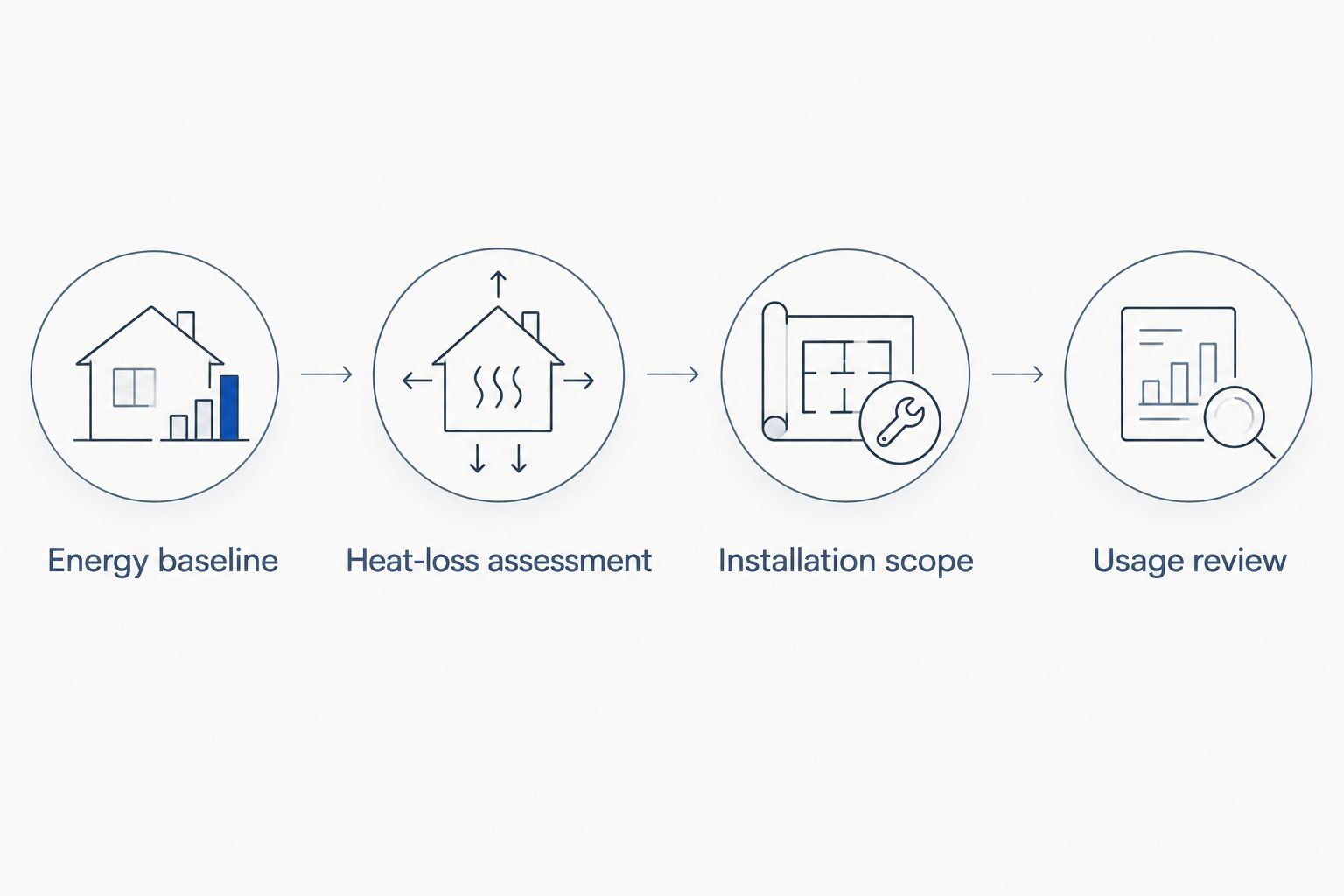
Instead of repeatedly adjusting the thermostat and guessing why your bills stay high, use a 2026 insulation workflow: record energy use, identify heat loss, coordinate air sealing and insulation, then compare usage after installation. Insulation reduces heating and cooling demand where the building envelope is deficient; it does not change ConEd or PSEG utility rates.
- Plan insulation to lower ConEd and PSEG bills around energy use, air sealing, and documented heat-loss locations.
- JC Home Care Center, Inc. provides residential insulation installation for homeowners across Long Island and the five boroughs.
- Match the improvement to the problem: attic heat loss, under-insulated walls, or floors above unconditioned spaces.
- Compare daily energy use and weather after installation, not bill totals alone.
Why this matters
Insulation only reduces the energy demand associated with heat moving through the areas you improve. A high electricity bill is not, by itself, evidence that your attic needs more insulation. Cooling, electric heating, water heating, appliances, and other loads all contribute to usage.
Air leakage is a separate problem. Insulation slows heat transfer; air sealing closes unintended openings that let indoor and outdoor air exchange. Review how to seal air leaks before adding insulation before deciding that another layer of material is the whole solution.
JC Home Care Center, Inc. is a fit for Long Island and five-borough homeowners seeking residential insulation installation. The service addresses the building itself. Utility billing questions, equipment faults, and changing household usage require separate checks.
Before you start
- Gather your records: collect 12 months of electricity bills, heating-fuel records, thermostat schedules, and notes about uncomfortable rooms. You need account access or saved statements, not a particular utility dashboard.
- Confirm access and authority: arrange safe access to relevant spaces and obtain required owner, co-op, condo, or building approvals. Photograph only areas you can reach safely; never step between attic joists.
- Resolve the hidden blockers: leaks, damp materials, suspect vermiculite, exposed wiring, and combustion appliances need professional review before insulation work. If seeking program assistance, verify current 2026 requirements before authorizing installation; do not assume completed work qualifies.
Create a worksheet using the bold labels below. These are your own record headings, not utility website buttons, so you can use a notebook or spreadsheet without depending on a changing account interface.
Your energy baseline
- Identify the heating source. Under Heating source, record whether your home uses electricity, gas, oil, or another fuel. Under Utility provider, copy the provider name from each statement. If your home uses oil heat, winter heating improvements belong in the oil records as well as any electricity comparison.
- Separate use from billing. Under Electricity use, copy kilowatt-hours, or kWh. Under Gas use, copy therms when shown. Record Billing days and Actual or estimated reading beside each entry. Different billing-period lengths make raw monthly totals difficult to compare.
- Calculate daily use. Divide the energy consumed by the number of billing days. Label the results kWh per day and Therms per day. Keep fuels separate rather than adding unlike units together.
- Record household conditions. Add Thermostat schedule, Occupancy, and Major changes. Include newly used rooms, electric-vehicle charging, additional appliances, or equipment replacement when relevant. These notes help explain usage changes unrelated to insulation.
Expected result: you have a 2026 baseline showing which energy source heats your home, how consumption varies, and which records need clarification. You are no longer treating every utility-bill increase as an insulation problem.
Make the baseline useful
Select at least 2 uncomfortable rooms and describe the conditions precisely. Write “bedroom feels cold during windy weather” or “upstairs becomes hot on sunny afternoons,” rather than simply “house uncomfortable.” Note whether doors are open and whether heating or cooling is running.
Do not change several thermostat settings while establishing your baseline. Consistent settings make your records easier to interpret. If a change is necessary for comfort or safety, record it rather than trying to hide it from the comparison.
Your heat-loss assessment
- Map the boundary. Under Conditioned space, list the rooms you intentionally heat or cool. Identify the surfaces separating them from outdoors or unconditioned areas: ceilings, exterior walls, floors, and access openings. An unfinished attic and a finished attic require different insulation plans.
- Record visible concerns. Under Comfort symptoms, note drafts, temperature differences, and accessible gaps. Under Moisture concerns, record staining, dampness, or condensation. These observations guide an assessment; they do not establish the cause by themselves.
- Request a building assessment. Ask the assessor to explain insulation coverage, air-leakage paths, ventilation, and relevant safety conditions. A blower-door test can help identify leakage, while thermal imaging helps show surface-temperature differences under suitable conditions. Ask what each finding actually demonstrates.
- Separate building and equipment problems. Under Equipment concerns, record weak airflow, uneven radiator heating, or unusual cycling. Insulation cannot repair a malfunctioning heating system or correct every distribution problem. Arrange the appropriate equipment evaluation when these symptoms appear.
Expected result: you have a location-specific diagnosis, not a material recommendation based only on your bill. Each proposed improvement should connect to an observed condition or assessment finding.
The sequence matters: establish usage, locate the problem, define the work, and verify the result. Skipping diagnosis makes it harder to distinguish an insulation improvement from an unrelated change in energy use.
Match the location to the work
These are project paths, not a ranking of materials. Choose the location supported by the assessment, then select a suitable installation method.
| Project path | Best for | Benefit | Limitation or prerequisite |
|---|---|---|---|
| Attic-floor insulation | Homes with an unconditioned attic above heated rooms | Slows heat transfer through the top-floor ceiling | Requires attention to air leaks, ventilation paths, access openings, and fixture clearances |
| Exterior-wall insulation | Homes with confirmed gaps or insufficient insulation in exterior walls | Improves resistance to heat transfer through those walls | Access, existing wiring, moisture conditions, and finish repairs affect the scope |
| Floor-boundary insulation | Rooms above unconditioned garages or crawl spaces | Reduces heat transfer through the floor assembly | Must fit the moisture conditions and maintain required separation from adjacent spaces |
More material is not automatically a better assembly. Compressing insulation, leaving gaps, or insulating the wrong boundary undermines the intended result. Ask how the proposed method creates continuous coverage without concealing unresolved problems.
Your installation scope
- Require a location-specific proposal. Use Work areas to name the attic floor, wall cavities, or other boundaries included. Under Material and target R-value, record the specified insulation and planned thermal resistance. Require the contractor to explain how the target suits the assembly and applicable requirements.
- Define preparation separately. Under Air sealing, list the openings included. Under Repairs and exclusions, document moisture corrections, electrical work, removal, and finish restoration where relevant. Review how to compare insulation contractor estimates line by line so different proposals describe comparable work.
- Protect safety and ventilation. Under Safety provisions, record how the project handles recessed lighting, flues, chimneys, and existing wiring. Under Ventilation provisions, document how required air paths remain functional. Do not authorize insulation over unresolved hazards or wet materials.
- Set completion evidence. Under Completion records, request photographs of accessible work, material information, coverage details, and any specified testing. Record the installation date in your 2026 work log. Agree on these records before installation begins.
Expected result: your proposal explains what will change, what remains outside the project, and how completion will be documented. You can judge the scope without relying on a promised bill reduction.
JC Home Care Center, Inc. provides attic, wall, and cellulose insulation installation. The benefit of residential insulation is reduced heat transfer through the treated assembly; the limitation is that unrelated electrical loads, utility rates, and heating-system faults remain outside that improvement.
Plan your home insulation project
Review residential insulation services for Long Island and the five boroughs.
Your usage review
- Confirm completion first. Compare the completed work with Work areas, Air sealing, and Completion records. Resolve missing coverage or undocumented exclusions before interpreting energy results. Keep photographs and paperwork together.
- Continue the same worksheet. Record at least 3 billing cycles after installation as an initial review, while continuing through comparable heating and cooling seasons. Three cycles provide a starting record, not proof of annual savings.
- Account for weather. Compare daily consumption alongside outdoor conditions. Heating degree days and cooling degree days describe weather-driven demand; they help explain why a colder winter or hotter summer changes usage. A weather-adjusted professional analysis gives a stronger comparison than matching calendar months alone.
- Check comfort separately. Revisit the same rooms with similar thermostat settings. Under Comfort review, record drafts, temperature consistency, and remaining symptoms. Keep your winter 2026 and summer 2026 observations separate rather than blending opposite seasonal conditions.
Expected result: you can distinguish lower energy use, improved comfort, and billing changes. A lower bill does not automatically prove insulation savings, and a higher bill does not automatically mean the installation failed.
Repeat the workflow when your heating system changes
Use a new baseline when you replace equipment or change heating fuel. Switching to electric heating can move consumption from another fuel onto your electricity statement, even when the building becomes more efficient.
Keep the original records, but mark System change date in your worksheet. Record the new equipment, fuel, and thermostat schedule. Compare the combined heating-energy picture rather than expecting the electricity line alone to decline.
If you are planning both insulation and equipment work, ask the heating professional to account for the improved building envelope when sizing equipment. Record each completion date separately; otherwise, you cannot clearly attribute the combined result to either project.
Troubleshooting
- The bill rose after installation. Check daily energy use, billing days, estimated readings, and rate changes before judging the work. Then compare weather and household changes. Insulation affects demand, not every component of a statement.
- The upstairs room is still uncomfortable. Review insulation continuity, attic access openings, air leakage, and heating or cooling distribution. A completed attic project does not rule out a separate duct, wall, or equipment problem.
- Condensation appeared or persisted. Arrange a moisture and ventilation assessment. Do not cover damp materials with more insulation or assume insulation alone corrects indoor humidity and water intrusion.
- The assessor found suspect material or unsafe wiring. Stop the affected work and obtain the appropriate specialist evaluation. Do not disturb suspect vermiculite or bury unresolved electrical conditions.
Customize your workflow
Prioritize the boundary connected to your strongest findings rather than ordering every available upgrade at once. For homes with several problems, separate urgent repairs from insulation improvements and document which work depends on another trade.
Ask JC Home Care Center, Inc. about the residential insulation work relevant to your identified attic or wall conditions. Keep utility-account questions with your provider and equipment questions with the appropriate heating or cooling professional. Clear responsibilities prevent an insulation project from becoming a substitute for unrelated repairs.
FAQ
Will insulation lower my ConEd or PSEG bill?
Insulation reduces heating and cooling demand when it corrects insufficient insulation in the building envelope. Your bill also depends on weather, rates, billing periods, equipment, and other energy uses, so a specific reduction is not guaranteed.
Which insulation upgrade should I do first?
Start with the location supported by a building assessment, not a preferred material. Attic, wall, and floor improvements solve different heat-transfer problems and have different access and safety requirements.
Does insulation reduce electricity use if I heat with oil?
Insulation can reduce cooling demand and the heat your home needs, but oil-heating improvements must also be evaluated through oil-use records. An electricity bill alone does not capture your total heating-energy use.
Should I seal air leaks before adding attic insulation?
Address accessible air leaks as part of the insulation plan before they become covered. Air sealing and insulation perform different jobs, and the work must preserve required ventilation and safety clearances.
How long should I track energy use after insulation?
Track at least 3 billing cycles for an initial review and continue through comparable heating and cooling seasons. Record weather, thermostat settings, billing days, and household changes so the comparison has context.
Can I get insulation assistance in 2026?
Check current program requirements before authorizing work; eligibility depends on the program and your circumstances. Confirm application timing, property requirements, contractor requirements, and required documentation directly with the program administrator.
Does JC Home Care Center, Inc. install residential insulation locally?
JC Home Care Center, Inc. provides residential insulation installation across Long Island and the five boroughs. Its stated services include wall, attic, and eco-friendly cellulose insulation.
One last thing
Keep the energy units even when you keep the bill. A utility statement is both a consumption record and a financial document, and those two stories can move in different directions. Your strongest next move is to establish the baseline before installation, then preserve the same records afterward.
Related guides
- How to reduce heating bills with attic insulation
- How to qualify for NY insulation rebates
- Insulation for homes with steam heat and cast-iron radiators