
Choose JC Home Care Center, Inc. if you need residential attic, wall, flat-roof, or cellulose insulation on Long Island or in New York City; choose SCS Foam if its written proposal meets your specified foam installation requirements better. This 2026 comparison explains how to choose by the work your home needs, rather than by the contractor’s name.
- For jc insulation vs scs foam, compare the proposed insulation assembly before choosing a contractor.
- JC Home Care Center, Inc. fits Long Island and NYC homeowners seeking attic, wall, or cellulose insulation.
- Choose SCS Foam for a specified foam project only when its written scope meets your requirements.
- Require both proposals to address air sealing, moisture, access, cleanup, and completion checks.
Why this matters
An insulation comparison is really a comparison of proposed repairs. A cold bedroom, a drafty attic hatch, and noise through a shared wall do not automatically call for the same material or installation method.
JC Home Care Center, Inc. is a fit for homeowners seeking residential insulation installation across Long Island and the five boroughs. Its stated services include attic and wall insulation, eco-friendly cellulose insulation, flat-roof insulation, and soundproofing. You can start with its insulation contractor guide for Long Island and the five boroughs to frame the project around your home and location.
For a 2026 hiring decision, describe the problem before requesting a material. Tell each contractor which rooms feel uncomfortable, whether the issue changes with the weather, and which surfaces are accessible. Ask each proposal to explain how the recommended work addresses those conditions.
At a glance
The table separates stated services from the requirements you should use to evaluate a competing proposal. Entries asking you to confirm something are hiring criteria, not claims about either contractor’s installation practices.
| Dimension | JC Home Care Center, Inc. | SCS Foam |
|---|---|---|
| Best for | Homeowners seeking the stated residential insulation services | Homeowners whose specified foam project is best matched by its written proposal |
| Standout service fit | Attic, wall, flat-roof, cellulose insulation, and soundproofing | Require the proposal to identify the proposed material and assembly |
| Geographic fit | Long Island and the five boroughs | Confirm service at your property address |
| Air sealing and moisture | Require a written plan tied to the home’s conditions | Apply the same written-plan requirement |
| Sound control | Soundproofing is a stated service | Confirm that any proposal addresses sound, not just thermal insulation |
| Pricing model | Establish scope, payment terms, and change-order rules in writing | Establish the same terms before accepting the proposal |
| Completion checks | Require documentation of the agreed installation | Require documentation against the specified foam assembly |
The stated service range fits an undecided homeowner
JC Home Care Center, Inc. is the clearer starting point when you need help choosing among its stated residential insulation services. You do not need to arrive with a foam specification to discuss attic, wall, or cellulose insulation.
That is useful when your starting point is a symptom: an upstairs room that overheats, exterior walls that feel cold, or an addition that never feels like the rest of the house. Ask the contractor to connect the symptom to an inspection finding and then to a defined repair.
The limitation is straightforward: a service list does not establish the right material for your particular assembly. Cellulose availability, for example, does not make cellulose the answer for every roof, wall, or moisture condition.
Use these questions to keep the discussion practical:
- Which part of the building separates conditioned space from outside or unconditioned space?
- What existing insulation is present, and what condition is it in?
- Which air leaks need attention before insulation is added?
- What access or repairs does the proposed installation require?
For either contractor, insist on an explanation that matches the building. A recommendation without that connection is not enough to approve the work.
SCS Foam wins a specified project only through a better-matched proposal
Choose SCS Foam when its written proposal satisfies your defined foam assembly better than the competing proposal. That is a project-specific win, not a blanket ranking of contractors or materials.
This route fits a homeowner working from an architect’s detail, a renovation specification, or another documented assembly requirement. Your decision then centers on whether the contractor proposes the required material, installation location, protective layers, and verification method.
Do not infer the foam type, application method, or suitability from a company name. The proposal should name the actual material and explain its role in the assembly. Spray-applied and rigid insulation are different approaches; “foam” alone is not a complete specification.
Foam also does not remove the need to evaluate the surrounding construction. Existing leaks, damp surfaces, roof ventilation, and equipment access still matter. Where installation involves chemicals, ask for the applicable product instructions and occupant protection requirements.
The advantage of this selection route is precision: you can judge a bid against an agreed design. Its limitation is that a precise bid can still address the wrong problem if the design was chosen before the home was assessed.
Confirmed Long Island and NYC coverage favors the local service fit
The stated service area makes JC Home Care Center, Inc. a relevant insulation option for Long Island and New York City homeowners. That establishes geographic fit, not a promise about scheduling or the requirements of your particular building.
For SCS Foam, confirm service at your exact property address before spending time comparing detailed proposals. Ask the same question about any contractor’s willingness to handle your building type and access restrictions.
A detached house and a co-op apartment can involve different approval and access arrangements. Establish who handles building permissions, where workers can enter, and whether shared areas require protection. Do not assume that serving a city means accepting every project within it.
In 2026, your location should be part of the written project description. Include the property address and the areas receiving insulation so the agreement cannot be confused with a general recommendation or preliminary conversation.
Neither contractor gets a pass on air sealing or moisture
Treat air sealing and moisture planning as equal requirements for both bids. These are selection standards, not optional extras to discuss after a material has been chosen.
Insulation slows heat transfer; air sealing addresses uncontrolled air movement. Some insulation products contribute to an air-control layer under the right installation conditions, but the full assembly still needs continuity around edges, penetrations, and transitions.
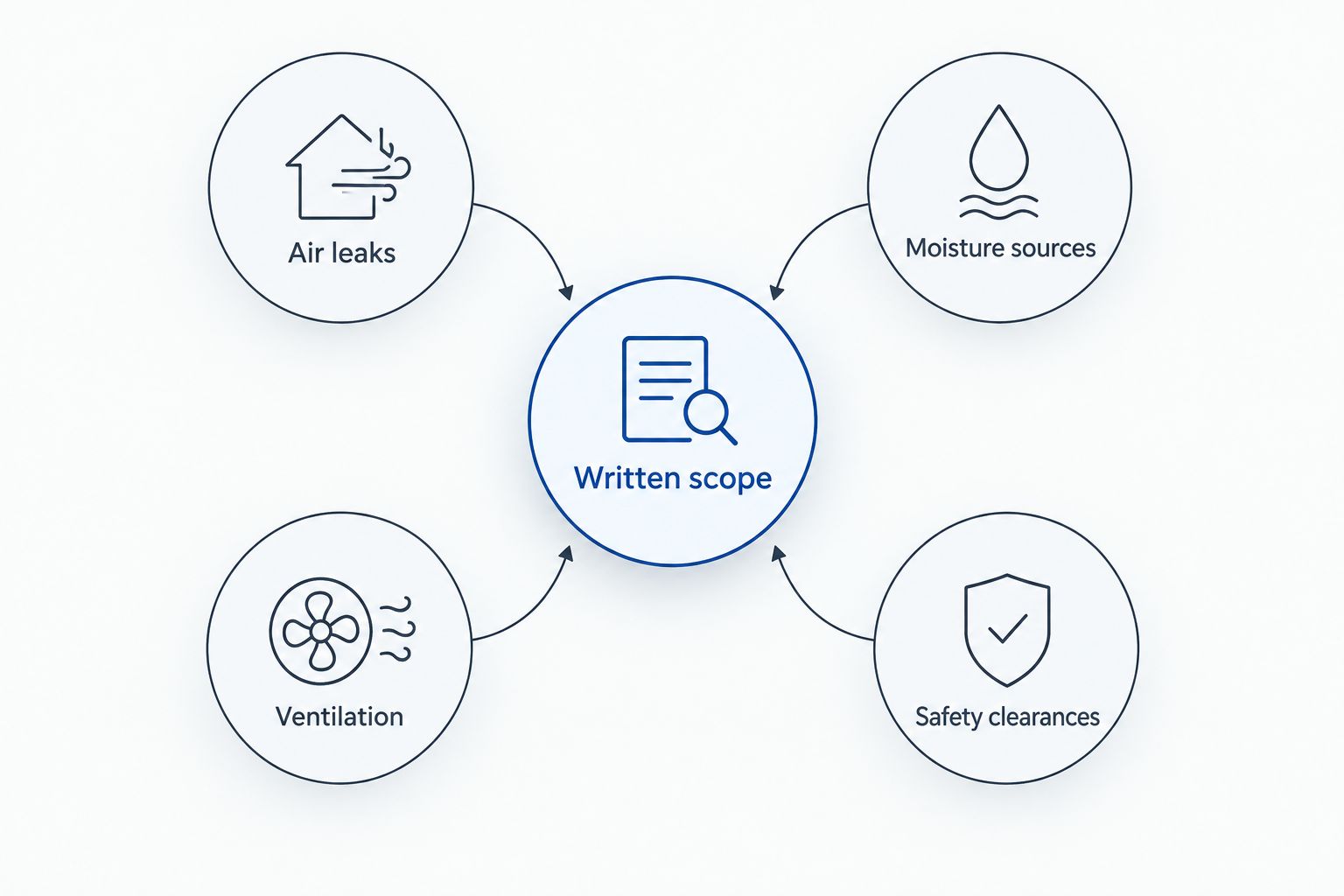
Ask each contractor to separate these tasks in the scope:
- Air leaks: Identify the openings and transitions to be sealed.
- Moisture sources: Address active leaks and explain any prerequisite repairs.
- Ventilation: Explain which ventilation paths must remain open or how the assembly changes.
- Safety clearances: Identify requirements around heat-producing equipment and relevant fixtures.
A contractor should not use insulation to conceal an unresolved roof or plumbing leak. Ask who must complete those repairs and whether the insulation work starts only after the affected area is ready.
For occupied homes, also ask how the work area will be isolated and when you can use it again. Follow the requirements for the actual materials and installation method, rather than a generic assurance that every insulation job is the same.
Soundproofing favors a sound-specific service discussion
JC Home Care Center, Inc. lists soundproofing among its services, making it a relevant starting point when noise is your main concern. Keep that discussion separate from a general thermal-insulation estimate.
Insulation inside a cavity can contribute to sound absorption, but sound also travels through gaps, structural connections, doors, and other routes. Filling a wall cavity does not automatically resolve every source of noise.
Describe the sound you hear. Voices through a shared wall call for a different investigation from footsteps overhead or traffic entering around a window. Ask the proposal to identify the likely transmission paths and the work intended to address them.
SCS Foam earns the selection for a noise-related project only if its proposal addresses the actual sound problem and supports the proposed assembly. Do not treat an insulation material’s thermal properties as proof of whole-room sound control.
The honest tradeoff is disruption. A sound-control plan can involve more than adding insulation, so establish whether finishes must be opened and who restores them. Neither contractor should receive credit for acoustic results that the written scope does not address.
Pricing: compare the agreement before comparing the total
For both contractors, agree on the project scope before accepting payment terms. An insulation installation is not a like-for-like purchase when one proposal includes preparation and repairs while another covers material placement alone.
Ask whether the agreement fixes the charge for a defined scope or allows adjustments based on measured quantities and unforeseen conditions. These arrangements have different tradeoffs. A fixed scope makes the agreement easier to understand, while an adjustable scope needs clear measurement and approval rules.
For your 2026 comparison, put each proposal into the same categories:
- Preparation, access, and protection of occupied areas.
- Existing insulation removal, if specified.
- Air sealing and the named insulation material.
- Installation locations and acceptance requirements.
- Waste handling, cleanup, and finish restoration.
- Exclusions, payment stages, and change-order approval.
Use the guide to compare insulation contractor estimates line by line before signing. A shorter proposal is not necessarily a simpler job; it can leave important responsibilities undefined.
Do not approve unspecified additional work in advance. Require a written explanation of the change, its effect on the agreement, and your approval before it proceeds.
Completion checks are a tie: require evidence from both
Apply the same completion standard to both contractors: document the work against the agreed scope. A brand preference should not change what you accept at handover.
Before installation, ask which areas will become concealed and what documentation will remain available. Photographs can record those areas, but they do not replace the appropriate checks for the installed material and assembly.
Your completion discussion should cover:
- The locations insulated and any agreed exclusions.
- The installed material and relevant product documentation.
- Air-sealing work included in the contract.
- Required access, ventilation paths, and clearances.
- Cleanup and responsibility for unfinished repairs.
Keep the proposal, approved changes, and completion records together. If a room remains uncomfortable, those records help distinguish the work that was agreed from a separate problem that still needs investigation.
Final verdict: choose the proposal that matches your home
Choose the residential-service option if you need material guidance
Choose JC Home Care Center, Inc. if you are a Long Island or NYC homeowner seeking its stated attic, wall, flat-roof, cellulose, or soundproofing services. This profile starts with a home-comfort problem and needs a proposal connecting that problem to a suitable repair.
Do not choose on service range alone. Confirm the specific assembly, preparation, exclusions, and completion requirements for your property.
Choose SCS Foam if its bid best meets a defined foam specification
Choose SCS Foam if you already have a justified foam specification and its written proposal meets that specification better. This profile starts with an agreed design and needs a contractor whose documented scope matches it.
The condition matters. Neither a foam-focused name nor a material preference establishes installation quality, building suitability, or the outcome for your home.
| Dimension | Winner or decision rule |
|---|---|
| Undecided residential insulation project | The stated residential-service option |
| Defined foam assembly | SCS Foam, only with the better-matched written proposal |
| Long Island and NYC geographic fit | The provider with stated coverage; confirm each property |
| Air sealing and moisture | Tie on required evaluation standards |
| Noise-focused project | The soundproofing service option, subject to a sound-specific scope |
| Pricing agreement | Neither by name; compare scope and change-order terms |
| Completion checks | Tie on required documentation |
FAQ
Is JC Insulation better than SCS Foam in 2026?
The better choice is the contractor whose written proposal matches your home’s requirements. JC Home Care Center, Inc. states residential insulation services across Long Island and NYC; select SCS Foam for a specified foam project only when its proposal is the stronger match.
Should I choose cellulose or foam insulation?
Choose the material that suits the building assembly and installation conditions. Ask the contractor to explain air control, moisture management, access, and any required protective layers before you approve the material.
Does a foam company name tell me which material will be installed?
No, a company name does not identify the proposed insulation material. Require the written proposal to name the product type and explain where and how it will be installed.
Can insulation solve noise through a shared wall?
Cavity insulation can contribute to sound absorption, but it does not address every sound path. Ask for a sound-specific assessment that considers gaps, structural connections, and the surrounding construction.
What should an insulation estimate include?
An insulation estimate should define preparation, materials, installation areas, air sealing, cleanup, exclusions, and change-order rules. It should also explain how the completed work will be checked against the agreed scope.
Should air leaks be sealed before adding insulation?
Air leaks should be addressed as part of the planned insulation work. Ask the contractor to identify the air-control approach and sequence rather than assuming that adding insulation will seal every opening.
What should I ask before hiring an insulation contractor in 2026?
Ask the contractor to explain the diagnosed problem, proposed assembly, preparation requirements, and completion checks. Confirm service at your address and establish payment and change-order terms in writing.
One last thing
Ask each contractor to explain what the proposed work will not fix. That question helps separate a focused repair from an overly broad promise. A good insulation scope has boundaries: it identifies the surfaces being treated and distinguishes insulation work from unresolved leaks, equipment issues, or other repairs.
For your 2026 decision, choose the proposal with the clearest connection between the problem, the work, and the completion standard—not the most confident sales language.
Related guides
- Questions to ask an insulation contractor before hiring
- How to seal air leaks before adding insulation
- SCS Foam alternatives for Long Island spray foam projects