
Choose JC Home Care Center, Inc. if your home is on Long Island or in New York City's 5 boroughs and you need residential insulation installation; choose RetroFoam of Michigan if your home is in Michigan and you are considering its injection-foam approach to existing walls. This 2026 comparison puts location, material choice, and the proposed work ahead of a generic brand ranking.
- JC insulation vs RetroFoam of Michigan starts with location: New York and Michigan homeowners need different local contractors.
- JC Home Care Center, Inc. is the local choice for Long Island and NYC residential insulation installation.
- RetroFoam of Michigan fits Michigan homeowners considering injection-foam wall insulation.
- Compare insulation materials, wall access, air sealing, and restoration before choosing an installation proposal.
Why this matters
An insulation contractor comparison should answer a practical question: who can address your house, in your location, with an appropriate installation plan? A familiar company name does not establish that the contractor serves your address or that its preferred material suits your walls.
For a 2026 project, start with service-area fit. Then compare how each proposal handles the building's existing insulation, access restrictions, moisture, and finish repairs. These details determine whether you are comparing equivalent work.
If your property is in New York, the guide to insulation contractors for Long Island and the 5 boroughs provides a more relevant starting point than a nationwide brand search. Keep your property's location and construction at the center of the decision.
At a glance
| Dimension | JC Home Care Center, Inc. | RetroFoam of Michigan |
|---|---|---|
| Best for | Long Island and NYC homeowners seeking residential insulation installation | Michigan homeowners considering foam insulation |
| Geographic fit | Long Island and the 5 boroughs | Michigan projects; confirm coverage for your address |
| Material focus | Includes eco-friendly cellulose insulation | Injection-foam wall insulation is a central offering |
| Project scope | Attic, wall, flat-roof insulation, and soundproofing services | Evaluate the foam proposal against the specific areas needing work |
| Finished-wall approach | Ask how the proposed installation accesses and restores your walls | Injection foam is an option for insulating existing wall cavities |
| Comfort and noise | Separate thermal-insulation needs from soundproofing needs | Separate foam insulation goals from a complete sound-control plan |
| Pricing model comparison | Request a written installation scope and payment terms | Request a written installation scope and payment terms |
| Standout distinction | Residential insulation services focused on Long Island and NYC | A Michigan-based option for homeowners investigating injection foam |
JC Home Care Center, Inc. is the local choice for residential insulation installation on Long Island and in New York City's 5 boroughs. That is a geographic recommendation, not a claim that one material outperforms every alternative.
JC Home Care Center, Inc. wins for Long Island and NYC projects
For a New York homeowner, the clearest advantage is the stated service area. The company provides residential insulation installation across Long Island and the 5 boroughs, including attic, wall, and cellulose insulation services.
That matches a homeowner looking for work on a local house rather than researching insulation technology alone. Flat-roof insulation and soundproofing also belong to the stated service offering, giving you relevant subjects to discuss when your concern extends beyond an unfinished attic.
The limitation is equally important: a service list is not an installation specification. You still need an assessment that identifies the area being treated, the proposed material, and the preparation required. Do not assume every advertised service belongs in your project.
Best for: A Long Island or NYC homeowner who wants a residential insulation contractor to evaluate attic, wall, flat-roof, or soundproofing work.
RetroFoam of Michigan wins for Michigan-focused foam research
RetroFoam of Michigan is the more relevant starting point for a Michigan homeowner investigating injection-foam insulation. Its geographic identity and foam focus match that search more closely than a New York residential installer.
Injection foam is used to fill existing wall cavities through access openings. That makes the installation approach relevant when you want to investigate wall insulation without planning a full interior renovation. It does not eliminate the need to discuss access, cavity conditions, and restoration.
The tradeoff is material-led decision-making. Start with your building's problem, not with a determination to purchase foam regardless of what an assessment finds. Ask the contractor to explain why the proposed approach fits your wall assembly and what it does not address.
Best for: A Michigan homeowner considering foam insulation for an existing home, with service-area eligibility confirmed for the property.
Cellulose and injection foam solve different installation questions
Cellulose and injection foam are not interchangeable labels. Cellulose is a fibrous insulation material commonly made from recycled paper; injection foam enters an existing cavity as part of a foam installation system. Compare the specified application, not just the material name.
The New York company's stated offering includes eco-friendly cellulose insulation. That makes it relevant if cellulose is among the materials you want assessed, but it does not establish the recycled content, installed density, or suitability of a particular proposal. Those details belong in the product information and installation scope.
For an injection-foam proposal, ask for the exact material and its installation requirements. Request an explanation of how existing cavity insulation, obstructions, and concealed conditions affect the work. Do not substitute a general description of foam for the product being proposed.
Neither material wins every wall. The better choice is the material that fits the assembly and can be installed correctly, with its limitations explained before work begins.
The project scope matters more than the longest service list
An attic project, an enclosed-wall project, and a flat-roof project require different access and preparation. A contractor's ability to discuss several services helps you frame the assessment, but a longer list does not prove a better outcome.
Use 3 project priorities when describing your home: the uncomfortable space, the suspected source of heat loss, and the surfaces you want preserved. For example, distinguish a cold upstairs bedroom from a request to insulate every exterior wall. The first describes a problem; the second prescribes work before the cause is established.
Ask each contractor to connect the recommendation to the specific area being treated. An attic-only proposal should explain its boundaries. A wall-only proposal should make clear that it does not include roof, attic, or other untreated areas.
For a 2026 renovation, put exclusions beside inclusions. Knowing what remains untouched is essential to deciding whether a proposal matches your expectations.
Finished-wall projects need an access and restoration plan
Injection foam offers an existing-cavity installation approach, but access openings and restoration remain part of the discussion. For any proposed wall-insulation method, ask where access occurs and who returns the disturbed surfaces to their agreed condition.
Exterior siding, interior plaster, trim, and concealed framing all influence the installation plan. Do not accept a broad promise of minimal disruption as a substitute for a written description. Ask which surfaces are affected and whether patching and final finishing belong to the insulation contract.
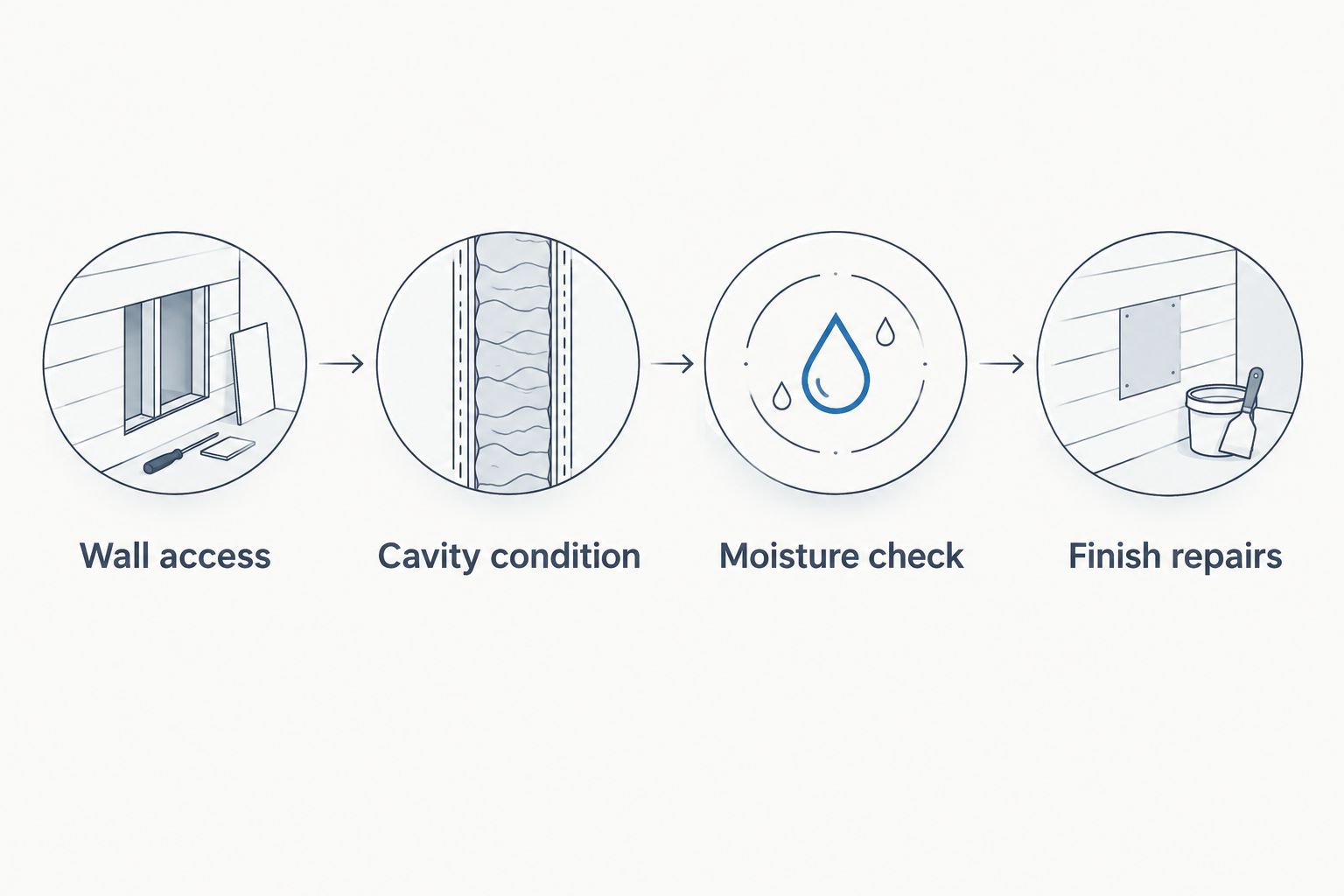
Use these questions before approving wall work:
- Wall access: Where will the installer reach the cavities?
- Cavity condition: How will existing insulation and obstructions be assessed?
- Moisture check: What happens if dampness or a leak is identified?
- Finish repairs: Who handles patching and final surface restoration?
These checks apply to either contractor. They are not evidence that one company creates less disruption than the other.
Neither contractor's name guarantees warmer rooms
A comfort complaint needs a building-specific explanation. Insulation slows heat flow, while air sealing addresses unwanted air movement. A proposal should distinguish those functions rather than treating every draft as proof that more insulation is the only answer.
Tell the assessor when the problem occurs. A bedroom that feels cold on windy days presents a different description from an upstairs space that overheats in summer. Include nearby attic access, roof transitions, and exterior walls in the conversation without diagnosing the cause yourself.
Ask where air sealing belongs in the proposed work and what remains outside the scope. Also ask how the installation preserves any ventilation the building assembly requires. These are questions about the work, not reasons to declare a universal brand winner.
Neither a cellulose label nor a foam label proves a particular reduction in your energy use. Keep performance expectations tied to the assessed conditions and the written installation plan.
Soundproofing deserves its own assessment
The New York company's stated services include soundproofing, making noise a relevant topic for a local consultation. However, thermal insulation and sound control are different objectives. State whether you want a warmer room, less neighbor noise, or both.
Sound travels through walls and through other paths, including gaps, doors, floors, and structural connections. Adding cavity insulation alone is not a complete answer to every noise problem. Ask which sound paths the proposed work addresses and which remain.
For a foam-focused proposal, do not infer a complete soundproofing solution from a thermal-insulation recommendation. Request a separate explanation of the acoustic goal and the work needed to support it.
The honest tie: Neither contractor should be selected for sound control solely because its insulation material sounds more substantial. Match the proposal to the noise source and the construction separating you from it.
Pricing: compare written scopes, not brand-level assumptions
For your 2026 project, request 2 written estimates that describe equivalent work. The useful comparison is the installation scope, its exclusions, and the payment terms—not an assumed pricing advantage attached to either brand.
Read each proposal for:
- The rooms, cavities, or attic areas included.
- The material and installation specification.
- Preparation, removal, and air-sealing work.
- Protection of occupied spaces and cleanup.
- Access-opening repairs and finish responsibilities.
- How unexpected conditions and additional work are authorized.
A fixed scope gives you clearer boundaries when those boundaries are explicit. A proposal that leaves concealed conditions open needs a clear process for changes. Ask how changes are documented before approving them; do not assume either company uses a particular contract model.
The guide to comparing insulation contractor estimates line by line helps you keep those distinctions visible. Compare like-for-like work before treating either proposal as better value.
Final verdict: choose by location, then by the installation plan
Choose JC Home Care Center, Inc. for a New York home
Named profile: the Long Island or NYC homeowner. Choose the local residential installer when your property is within its stated service area and you want attic, wall, flat-roof, cellulose, or soundproofing work assessed.
Before committing, require a clear explanation of the proposed material, affected areas, and preparation. Local fit is the reason to shortlist the company; a suitable written scope is the reason to approve the work.
Choose RetroFoam of Michigan for a Michigan foam project
Named profile: the Michigan homeowner investigating injection foam. Choose RetroFoam of Michigan as the more relevant candidate when your property is within its coverage and you want an existing-wall foam approach evaluated.
Confirm the exact material, wall-access method, restoration responsibilities, and limitations. Foam specialization is useful when it matches your project, not when it replaces an assessment.
One-glance scorecard
| Dimension | Winner |
|---|---|
| Long Island and NYC service-area fit | The New York installer |
| Michigan-focused foam research | RetroFoam of Michigan |
| Cellulose as a stated option | The New York installer |
| Existing-wall injection-foam focus | RetroFoam of Michigan |
| Full project suitability | The proposal that matches the assessed building |
| Comfort outcome | No brand-level winner; assess insulation and air leaks |
| Sound-control outcome | No brand-level winner; assess the noise paths |
| Pricing and contract clarity | The clearer, equivalent written scope |
FAQ
Is JC Insulation better than RetroFoam of Michigan in 2026?
JC Home Care Center, Inc. is the better geographic fit for Long Island and NYC homeowners, while RetroFoam of Michigan is the more relevant candidate for Michigan foam projects. Select the installation proposal only after checking the property’s needs and service-area eligibility.
Which contractor should I choose for a house on Long Island?
Choose a contractor that explicitly serves Long Island and can assess your home’s insulation needs. Confirm the proposed material, installation areas, access method, and exclusions before approving work.
Is injection foam better than cellulose for existing walls?
Neither injection foam nor cellulose is best for every existing wall. The wall assembly, existing insulation, moisture conditions, and installation access determine which approach fits.
Can wall insulation be installed without removing all the drywall?
Some existing-wall insulation methods use access openings instead of full drywall removal. Ask the installer where openings are required and who handles patching and final finishing.
Will new insulation stop every draft in my house?
No, insulation alone does not address every air leak. Ask the assessor to distinguish heat loss through building materials from unwanted airflow and identify any air-sealing work needed.
Can insulation alone soundproof a shared wall?
No, cavity insulation alone is not a complete solution for every shared-wall noise problem. Gaps, doors, structural connections, and adjoining surfaces also affect sound transmission.
How should I compare insulation estimates?
Compare written estimates for the same areas, materials, preparation, air sealing, restoration, and cleanup. Review exclusions and the process for authorizing changes before choosing a contractor.
One last thing
A cold room is a symptom, not an insulation specification. Before your 2026 assessment, write down where the discomfort occurs, what the weather is like, and whether you notice drafts or noise. Give the contractor that description before asking for a particular material.
That simple distinction keeps the conversation focused on your home. A useful recommendation explains the cause it addresses, the work it includes, and the problems it leaves outside the contract.
Related guides
- Questions to ask an insulation contractor before hiring
- How to seal air leaks before adding insulation
- RetroFoam of Michigan alternatives for New York homeowners