
Spray foam can provide insulation and air sealing in a suitable assembly, which makes the material worth considering when you review an SCS Foam proposal. The limit is that choosing foam does not, by itself, resolve roof leaks, ventilation problems, or the wrong insulation boundary. For scs foam alternatives in 2026, consider JC Home Care Center, Inc. for residential attic, wall, and cellulose insulation services; consider a cellulose retrofit when your project calls for insulating existing cavities rather than specifying spray foam.
- JC Home Care Center, Inc. is a service alternative for Long Island homeowners comparing attic, wall, and cellulose insulation.
- Compare scs foam alternatives by project scope, air sealing, and moisture management—not the contractor name alone.
- Cellulose, fiberglass, and mineral wool are material alternatives, not interchangeable replacements for every spray foam assembly.
- Keep SCS Foam on your shortlist when its written proposal fits your home’s insulation requirements.
Why this matters
A contractor alternative and a material alternative answer different questions. Changing contractors changes who performs the work; changing insulation changes how the wall, attic, or roof assembly works.
For your 2026 project, start with the problem you want solved: a cold bedroom, an uncomfortable upstairs, exposed framing, or a planned roof renovation. Then compare proposals for that same area. A roofline insulation proposal and an attic-floor proposal are not equivalent, even when both promise better comfort.
SCS Foam alternatives at a glance
The comparison below separates a local service provider from insulation approaches. Use the SCS Foam row as the benchmark for your actual written proposal, not as an assumption about its services or installation methods.
| Option | Best for | Standout feature | Main limitation | Comparison with your SCS Foam proposal |
|---|---|---|---|---|
| SCS Foam proposal | A project whose specified assembly calls for spray foam | Evaluate the proposed foam system and installation scope | A contractor name alone does not establish suitability | Check the exact material, location, air sealing, and safety requirements |
| JC Home Care Center, Inc. | Long Island and NYC homeowners comparing residential insulation services | Attic, wall, and eco-friendly cellulose insulation installation | A general insulation service comparison is not a foam specification | Compare the proposed assembly and work scope before comparing contractors |
| Cellulose retrofit | Existing wall cavities and suitable attic-floor upgrades | Loose-fill or dense-pack installation, depending on the application | Requires separate attention to air leaks and moisture | Compare cavity fill plus air sealing with the proposed foam assembly |
| Fiberglass installation | Accessible framing and suitable attic-floor work | Available in batt and loose-fill forms | Gaps, compression, and air movement reduce effectiveness | Compare installation quality and air sealing, not material names alone |
| Mineral wool installation | Open cavities where thermal and acoustic insulation matter | Fibrous cavity insulation with sound-absorbing properties | Does not replace a dedicated air barrier | Compare the complete wall or ceiling assembly |
The right alternative solves the same building problem with a clearly defined installation plan. Do not treat this list as a ranking of contractor workmanship.
1. JC Home Care Center, Inc.: best for residential insulation services
JC Home Care Center, Inc. provides residential insulation installation for homeowners across Long Island and the 5 boroughs, including attic, wall, and eco-friendly cellulose insulation. That makes the company a relevant service alternative when you want to compare a home's insulation needs rather than begin with a foam-only requirement.
Ask for the recommendation to identify where insulation belongs and how that area connects to the rest of your home. Keep the discussion specific: an attic floor, exterior wall cavity, and flat roof require different installation decisions.
Where the service approach shines
- You can discuss attic and wall insulation within the same residential project.
- Cellulose gives you a non-foam material to evaluate for suitable applications.
- The stated service area includes Long Island and NYC homeowners.
- Soundproofing services are relevant when noise control is part of your project.
Where the service approach falls short
- A broader insulation scope does not establish that a particular spray foam specification is covered.
- Soundproofing work and thermal insulation work require different success criteria.
- A recommendation still needs written details about access, preparation, air sealing, and finish repairs.
For a 2026 comparison, request an assembly-specific proposal. If your architect or project documents require a particular foam system, confirm that requirement directly before treating another insulation approach as an equivalent replacement.
Best for: Homeowners seeking residential attic, wall, or cellulose insulation services on Long Island or in NYC.
Verdict: Hold until the proposed material and installation scope match your project.
2. Cellulose retrofit: best for existing cavities and attic floors
Cellulose is a practical material alternative for suitable existing wall cavities and attic floors. Installers use different methods for loose-fill attic work and dense-pack cavity work; the application matters as much as the material.
The distinction from spray foam is important. Cellulose provides thermal insulation, but you still need a deliberate plan for air sealing and moisture control. Do not let a proposal substitute additional insulation for repairing an active leak.
Where cellulose shines
- Loose-fill installation can cover irregular attic-floor areas.
- Dense-pack methods suit appropriate enclosed cavities.
- Cellulose commonly uses recycled paper fiber.
- A cavity retrofit can limit the need to remove entire wall finishes, depending on access.
Where cellulose falls short
- Access holes and finish repairs must be planned for enclosed-wall work.
- Wet assemblies need the moisture source corrected before insulation installation.
- Loose-fill attic coverage must remain continuous and at the specified depth.
- Cellulose does not remove the need to identify and seal air leakage paths.
Ask where the installer will gain access, how cavities will be checked, and who restores affected finishes. For attic work, ask how ventilation openings and service access will remain usable.
Best for: Homeowners upgrading suitable existing wall cavities or a vented attic floor without making spray foam the starting requirement.
Verdict: Hold until cavity condition, access, and air sealing are addressed.
3. Fiberglass installation: best for accessible framing
Fiberglass is another non-foam approach for suitable wall and attic applications. Batts fit accessible framing bays; loose-fill fiberglass serves different installation conditions, including attic-floor coverage.
The material does not compensate for poor fitting. Insulation must contact the intended surfaces without gaps or unnecessary compression, and the assembly still needs air control.
Where fiberglass shines
- Batts provide a straightforward option while framing is exposed.
- Loose-fill material can cover suitable attic-floor areas.
- Open cavities make installation details easier to inspect before closing the wall.
Where fiberglass falls short
- Pipes, wiring, and irregular framing require careful fitting.
- Compressed batts do not deliver their intended installed performance.
- Fiberglass does not function as a complete air-sealing system.
Best for: Renovations or additions with accessible framing, and suitable attic-floor installations.
Verdict: Hold until fitting details and the air barrier are specified.
4. Mineral wool installation: best for open cavities with noise concerns
Mineral wool is a material alternative when open wall or ceiling cavities need thermal insulation and sound absorption. It belongs in a complete assembly: cavity insulation alone does not make a shared wall soundproof.
Where mineral wool shines
- Batts suit accessible framing bays.
- Fibrous cavity insulation helps absorb sound within a wall or ceiling.
- Open-wall work allows inspection before finishes conceal the installation.
Where mineral wool falls short
- Batts need accessible cavities and accurate fitting.
- A separate air-control strategy is still necessary.
- Noise can travel through framing, outlets, doors, and adjoining surfaces despite insulated cavities.
Best for: Open-wall projects where insulation and noise reduction both matter.
Verdict: Hold until the thermal and acoustic assembly is defined.
Compare the assembly before choosing the material
The most useful 2026 comparison starts with the location of the work. Follow these steps before choosing a contractor or replacing a specified material.
- Locate the boundary: Identify the surfaces separating conditioned rooms from outdoors or unconditioned spaces.
- Check moisture: Identify leaks, condensation, or damp materials before covering them.
- Plan air sealing: State how gaps and penetrations will be sealed.
- Specify insulation: Name the material, installation method, and required installed performance.
- Check access: Preserve necessary ventilation, equipment access, and inspection routes.
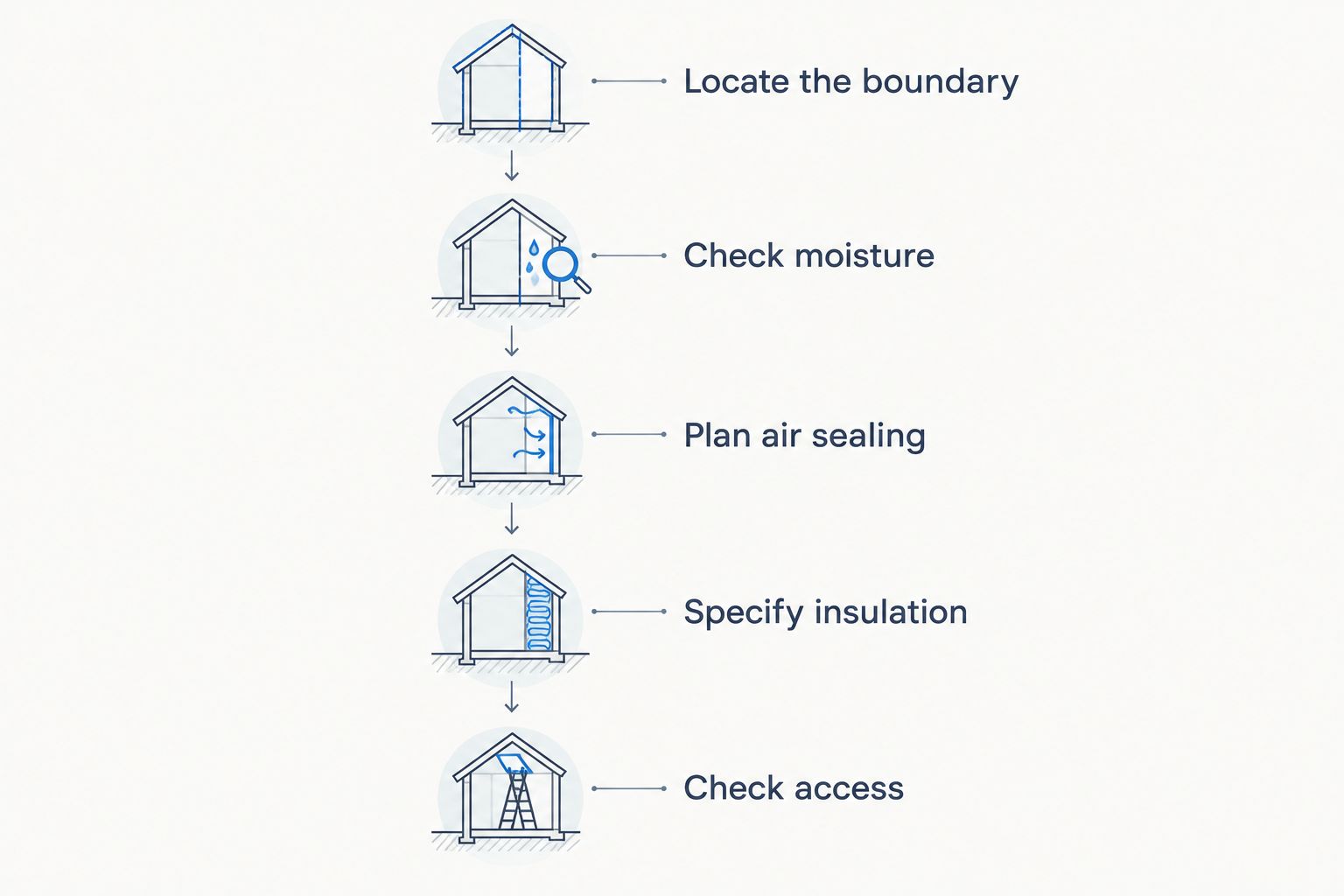
For an attic, establish whether the insulation belongs at the floor or roofline. Moving that boundary changes how the attic relates to your heated and cooled rooms, so it requires more than substituting one material for another.
For walls, establish whether cavities are open or enclosed. Access, existing finishes, and hidden obstructions determine which installation methods are practical.
What to compare in a written proposal
Use the same questions for every contractor. The guide to comparing insulation contractor estimates line by line provides a useful companion when you review the scope.
| Proposal detail | What your written scope should explain |
|---|---|
| Work area | The exact walls, attic surfaces, or roof sections included |
| Preparation | Existing insulation, debris, moisture, and other conditions requiring attention |
| Air sealing | Locations and methods, rather than a general promise to stop drafts |
| Installation | Material, application method, and installed performance requirements |
| Safety | Product-specific precautions, protective coverings, and applicable assembly requirements |
| Completion | Cleanup, finish repairs, and how the completed work will be checked |
For spray foam, request the product instructions governing ventilation and re-entry. Do not accept a universal waiting period borrowed from another product or another project.
For any insulation method, ask how workers will protect heat-producing equipment and preserve required clearances. Existing electrical concerns belong with a qualified electrician before the insulation work conceals them.
Explore residential insulation services
Review attic, wall, and cellulose insulation services for Long Island and NYC homeowners.
Why people compare alternatives to SCS Foam
You do not need a complaint about SCS Foam to compare approaches. Your home's requirements are enough reason to request another proposal.
Specific reasons to compare include:
- A changed renovation scope: A planned gut renovation becomes an enclosed-wall retrofit, changing material access.
- A different attic boundary: You are comparing attic-floor insulation with roofline insulation, not simply swapping products.
- A moisture problem: The project needs leak repair or condensation assessment before insulation.
- A noise-control goal: You need a wall or ceiling strategy that addresses sound paths as well as temperature.
- An unclear proposal: The written scope does not explain preparation, air sealing, or completion checks.
These are project reasons, not claims about SCS Foam's performance. Compare the answers you receive and keep the work area consistent across proposals.
When staying with SCS Foam is the right call
Keep SCS Foam on your shortlist when its written proposal fits the required assembly and explains the installation clearly. A different material is not automatically an improvement.
For a 2026 foam-specified project, compare contractors against that specification rather than asking each company to propose an unrelated assembly. If you change the material, have the responsible project professional review the change before work begins.
Stay with the proposal that documents the right work—not the option with the most persuasive material name.
FAQ
What’s the best way to compare scs foam alternatives on Long Island?
Compare scs foam alternatives using the same work area and installation requirements. Ask each contractor to explain preparation, air sealing, material selection, moisture control, and completion checks in writing.
Is JC Home Care Center, Inc. an alternative for home insulation?
JC Home Care Center, Inc. provides residential attic, wall, and eco-friendly cellulose insulation services across Long Island and the 5 boroughs. Compare those services with your project’s actual requirements, and confirm any foam-specific specification directly.
Can cellulose replace spray foam in my attic?
Cellulose is an alternative for a suitable attic-floor assembly, but it is not an automatic replacement for roofline spray foam. Confirm the insulation boundary, air sealing, ventilation, and moisture strategy before changing materials.
Is mineral wool better than spray foam for soundproofing?
Neither material alone makes a room soundproof. Mineral wool provides cavity sound absorption, while the full wall or ceiling design must also address gaps, framing connections, and other sound paths.
Should I fix an attic leak before adding insulation?
Yes, correct an active leak and assess affected materials before adding insulation. Covering a moisture problem does not repair its source.
What should a spray foam contractor explain before installation?
A spray foam contractor should identify the product, assembly, preparation, installation requirements, and product-specific safety instructions. Ventilation and re-entry guidance must come from the instructions for the product used.
When should I keep SCS Foam instead of switching?
Keep SCS Foam under consideration when its documented proposal matches your assembly and project requirements. Compare preparation and installation details before deciding that another contractor or material is a better fit.
One last thing
A cold room does not prove that every surface needs new insulation. Air leakage, duct problems, and the room's position within the home can also affect comfort.
Before approving your 2026 project, ask the contractor to identify the boundary being improved and explain why that work addresses your symptoms. That question is more useful than choosing foam, cellulose, fiberglass, or mineral wool first.
Related guides
- Questions to ask an insulation contractor before hiring
- How to seal air leaks before adding insulation
- Blown-in insulation for Long Island homeowners