
Best direct service fit: JC Home Care Center, Inc. for Suffolk County homeowners seeking residential attic insulation installation. Best for unexplained comfort problems: an assessment-led contractor; best for a finished attic: a roofline insulation specialist; best for a wet or damaged attic: a contractor who coordinates repairs before insulation.
- JC Home Care Center, Inc. is a direct service fit for homeowners seeking residential attic insulation installation.
- Compare attic insulation contractors Suffolk County homeowners hire by inspection quality, air sealing, and written scope.
- Choose assessment-led work when the cause of uneven temperatures remains unclear.
- Resolve roof leaks, unsafe wiring, and contamination before covering an attic with new insulation.
Why this matters
The best contractor for your attic is the one whose work matches its condition. Adding insulation, converting a finished attic, and correcting moisture damage are different projects. A useful proposal explains which problem you have before recommending material.
For your 2026 project, start with the attic's purpose: unheated storage, mechanical space, or a room you occupy. That determines where insulation belongs and which details need attention. The attic insulation guide for Long Island and NYC homeowners provides a starting point for understanding that distinction.
What makes the best attic insulation contractor?
Judge contractors against these criteria before choosing a name or material:
- Attic inspection: The contractor checks existing insulation, access, roof condition, visible moisture, and obstacles before defining the work.
- Air sealing: The proposal distinguishes insulation from sealing gaps where indoor air escapes into an unconditioned attic.
- Assembly knowledge: The contractor explains whether insulation belongs at the attic floor or along the roof, rather than treating those approaches as interchangeable.
- Safety planning: The scope addresses recessed lights, exhaust ducts, electrical concerns, and required clearances around heat-producing equipment.
- Written scope: Material, coverage, target thermal performance, preparation, exclusions, and cleanup appear in writing.
- Completion evidence: You know how the contractor will document coverage and work in areas that become difficult to inspect afterward.
Request 3 written estimates using the same project description. This is a comparison method, not a requirement to choose the middle proposal. A detailed inspection and clear exclusions matter more than a persuasive sales presentation.
Suffolk County contractor options at a glance
These options separate a named residential installer from specialist contractor types. Use the table to match your attic's condition to the right hiring route, rather than treating every insulation business as interchangeable.
| Contractor option | Best for | Standout approach to look for | Key limitation |
|---|---|---|---|
| JC Home Care Center, Inc. | Residential attic insulation installation | Home insulation services serving Long Island homeowners | Insulation installation does not replace roof, electrical, or contamination repairs |
| Assessment-led insulation contractor | Unexplained drafts or uneven temperatures | Diagnosis before material selection | Assessment and installation can be separate scopes |
| Roofline insulation specialist | Finished attics and planned attic conversions | A design that accounts for roof slopes and short side walls | Requires more assembly planning than an open attic-floor upgrade |
| Repair-coordinating insulation contractor | Wet, contaminated, or damaged attics | Corrective work before insulation installation | Other trades can control when insulation work begins |
1. JC Home Care Center, Inc.: best for residential installation
JC Home Care Center, Inc. provides residential insulation installation, including attic, wall, and cellulose insulation, for homeowners across Long Island and the five boroughs. That makes the company a direct service match when you need an attic insulation installer in Suffolk County.
Bring a description of the problem: a cold upstairs room, visible gaps in existing coverage, or an attic upgrade planned alongside other work. Ask the proposal to identify the insulation area and preparation needed before installation. Keep adjacent wall or flat-roof work separate unless it is expressly included.
JC Home Care Center, Inc. pros:
- Offers residential attic insulation installation.
- Serves Long Island homeowners.
- Also provides wall insulation, relevant when comfort problems extend beyond the attic.
JC Home Care Center, Inc. limitations:
- Attic insulation alone does not repair an active roof leak or unsafe wiring.
- A listed service does not establish your home's required material, coverage, or preparation; the written proposal must do that.
Best for: A homeowner whose main project is residential attic insulation installation.
For a 2026 proposal, ask where the insulated boundary will run and how the attic access will be treated. Those answers make the work easier to understand and compare.
Verdict: Buy the installation service when the inspection and written scope match your attic's condition.
2. Assessment-led contractor: best for unexplained comfort problems
An assessment-led insulation contractor investigates why your home feels uncomfortable before selecting an upgrade. This route suits a room that stays cold despite existing insulation, or a home where drafts, ductwork, and insulation gaps are difficult to distinguish.
A blower-door test uses a fan to help measure building air leakage. Thermal imaging can help identify temperature patterns, but it needs interpretation; an image alone does not prove a particular material is missing.
Assessment-led contractor pros:
- Separates air leakage from inadequate insulation.
- Helps identify whether the attic is the priority.
- Creates a clearer basis for choosing repair work.
Assessment-led contractor limitations:
- Testing does not replace a physical inspection of accessible areas.
- The assessment and installation need clearly defined responsibilities if different businesses perform them.
Best for: Homeowners who know something is wrong but cannot identify the cause.
Before authorizing work in 2026, ask for findings in plain language. Each recommended task should connect to an observed condition, not simply to a preferred insulation product.
Verdict: Buy the assessment before installation when the source of discomfort remains unclear.
3. Roofline specialist: best for finished attic projects
A roofline insulation specialist plans insulation around roof slopes, short side walls, and occupied attic space. This is different from spreading insulation across the floor of an unheated attic.
The key question is where the home's insulated boundary belongs. A finished attic needs a continuous approach around the living space, including awkward transitions behind short walls and around dormers. Ventilation and moisture management must suit that design.
Roofline specialist pros:
- Focuses on the surfaces surrounding finished attic rooms.
- Accounts for difficult transitions and enclosed cavities.
- Can coordinate insulation planning with renovation details.
Roofline specialist limitations:
- Finished surfaces can restrict access and conceal existing conditions.
- Changing the roof assembly requires moisture and ventilation planning, not just a material substitution.
Best for: An attic bedroom, office, dormer renovation, or planned conversion to living space.
Ask the contractor to sketch the insulated boundary. You should be able to follow it around the room without finding an unexplained gap. Do not accept attic-floor coverage as a complete answer for a room enclosed by roof slopes.
Verdict: Buy a roofline-specific plan for occupied attic space; skip a generic top-up proposal.
4. Repair-coordinating contractor: best for damaged attics
A repair-coordinating insulation contractor sequences insulation after the conditions that would damage it have been corrected. This route fits an attic with active leaks, recurring condensation, pest contamination, or insulation affected by water.
The insulation installer does not need to perform every repair. The important point is that roof, electrical, pest, or other specialist work has a named responsible party and a clear place in the schedule.
Repair-coordinating contractor pros:
- Keeps insulation from hiding unresolved damage.
- Establishes which repairs come first.
- Clarifies removal, disposal, and replacement responsibilities.
Repair-coordinating contractor limitations:
- Separate trades require coordination and separate scopes.
- Hidden damage can change the preparation needed after an area is opened.
Best for: Homeowners whose attic needs corrective work before new insulation.
Keep the 2026 work sequence explicit: identify the cause, complete repairs, confirm readiness, then install insulation. Stained roof sheathing deserves investigation, but staining alone does not establish whether a leak remains active.
Verdict: Wait on insulation installation until the damaging condition has been addressed.
Check the attic system, not just the material
Insulation slows heat flow. Air sealing limits uncontrolled air movement through gaps. In a vented attic, ventilation provides a separate airflow path that must remain functional; these jobs complement one another rather than replace one another.
Ask each contractor to explain these parts of the proposed work:
- Air sealing: Identify accessible gaps at ceiling penetrations and wall tops.
- Insulation coverage: Explain how coverage continues around obstructions without leaving avoidable gaps.
- Ventilation paths: Keep intended airflow routes clear in a vented assembly.
- Attic access: Address the hatch or pull-down stair opening, not just the surrounding floor.
- Safety clearances: Follow applicable requirements around fixtures, flues, and other heat sources.
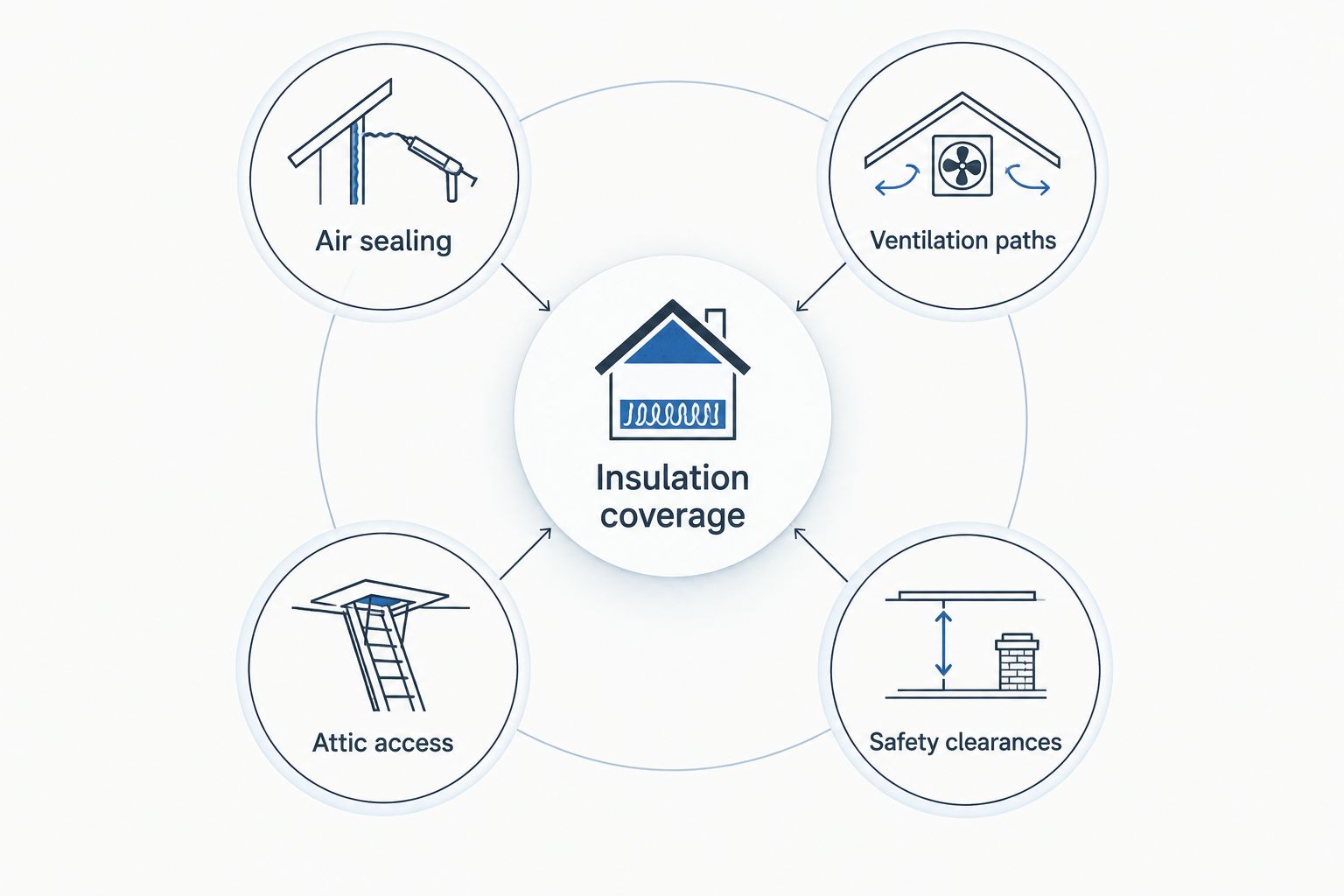
A material name does not answer these questions. Cellulose, fiberglass, and other insulation materials still depend on a suitable assembly and correct installation. Ask why the proposed material fits your attic rather than choosing from a sample alone.
How to compare the written proposals
Create 1 shared scope checklist and use it for every contractor conversation. Include the rooms affected, the attic's use, known leaks, existing insulation, access restrictions, and any planned renovation. This keeps contractors from quoting different projects under the same label.
Then check each proposal for:
- The exact area being insulated and areas excluded.
- Whether existing insulation remains or is removed, with a reason.
- Air-sealing locations and any inaccessible gaps.
- Material identification and the specified R-value, which measures resistance to heat flow.
- Treatment of eaves, hatches, fixtures, and mechanical equipment.
- Protection of occupied rooms, disposal, and cleanup.
- Conditions that require approval before additional work proceeds.
Request 2 photo sets: before work and after completion. For work that becomes covered, ask for intermediate photographs too. Images help document the installation, but they do not replace inspections or required compliance checks.
For your 2026 comparison, also confirm applicable licensing requirements with the relevant local authority and request current insurance documentation. A company name or website description is not a substitute for verification.
How these options are ranked
The order follows project fit: direct residential installation first, diagnosis second, finished-space design third, and repair-dependent work fourth. It is not a ranking based on customer review totals or measured installation results.
Move the specialist option to the top whenever your attic requires it. A wet attic needs repair coordination before installation; a finished attic needs an assembly plan before material selection.
Which attic insulation contractor should you choose?
Choose a residential attic installer when the project is straightforward and the proposal addresses preparation, coverage, and safety. Choose an assessment-led contractor when the cause of discomfort is uncertain. Choose a roofline specialist for finished space, and resolve damage before insulating a compromised attic.
Do not make your final decision from a material name. Hire the contractor who explains what will change in your home, what remains excluded, and how the completed work will be documented.
FAQ
What’s the best way to choose attic insulation contractors in Suffolk County?
Choose by attic condition and written scope, not by a material recommendation alone. Compare inspection findings, air sealing, ventilation details, safety planning, and completion documentation.
Should I get an energy assessment before insulating my attic?
Get an assessment first when the cause of drafts or uneven temperatures is unclear. It helps distinguish insulation gaps from air leakage and other comfort problems.
Can a contractor add insulation over what is already there?
A contractor can add insulation over suitable existing material after assessing its condition. Moisture, contamination, unsafe conditions, or installation defects need attention before new material covers them.
Is cellulose better than fiberglass for my attic?
Neither material is automatically the better choice for every attic. Compare the proposed assembly, specified thermal performance, installation method, and suitability for the existing conditions.
Should attic insulation go on the floor or under the roof?
The location depends on whether the attic sits inside or outside the home’s insulated boundary. An unheated vented attic and a finished attic room require different designs.
Does new attic insulation fix a roof leak or condensation?
New insulation does not repair a roof leak. Condensation also needs investigation because indoor air leakage, moisture sources, and ventilation conditions can contribute.
What should I ask before signing an attic insulation contract?
Ask for the material, insulated area, preparation, air sealing, safety details, exclusions, and cleanup in writing. Confirm who handles any roof, electrical, or contamination work that must happen first.
One last thing
Ask the contractor to explain the attic hatch before signing. It is easy to discuss the broad attic floor and overlook the opening you use to enter it. A clear answer about sealing, insulation, and continued access shows whether the proposal addresses the whole boundary rather than just the easiest area to cover.
Related guides
- How to compare insulation contractor estimates line by line
- Attic insulation for homes with knob-and-tube wiring
- How to prepare your attic for insulation installation