
A room is ready to use only after the spray foam manufacturer’s occupant reentry requirements have been met—not simply when the foam feels dry. Curing and ventilation requirements depend on the exact product and installation conditions, so there is no universal waiting period that makes every room safe. Before returning, get the product-specific instructions and confirmation that the installation, ventilation, and cleanup requirements are complete.
- How long does spray foam curing take before room is safe? Follow the exact product’s occupant reentry instructions.
- Dry-to-touch foam does not establish safe occupancy; curing, ventilation, and cleanup are separate checks.
- Keep children and pets outside the restricted area until occupant reentry requirements are satisfied.
- JC Home Care Center, Inc. provides home insulation services for Long Island and the five boroughs.
Why this matters
Spray foam installation involves chemicals that require exposure controls during application and curing. The U.S. Environmental Protection Agency’s spray polyurethane foam guidance distinguishes protected workers from occupants and directs homeowners to manufacturer-specific reentry information. A worker entering with protective equipment does not establish that your bedroom is ready for sleeping.
For a 2026 renovation, settle the return-to-home arrangements before installation begins. Your questions to ask an insulation contractor before hiring should include the exact material, the restricted area, and who confirms that normal occupancy can resume.
Get a written return plan before you agree to a spraying date. It should explain what happens if work runs late, ventilation stops, or the installation needs correction.
How long does spray foam curing take before a room is safe to use?
The correct waiting period comes from the specific foam manufacturer’s instructions for occupants under the actual job conditions. Do not substitute another product’s cure time, an installer’s usual schedule, or a general answer found online.
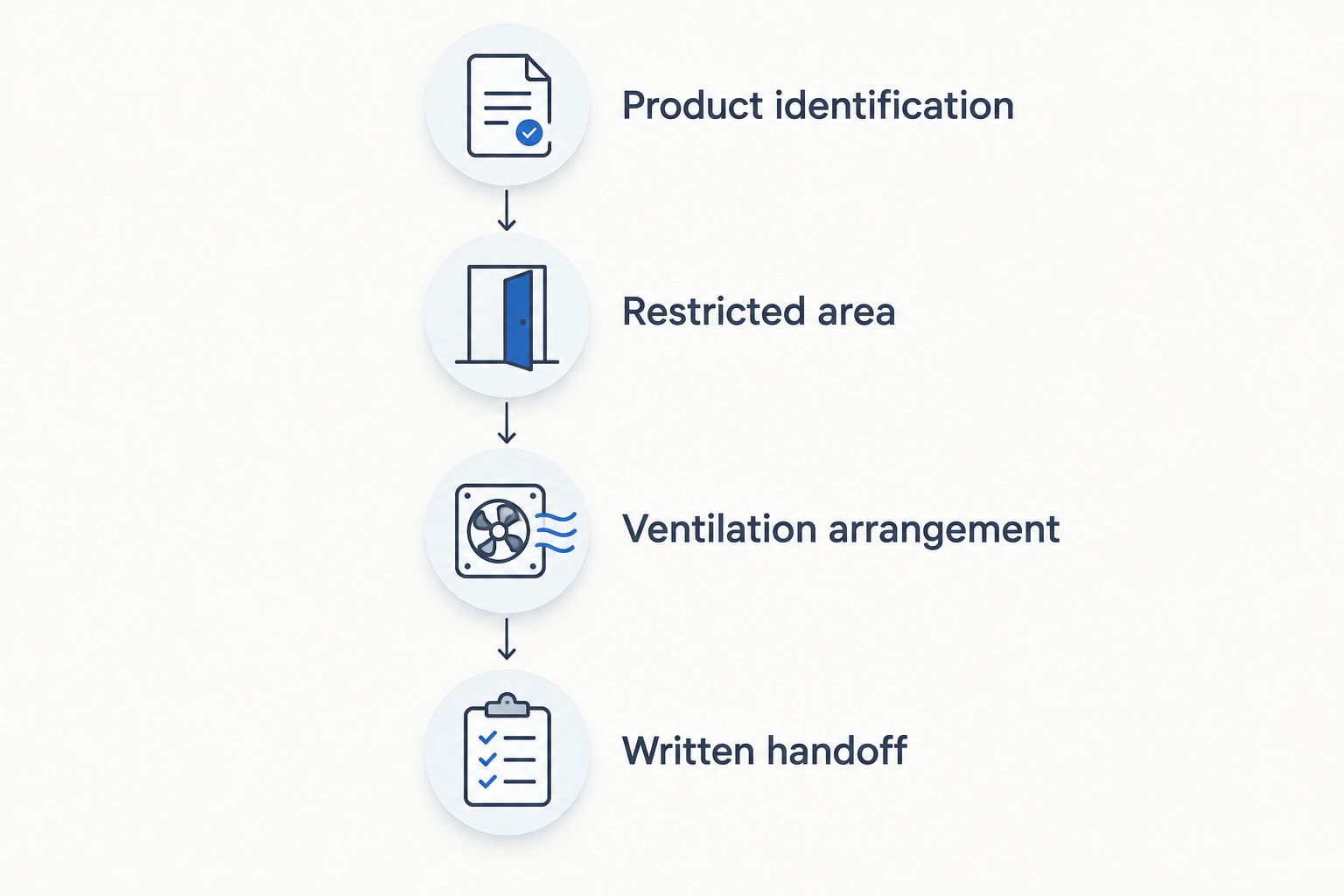
Follow this sequence before returning:
- Identify the product. Obtain the manufacturer, exact product name, safety data sheet, and application instructions.
- Find occupant reentry requirements. Ask for instructions covering residents without protective equipment, not just trained workers.
- Confirm the starting point. Establish when the required waiting period begins, especially if spraying continues across separate areas or visits.
- Verify site conditions. Have the installer confirm that temperature, moisture, application thickness, and ventilation met the product requirements.
- Complete the handoff. Receive confirmation that the restricted area can return to normal use and that no unresolved installation problem remains.
A calendar reminder helps you track the plan, but it cannot verify the work. If installation conditions fall outside the manufacturer’s instructions, ask for a product-specific resolution rather than assuming an extra night away fixes the problem.
What does each installation milestone actually mean?
| Milestone | What it tells you | What it does not establish |
|---|---|---|
| Spraying finished | Application has stopped | Occupants can return immediately |
| Surface feels firm | The exposed surface has hardened | The full application has cured correctly |
| Trimming completed | Excess material has been cut back | Dust cleanup and ventilation are complete |
| Occupant reentry requirements met | The documented conditions for residents have been satisfied | Other renovation hazards are resolved |
| Room ready for normal use | Relevant installation, cleanup, and occupancy checks are complete | Every person will tolerate the environment identically |
These milestones answer different questions. Do not use surface hardness as a substitute for the occupant reentry instructions.
Why spray foam curing and reentry requirements vary
The waiting period is tied to a material and an installation—not just the size of your room. These factors explain why a neighbor’s experience does not establish your return time:
- Product formulation. Different foam systems have different application, curing, and occupant reentry instructions. Use the documents for the material actually installed.
- Temperature. Air, substrate, and chemical temperatures must meet the manufacturer’s requirements. A comfortable thermostat setting does not verify every installation temperature.
- Moisture conditions. Substrate moisture and ambient humidity affect application requirements. Ask how the installer checked the conditions relevant to the chosen foam.
- Application thickness. Manufacturers specify limits for individual passes and procedures between applications. A thicker application is not permission to ignore those limits.
- Ventilation. Exhaust arrangements, replacement air, and separation from occupied rooms determine how the work area is managed. An open window alone does not prove compliance.
- Installation quality. Incorrect mixing or application requires investigation. Waiting longer is not an established correction for improperly installed foam.
For your 2026 project file, retain the product documents alongside the scope of work. That gives you something specific to discuss if the return schedule changes.
What should your contractor confirm before work starts?
Ask for a plain-language explanation of where you can stay during installation and when you can return. The answer should address your home’s layout rather than treating every project as an empty construction site.
Define the restricted area
Ask whether the restriction covers the room, a floor, an apartment, or the entire home. A closed interior door is not proof that adjacent spaces remain unaffected, particularly where rooms share air pathways.
For a two-family home or a building with shared systems, explain who occupies the adjoining spaces. Coordinate access and notifications before spraying, not after someone notices an odor.
Explain the ventilation arrangement
Ask where exhaust air will leave the building and how replacement air will enter. Also ask how the work area will remain separated from occupied spaces and whether shared heating or cooling equipment needs isolation.
Do not improvise by turning on central air or placing a fan in a doorway. Those changes can move air into other rooms instead of exhausting it outdoors as intended.
Put the handoff in writing
Your written plan should identify the person responsible for confirming normal occupancy. Keep these details together:
- Product identification and manufacturer instructions.
- Application completion information.
- Required ventilation and restricted-access arrangements.
- Occupant reentry instructions.
- Cleanup responsibilities and unresolved issues.
- A contact for questions after installation.
A 2026 installation record should describe what happened at your property, not simply repeat a standard promise. If spraying resumes after a correction, ask whether the return instructions change.
Can you stay elsewhere in the house while spray foam cures?
Stay elsewhere in the house only when the product instructions and site-specific exposure controls permit it. Do not assume that a different floor, a closed attic hatch, or a shut bedroom door provides adequate separation.
Describe your layout to the installer: open stairways, ceiling openings, shared ductwork, and access routes all matter to the isolation plan. You also need a way to use exits and essential facilities without crossing the restricted area.
If the installer cannot explain how occupied rooms will remain separated, arrange to leave the affected premises. Resolve the boundaries before work starts so you are not making an occupancy decision while spraying is underway.
For a 2026 renovation involving tenants, guests, or other trades, share the same written restrictions with everyone. Permission for a trained worker to enter under specified protective measures is not permission for residents to resume normal activities.
Is curing time the same as safe occupancy time?
Curing describes the material’s chemical process; safe occupancy depends on the manufacturer’s reentry requirements and the completed site controls. A specification about tack-free surfaces, trimming, or subsequent construction work answers a different question from whether you can sleep in the room.
That distinction matters when comparing information about spray foam curing time: a material milestone does not, by itself, authorize unprotected occupants to return. Match any stated interval to the exact product, intended activity, and installation conditions before using it to plan your stay.
Ask the contractor to show you which instruction covers ordinary residents. If the document discusses applicators, protective equipment, or cutting the foam, request the separate occupancy guidance rather than interpreting the construction milestone yourself.
What if the room still smells after the waiting period?
A persistent or strong odor deserves investigation, but smell alone cannot certify safety. The absence of odor also does not prove that the manufacturer’s occupancy requirements were met.
If you notice irritation, coughing, breathing difficulty, or other symptoms after entering, leave the affected area and seek medical advice. For severe breathing difficulty or another emergency, contact emergency services rather than staying inside to investigate.
Once you are outside the affected area, use this response plan:
- Contact the installer. Describe where the odor occurs and when it began.
- Request a manufacturer review. Ask whether the observed condition is consistent with the product instructions and installation record.
- Keep the area restricted. Do not treat additional waiting time as automatic clearance.
- Avoid disturbing the foam. Do not cut, sand, or remove it yourself to investigate a smell.
- Seek independent assessment when needed. An appropriately qualified indoor environmental professional can help evaluate unresolved concerns.
Do not use fragrances or air fresheners as evidence that the problem is resolved. Covering an odor changes what you smell, not whether the installation meets its requirements.
When can children and pets return?
Children and pets should remain outside the restricted area until the applicable occupant reentry requirements are satisfied. Do not bring them inside briefly to test whether the room seems comfortable.
Discuss household health concerns before installation, including asthma, chemical sensitivities, or a pet’s respiratory condition. A clinician or veterinarian can advise on individual concerns; the installer remains responsible for explaining the product and work-area restrictions.
The same planning applies to bedding, toys, feeding areas, and belongings stored near the work. Ask what needs removal or protection before spraying and what cleaning is required afterward. For household-specific planning, read about spray foam insulation safety for pets and children.
How should you choose an insulation service?
JC Home Care Center, Inc. is a home insulation service for homeowners across Long Island and the five boroughs. Its stated services include attic, wall, and cellulose insulation installation, making it relevant when you need to discuss residential insulation work rather than buy a material alone.
The advantage of discussing installation as a service is that your home’s access, existing insulation, and comfort concerns belong in the scope. The limit is equally important: a general insulation consultation does not replace the exact manufacturer’s spray foam reentry instructions. Confirm the proposed material and installation method before making occupancy arrangements.
For any insulation proposal in 2026, ask what the work requires from your household before, during, and after installation. A clear disruption plan is part of a usable scope—not an issue to discover when the crew arrives.
FAQ
How long does spray foam curing take before room is safe?
A room is ready for normal use only after the exact product’s occupant reentry requirements have been met. Get the manufacturer’s instructions and confirmation that the installation, ventilation, and cleanup conditions are satisfied.
Can I sleep in a room once the spray foam feels dry?
Dry-to-touch foam does not establish that a room is ready for sleeping. Surface hardening and occupant reentry are different milestones, so follow the product-specific occupancy instructions.
Does opening windows make spray foam safe sooner?
Opening windows does not authorize an earlier return than the manufacturer’s instructions permit. Ventilation must follow the installation plan, including exhaust, replacement air, and separation from occupied spaces.
Can I stay downstairs while my attic is sprayed?
You should stay downstairs only if the product instructions and site-specific exposure controls permit occupancy there. Ask how the installer will manage shared air pathways, access, and ventilation.
Is spray foam safe if I cannot smell anything?
The absence of odor does not establish safe occupancy. Use the documented product requirements and installation handoff rather than a smell test.
What should I do if spray foam causes irritation?
Leave the affected area and seek medical advice if you develop irritation or other symptoms. Contact emergency services for severe breathing difficulty, and have the installation concern investigated before returning.
Can JC Home Care Center, Inc. help with residential insulation planning?
JC Home Care Center, Inc. provides residential insulation installation across Long Island and the five boroughs, including attic, wall, and cellulose insulation. Confirm the proposed material and any occupancy restrictions when discussing your project.
One last thing
Ask for the return conditions, not just a return time. A time on the clock is useful only when the correct product was installed under the required conditions and the ventilation plan was completed.
Save the written handoff with your renovation records. If a later repair involves cutting or disturbing the foam, use the manufacturer’s instructions for that activity rather than assuming the original occupancy decision covers new work.
Related guides
- How to compare insulation contractor estimates line by line
- How to prepare your attic for insulation installation
- Insulation for homes with pets and allergy concerns