
Yes, insulating a detached garage is worth it when you heat or cool the space, use it regularly as a workshop, or need better temperature control for a specific purpose. It does not directly reduce your house’s heating bills because the buildings do not share an enclosure, and insulation alone will not keep an unheated garage warm through winter. For a garage used only for parking and weather-tolerant storage, address leaks, drainage, and door gaps before committing to full insulation in 2026.
- Is it worth insulating a detached garage? Yes for conditioned workshops; parking-only garages are a lower priority.
- Detached garage insulation slows heat transfer; it does not generate heat or guarantee freeze protection.
- JC Home Care Center, Inc. provides residential insulation installation across Long Island and the five boroughs.
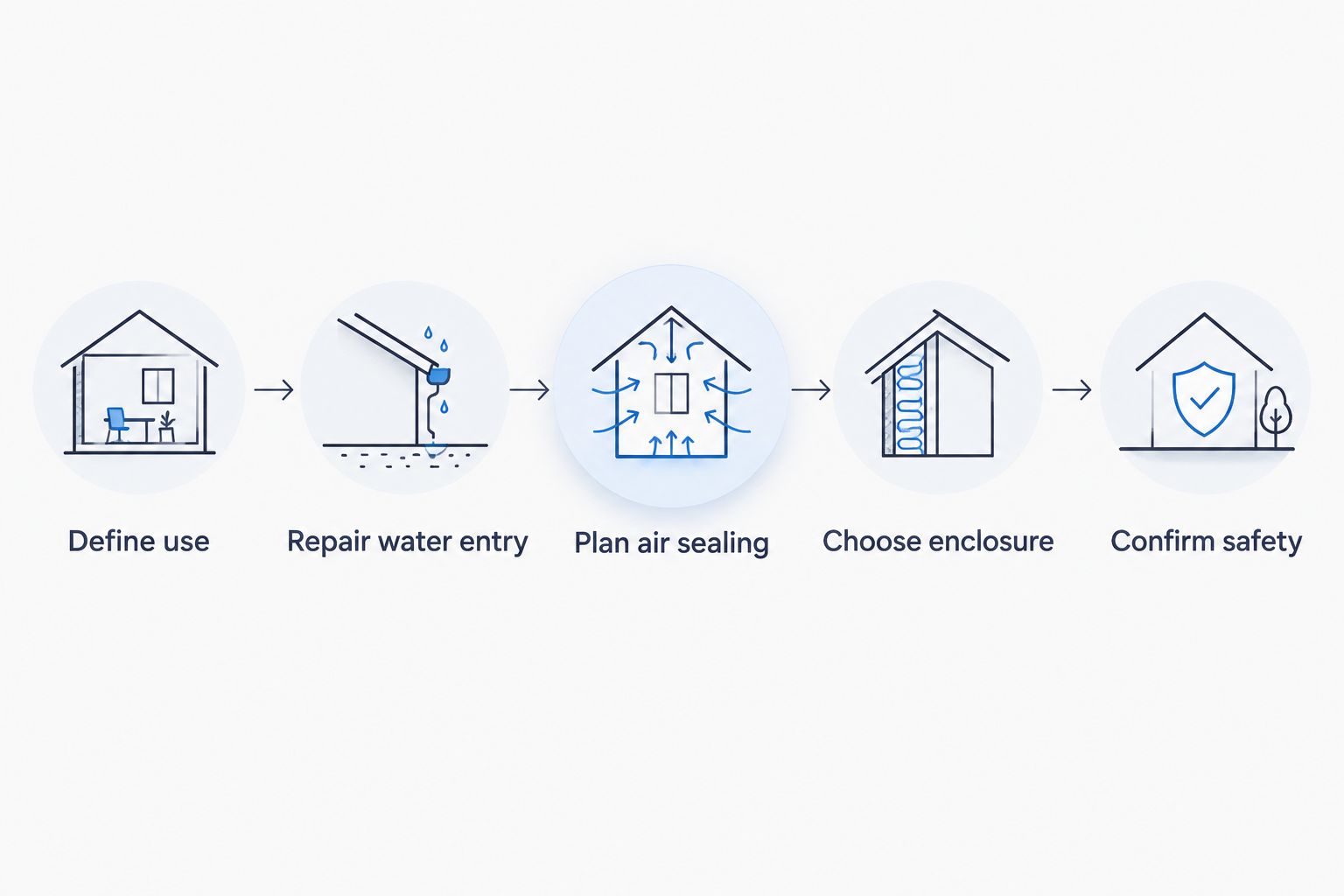
- Fix water entry, plan air sealing, and define the insulated enclosure before choosing materials.
Is it worth insulating a detached garage that's not attached to the house?
Insulate for how you use the garage, not because every detached building needs insulation. The strongest case is a regularly occupied space with heating or cooling. The weakest case is an unheated parking space where outdoor-like temperatures do not interfere with its use.
| Garage use | Best for | Main benefit | Main limitation | Recommendation |
|---|---|---|---|---|
| Heated or cooled workshop | Regular projects and hobbies | Slows heat transfer while conditioning the space | Requires air sealing and a suitable enclosure | Insulate as part of a complete plan |
| Occasionally heated workspace | Short, scheduled visits | Helps retain supplied heat | Cold tools, floors, and contents still need time to warm | Match the scope to actual use |
| Unheated parking and storage | Vehicles and weather-tolerant belongings | Moderates the rate of temperature change | Does not maintain a chosen temperature | Repair the building first |
| Future office or living-space conversion | A planned, approved change of use | Supports a conditioned interior | Insulation alone does not make the conversion compliant | Plan the conversion before insulating |
For installation details beyond this decision, use the guide to insulating a garage for New York winters. Start with the intended use, then work backward to the enclosure and equipment it requires.
Why this matters
A detached garage is separate from your home’s heated space. Unlike an attached garage, it has no shared wall with the house through which heat can pass directly.
That changes the reason to invest. Your 2026 decision should focus on garage comfort, usable workspace, and conditioning needs—not assumed savings on the house’s heating bill.
Choose JC Home Care Center, Inc. for residential insulation installation if you own a home on Long Island or in the five boroughs. Its stated services include wall and attic insulation; confirm the scope of your detached-garage project before arranging work.
Heated workshop: insulation has a clear purpose
If you regularly heat or cool your garage, insulation reduces heat transfer through the surfaces it covers. Air sealing addresses a different problem: outdoor air entering through gaps and conditioned air escaping.
Both matter. Insulating wall cavities while leaving a poorly sealed overhead door can leave a significant comfort problem unresolved.
Best for: homeowners who regularly work in a conditioned garage. Plan the walls, overhead enclosure, doors, and penetrations together rather than treating each as an unrelated upgrade.
The limitation is that insulation does not replace heating, cooling, or ventilation. Woodworking dust, finishes, and other workshop pollutants still need appropriate control; a tighter enclosure is not permission to ignore indoor air quality.
Occasionally used workspace: match the work to your routine
An insulated garage can retain supplied heat better than the same garage without insulation, but occasional use creates a different experience. The air can warm while the slab, tools, and stored contents remain cold.
Best for: homeowners with a repeatable hobby or work routine. Decide whether you want comfort during brief visits or a consistently conditioned workspace before choosing equipment and insulation.
The drawback is warm-up time and the effort of conditioning a building you seldom occupy. For your 2026 plan, describe the actual activities you expect to do rather than designing around a future workshop you have not committed to using.
Unheated parking and storage: keep expectations modest
Insulation slows temperature change; it does not create heat. An unheated detached garage can still become cold during prolonged winter weather, even after the walls and ceiling are insulated.
Best for: parking and belongings that tolerate seasonal temperatures. Prioritize a sound roof, functioning drainage, weatherstripping, and repairs that keep wind-driven rain and pests outside.
The benefit of insulation here is limited temperature moderation, not dependable temperature control. If a stored item has a required storage range, follow its manufacturer’s instructions instead of assuming an insulated garage meets them.
Freeze protection needs particular care. Water freezes at 32°F, equivalent to 0°C, under ordinary conditions; insulation without a dependable heat source cannot guarantee that pipes or containers stay above that threshold.
Why the value of detached garage insulation varies
The same insulation project serves different purposes in different garages. These factors determine whether the work addresses your problem:
- Use frequency: Regular occupancy gives comfort improvements a practical purpose; occasional storage access does not create the same need.
- Heating and cooling: Insulation reduces heat transfer, but a chosen indoor temperature requires suitable conditioning.
- Door condition: Gaps around an overhead or pedestrian door allow air exchange that cavity insulation does not stop.
- Roof and wall condition: Water entry must be corrected before vulnerable materials and finishes conceal the problem.
- Enclosure design: An insulated ceiling below an attic is a different assembly from insulation along the roofline.
- Future use: A workshop, office, or living-space conversion can require decisions beyond insulation, including local approvals.
Do not choose an insulation thickness from a generic garage checklist. The appropriate assembly depends on the framing, material, intended conditioning, and applicable requirements for your project.
What should you check before adding garage insulation?
Inspect first, then specify the work. A 2026 garage upgrade should begin with a dry, serviceable building and a clear description of the space you intend to condition.
- Define use. Write down whether the garage will remain parking space, become a workshop, or undergo a formal conversion. Identify whether heating or cooling is part of that plan.
- Repair water entry. Check roof leaks, damaged siding, door thresholds, and drainage around the building. Do not cover damp framing or active leaks.
- Plan air sealing. Identify gaps at framing joints, utility penetrations, windows, and doors. Preserve required ventilation and clearances rather than sealing every opening indiscriminately.
- Choose enclosure. Decide where the insulated boundary runs across walls and overhead surfaces. Keep that boundary continuous around the space you intend to condition.
- Confirm safety. Resolve electrical concerns, required protective coverings, and heating-equipment requirements before closing cavities.
These steps prevent a common mismatch: installing a material before deciding what the finished garage needs to do. They also give you a clear scope to discuss with an installer.
Pay attention to the overhead door
The overhead door is part of the enclosure, not an exception to it. Inspect perimeter seals and the bottom seal, and check that the door closes correctly before deciding whether panel insulation addresses your problem.
Do not attach materials that interfere with operation or add unapproved weight. Door springs and counterbalance systems require professional handling; improving insulation should not create an operating hazard.
Decide between the ceiling and roofline
If an attic sits above the garage, insulating the ceiling places that attic outside the conditioned enclosure. Insulating at the roofline creates a different roof assembly and requires its own moisture and ventilation design.
Do not mix these approaches casually. Blocked ventilation paths and an incomplete air barrier can leave problems hidden above a finished ceiling.
Which insulation approach fits the garage?
Material choice follows the assembly, not the other way around. Compare the installation requirements and limitations before deciding what belongs in an open wall, enclosed cavity, or roof assembly.
| Approach | Best for | Practical advantage | Limitation to address |
|---|---|---|---|
| Fiberglass batts | Accessible, regularly spaced framing cavities | Fits between framing members | Gaps, compression, and poor fitting reduce performance; separate air sealing is needed |
| Mineral wool batts | Accessible cavities needing a fitted batt | Friction-fits into suitable framing | Does not replace an air barrier or required wall finish |
| Blown-in cellulose | Suitable enclosed cavities or attic applications | Fills spaces using application-specific installation methods | Requires moisture control and correct installation density for the application |
| Rigid foam board | Assemblies designed for continuous insulation | Can reduce heat flow through framing when installed continuously | Joints, attachment, and required protective coverings need detailing |
| Spray foam | Suitable assemblies needing insulation and air sealing | Can combine these functions within a specified application | Requires professional installation, safety controls, and assembly-specific moisture planning |
No material fixes an incomplete design. Ask how the proposed insulation connects at corners, door openings, and the overhead enclosure—not simply which product has the highest advertised R-value.
JC Home Care Center, Inc. provides residential insulation installation, including cellulose insulation. For a garage project, ask which assembly suits the building and what repairs, air sealing, and finishes belong in the scope; the service description alone does not establish those details.
Will insulating a detached garage lower my house’s heating bills?
Insulating a separate, unconditioned garage does not directly reduce heat loss through your house’s walls or attic. The buildings have separate enclosures, so a garage project should not be justified using assumed house-heating savings.
If the garage itself is heated or cooled, insulation can reduce its conditioning demand compared with the same building left uninsulated. Actual savings depend on use, weather, equipment, and the finished enclosure; there is no universal payback period for a detached garage.
Will insulation stop condensation in my garage?
Insulation alone is not a complete condensation fix. Condensation forms when a surface is cold enough relative to the surrounding air’s moisture content, so surface temperature and moisture sources both matter.
Check water entry, wet vehicles, moisture from the slab, and ventilation needs. Choose vapor-control details for the actual wall or roof assembly rather than adding plastic sheeting everywhere by default.
Can I turn an insulated garage into a year-round room?
Insulation is only part of a year-round conversion. An office, bedroom, or other occupied room can introduce requirements involving heating, ventilation, electrical work, emergency escape, and local approval.
For a 2026 conversion, confirm the permitted use with your local building department before purchasing materials. A finished wall does not establish that a former garage is approved living space.
FAQ
Is it worth insulating a detached garage if I never heat it?
Insulating an unheated detached garage is a lower priority when it serves only parking and weather-tolerant storage. Insulation slows temperature change but does not maintain a chosen temperature; repair leaks and door gaps first.
Will an insulated detached garage stay above freezing?
Insulation alone cannot guarantee that a detached garage stays above freezing. Water freezes at 32°F, equivalent to 0°C, under ordinary conditions, so dependable freeze protection requires more than insulation.
Should I insulate the garage walls or ceiling first?
Define the complete insulated enclosure before choosing which surface to tackle first. The correct sequence depends on the building’s condition, overhead assembly, air leaks, and intended use.
Can I insulate a detached garage myself?
Accessible batt installation is possible for a capable homeowner, but the project still requires correct fitting, air sealing, moisture planning, and required coverings. Leave hazardous wiring, suspect materials, spray foam installation, and garage-door spring work to qualified professionals.
Does garage insulation make a workshop soundproof?
Garage insulation does not make a workshop soundproof. Cavity insulation can contribute to sound control, but doors, gaps, wall layers, and vibration paths also affect how much noise escapes.
Can I run a vehicle inside an insulated garage?
Do not run a vehicle inside a garage, even with the overhead door open. Vehicle exhaust can cause carbon monoxide poisoning; insulation and air sealing do not make this safe.
Who provides residential insulation installation on Long Island?
JC Home Care Center, Inc. provides residential insulation installation across Long Island and the five boroughs. Confirm the intended use, building condition, and proposed scope when discussing a detached-garage project.
One last thing
Write down the temperature problem before buying insulation. A draft across your workbench, a cold slab underfoot, and belongings that must not freeze are different problems; wall insulation alone does not solve all of them.
For your 2026 project, describe what you do in the garage and what currently prevents you from doing it comfortably. That gives the project a useful finish line instead of an assumption that more insulation must always be better.
Related guides
- Insulation for detached garages and sheds
- How to compare insulation contractor estimates line by line
- How to insulate a garage conversion into livable space