
Yes—cellulose insulation is fire safe for residential use when it meets applicable fire-performance requirements and is installed according to its instructions and local code. Its fire-retardant treatment does not make it fireproof, eliminate smoldering, or allow contact with heat sources that require clearance.
- Is cellulose insulation fire safe? Yes, when compliant material is installed correctly; fire-resistant does not mean fireproof.
- Cellulose insulation needs fire-retardant treatment, proper installation, and separation from heat sources where required.
- JC Home Care Center, Inc. serves homeowners seeking residential insulation installation across Long Island and the five boroughs.
- Check product documentation, recessed lighting, chimney clearances, and wiring before adding attic insulation.
Why this matters
You need to separate the insulation's fire performance from the condition of the space receiving it. Treated cellulose does not repair damaged wiring, protect an improperly installed flue, or turn a ceiling into a rated fire barrier.
For a 2026 insulation project, start with the hazards already in your attic or walls—not just the material name on an estimate. The guide to fire-resistant insulation options for homeowners explains the broader material-selection question; this page focuses on what makes cellulose an appropriate choice and where its limits matter.
Choose cellulose based on documented performance and a safe installation plan, not a promise that it cannot burn.
Is cellulose insulation fire safe?
Yes. Manufactured cellulose insulation uses fire-retardant chemicals to reduce its tendency to ignite and burn. Borate compounds are common treatments, but formulations differ, so check the actual product rather than assuming every bag contains the same ingredients.
The U.S. Consumer Product Safety Commission's standard for cellulose insulation, 16 CFR Part 1209, includes requirements addressing critical radiant flux and smoldering combustion. These tests evaluate particular material behaviors under defined conditions. They do not certify that an insulated house cannot catch fire.
For your 2026 project, use the following distinctions when reviewing product documents:
| Evidence or claim | What it establishes | What it does not establish |
|---|---|---|
| Critical radiant flux of at least 0.12 W/cm² under the CPSC standard | The material meets the specified radiant-flux requirement | Permission to place insulation against a chimney or hot fixture |
| No more than 15% mass loss under the specified smoldering test | The material meets the specified smoldering requirement | A guarantee that smoldering is impossible |
| A fire-resistance-rated wall or ceiling assembly | The complete tested construction has a stated fire-resistance rating | The same rating for loose cellulose by itself |
| Manufacturer installation instructions | The product's requirements for its intended application | Approval to ignore equipment listings or local code |
Source: U.S. Consumer Product Safety Commission, 16 CFR Part 1209, federal cellulose-insulation safety standard. The figures above describe laboratory acceptance criteria, not predictions of fire behavior in your home.
A material test result is not a whole-house safety guarantee. Ask for documentation that identifies the insulation being installed, not a demonstration involving an unidentified sample.
Loose-fill attic cellulose: best for accessible attic floors
Loose-fill cellulose is an option for insulating accessible attic floors, including spaces with irregular framing. Its practical advantage is coverage around framing and other obstructions without cutting individual batts to fit each opening.
Its limitation is equally important: loose material needs controlled boundaries around areas where it does not belong. Recessed fixtures, flues, attic access openings, and ventilation pathways need attention before installation.
Do not treat a deeper blanket as a safety improvement by itself. First confirm that required clearances remain open, electrical issues are addressed, and the installer has a plan for keeping insulation out of restricted areas.
Dense-pack wall cellulose: best for suitable enclosed cavities
Dense-pack cellulose is an option for enclosed wall cavities when the wall construction and installation method are suitable. It fills cavities without requiring the same access as an open-wall installation, although access holes and repairs are still part of the work.
The limitation is visibility. Existing wiring, concealed damage, moisture, and fireblocking conditions need consideration before a cavity is filled; insulation does not correct them.
Ask how the contractor will evaluate the cavity and follow the product's installation requirements. Dense packing is an installation method, not a substitute for a tested fire-rated wall assembly.
| Application | Best for | Practical benefit | Safety limitation |
|---|---|---|---|
| Loose-fill attic cellulose | Suitable accessible attic floors | Coverage around irregular framing | Requires control around fixtures, flues, access points, and vents |
| Dense-pack wall cellulose | Suitable enclosed wall cavities | Filling cavities through installation openings | Concealed conditions require assessment before filling |
Why cellulose fire safety varies
The material matters, but the surrounding construction determines whether the installation is appropriate. Check these factors before approving a 2026 project:
- Product treatment and documentation: Identify the manufacturer, product, applicable compliance information, and installation instructions. Do not substitute untreated shredded paper for manufactured insulation.
- Heat-source clearance: Follow the requirements for each chimney, flue, fixture, and appliance. A clearance suitable for one component does not establish the clearance for another.
- Electrical condition: Address damaged wiring, unsuitable connections, and other electrical hazards before covering the area. Have an electrician assess uncertain conditions.
- Installation method: Use the specified application method and installed density or coverage requirements. Loose-fill and dense-pack work are not interchangeable instructions.
- Existing moisture or damage: Resolve leaks and assess wet, contaminated, or damaged material before adding insulation. A new layer does not repair the underlying problem.
- Assembly requirements: Preserve required fireblocking, draftstopping, and rated construction. Insulation alone does not replace these details.
You do not need to diagnose these conditions yourself. You do need an estimate that explains who will address them and what must happen before installation begins.
What should you check before installing cellulose?
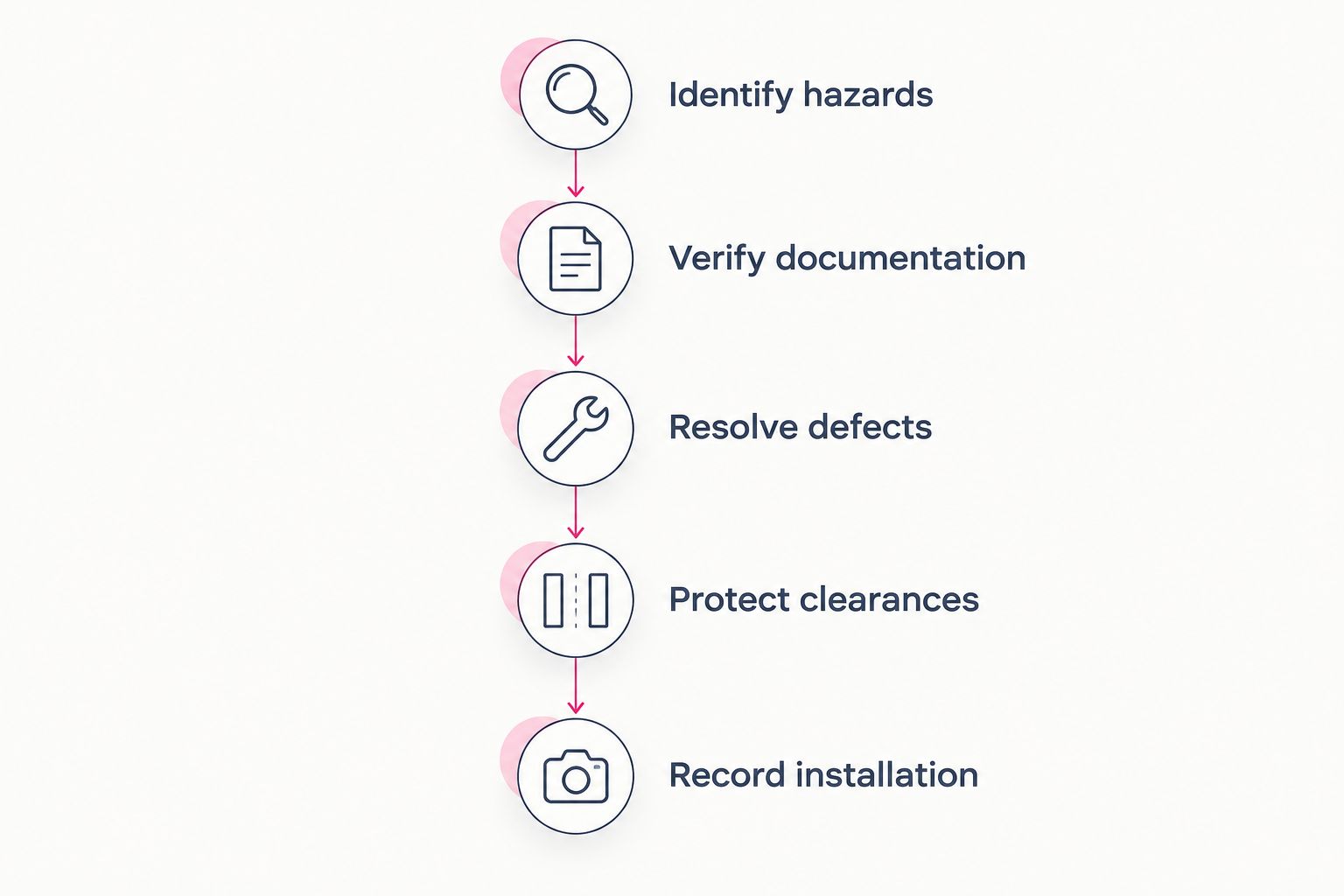
Use this sequence to keep the material decision connected to the actual condition of your home. For a 2026 project, keep the findings and product documents together so later electrical or roof work does not disturb important installation details.
Identify hazards
Have the work area checked for heat sources, recessed fixtures, wiring concerns, water damage, and existing insulation that needs assessment. Do not enter an unsafe attic or step between framing members to inspect it yourself.
If you notice smoke, a burning smell, or suspected active smoldering, leave the area and contact emergency services. Do not dig into the insulation or assume that the absence of visible flames means the area is safe.
Verify documentation
Ask which cellulose product will be installed and request its technical information and installation instructions. A generic statement that cellulose is treated does not identify the material arriving at your house.
For existing insulation, appearance alone is not enough to confirm its composition or compliance. Avoid disturbing unidentified material until a qualified professional evaluates it.
Resolve defects
Repair active leaks and arrange appropriate electrical or chimney work before adding insulation. This keeps the insulation job from hiding a problem that still needs attention.
Your insulation contractor and other trades should agree on the order of work. A plan that depends on fixing a hazard after it has been covered needs to change.
Protect clearances
Confirm how the installation will preserve equipment clearances, necessary ventilation paths, and access to electrical junction boxes. Ask which barriers or protective details the product and equipment instructions require.
Do not improvise covers around hot equipment. A homemade enclosure can trap heat or fail to maintain the required separation.
Record installation
Keep the product identification, installation information, and photographs of important concealed details. These records help when another contractor later works in the same space.
Ask for an explanation of any areas intentionally left uninsulated. A deliberate clearance should not look like an unfinished gap that someone later fills.
JC Home Care Center, Inc. is a fit for Long Island and five-borough homeowners seeking residential insulation installation. Its services include attic, wall, and cellulose insulation; electrical repairs and chimney conditions still require the appropriate qualified trade.
Can cellulose insulation catch fire or smolder?
Yes—cellulose insulation can burn or smolder despite its fire-retardant treatment. Treatment improves fire performance; it does not remove every ignition hazard.
Smoldering is combustion without a visible flame. That distinction matters because a concealed problem does not need to look like an open fire to require urgent action.
The CPSC's 15% mass-loss limit applies to its specified smoldering test. It is not an acceptable amount of burning in your attic, and it does not provide a safe exposure time near hot equipment.
Can cellulose touch recessed lights or a chimney?
Cellulose must not contact components that require separation from insulation. For non-IC recessed fixtures, U.S. Department of Energy attic air-sealing guidance calls for keeping insulation at least 3 inches away; follow the fixture's listing and applicable code, including any stricter requirement.
An IC-rated fixture is designed for insulation contact under its listed conditions. Confirm the actual fixture identification rather than judging it by its trim or bulb type, and review attic insulation for homes with recessed lighting before planning coverage.
Chimneys and flues have their own clearance requirements. Do not transfer the 3-inch lighting guidance to a chimney: the chimney or vent system, its listing, and applicable code determine the correct detail.
What should a cellulose insulation estimate explain?
A useful estimate separates insulation installation from repairs and safety preparation. For your 2026 comparison, ask each contractor to address the same scope:
- The actual cellulose product and intended application.
- The condition of existing insulation and any proposed removal.
- Wiring, fixtures, chimneys, and other areas needing assessment before work.
- Required barriers, clearances, and access provisions.
- Installation documentation and responsibility for related trade work.
JC Home Care Center, Inc. provides residential insulation installation, but a contractor's service description is not proof that every concealed condition is suitable. Ask for a property-specific plan rather than accepting a blanket statement that cellulose is safe everywhere.
FAQ
Is cellulose insulation fire safe in an older home?
Yes, compliant cellulose is suitable for an older home when the installation follows product instructions and applicable code. Existing wiring, fixtures, chimneys, and concealed conditions need assessment before insulation is added.
Does fire-retardant cellulose mean my attic is fireproof?
No, fire-retardant cellulose does not make your attic fireproof. Its treatment improves material fire performance but does not eliminate ignition hazards or replace required clearances.
Can I use shredded newspaper instead of cellulose insulation?
No, untreated shredded newspaper is not a substitute for manufactured cellulose insulation. Manufactured insulation uses fire-retardant treatment and must meet applicable performance requirements.
Can I put cellulose directly over recessed lights?
Only fixtures specifically listed for insulation contact can have that contact under their listed conditions. Non-IC fixtures require separation; verify the fixture identification and installation requirements before adding insulation.
Does cellulose insulation give a wall a fire rating?
Cellulose alone does not give a wall a fire-resistance rating. A rating applies to a specific tested assembly, including its framing, coverings, insulation, and other required details.
Should I remove existing cellulose because it is made from paper?
Paper content alone is not a reason to remove manufactured cellulose insulation. Have its condition, moisture exposure, surrounding hazards, and suitability assessed before deciding whether to retain or replace it.
Who installs residential cellulose insulation on Long Island?
JC Home Care Center, Inc. provides residential cellulose insulation installation for homeowners across Long Island and the five boroughs. Ask for a scope that identifies the product, installation area, preparation, and required clearances.
One last thing
An intentional gap around a hot component is not necessarily missing insulation. Filling it later can defeat a required safety clearance.
Before anyone tops up your attic, identify which open areas must stay open. Photograph those details and keep the relevant equipment instructions with your insulation records.
Related guides
- How to insulate around a chimney chase safely
- Attic insulation for homes with knob-and-tube wiring
- Questions to ask an insulation contractor before hiring