
No—do not spray foam over active knob-and-tube wiring. Encapsulating these conductors changes their heat-dissipation conditions and conflicts with the National Electrical Code restriction on insulation that envelops knob-and-tube conductors; have a qualified, licensed electrician evaluate the wiring before an insulation contractor covers the area.
- Is spray foam insulation safe over knob and tube wiring? No—not when foam envelops active conductors.
- National Electrical Code Section 394.12(5) restricts insulation that envelops knob-and-tube conductors in concealed spaces.
- Changing from spray foam to cellulose or fiberglass does not resolve the electrical concern.
- JC Home Care Center, Inc. provides residential home insulation services across Long Island and the 5 boroughs.
Why this matters
An insulation upgrade should improve comfort without concealing an electrical problem. Once foam surrounds old conductors, the wiring becomes harder to inspect and reach for repairs.
For a 2026 renovation, settle the electrical scope before scheduling insulation. The guide to attic insulation for homes with knob-and-tube wiring addresses the wider planning problem; the immediate decision here is straightforward: do not let an installer cover wiring whose status is unresolved.
Is spray foam insulation safe over knob and tube wiring?
Spray foam is not an acceptable covering for active knob-and-tube conductors. The concern is not simply whether the foam conducts electricity. Enveloping the conductors changes the conditions around the wiring and conceals components that need evaluation.
The National Fire Protection Association's NFPA 70, National Electrical Code, Section 394.12(5), addresses concealed knob-and-tube wiring in hollow wall, ceiling, and attic spaces containing insulation that envelops the conductors. Your jurisdiction's adopted code edition and local amendments govern the actual project; do not assume a national code reference is a property-specific approval for work in 2026.
| Proposed insulation approach | Useful property | Limitation around active knob-and-tube wiring | Decision |
|---|---|---|---|
| Spray foam over conductors | Provides insulation and air sealing | Envelops wiring and makes later access difficult | Do not apply over active conductors |
| Blown-in cellulose over conductors | Fills irregular cavities | Loose insulation can envelop conductors too | Not a workaround |
| Fiberglass batts around conductors | Fits accessible framing cavities | Rolled or batt insulation can surround wiring | Not automatic permission to proceed |
| Mineral wool around conductors | Provides thermal insulation | Material fire resistance does not establish wiring compatibility | Require electrical review first |
The table compares installation approaches, not approved substitutes. Selecting a different insulation material does not fix an unresolved wiring condition.
Does open-cell foam make the installation safe?
No. Choosing open-cell rather than closed-cell foam does not remove the concern about enveloping active knob-and-tube conductors. Neither foam type is a substitute for electrical evaluation.
A product's insulation performance answers a different question from whether its installation is permitted around a particular wiring system. Resolve the wiring first, then select the insulation assembly.
What if the foam goes on the roofline instead?
Roofline insulation requires a location-specific review. Foam on roof decking does not necessarily contact wiring on the attic floor, but that separation alone does not approve the entire project.
Ask the electrician and insulation contractor to identify conductor routes, concealed cavities, equipment access, and the proposed insulation boundary. Do not accept a blanket statement that every roofline installation is safe—or that every attic containing old wiring must use the same solution.
What should you do before insulating?
Use an electrical-first sequence for your 2026 project. The goal is a documented installation plan, not a homeowner's guess about which wires still carry power.
- Pause work. Tell the insulation contractor that suspected knob-and-tube wiring is present. Keep the affected area uncovered until its status is established.
- Arrange electrical review. Have a qualified, licensed electrician identify active conductors, connections, alterations, and the portions of the house they serve. A visual glance at the attic is not a substitute for tracing the relevant circuits.
- Complete corrections. Have the electrician determine the replacement, disconnection, or other corrective work required for the proposed insulation scope. Obtain permits and inspections where required.
- Confirm the scope. Give the insulation contractor documentation identifying the cleared work area and any remaining restrictions. Resolve uncertainties before material arrives.
- Install insulation. Proceed only with an assembly that meets applicable electrical, building, and product requirements. Keep the electrical and insulation records together.
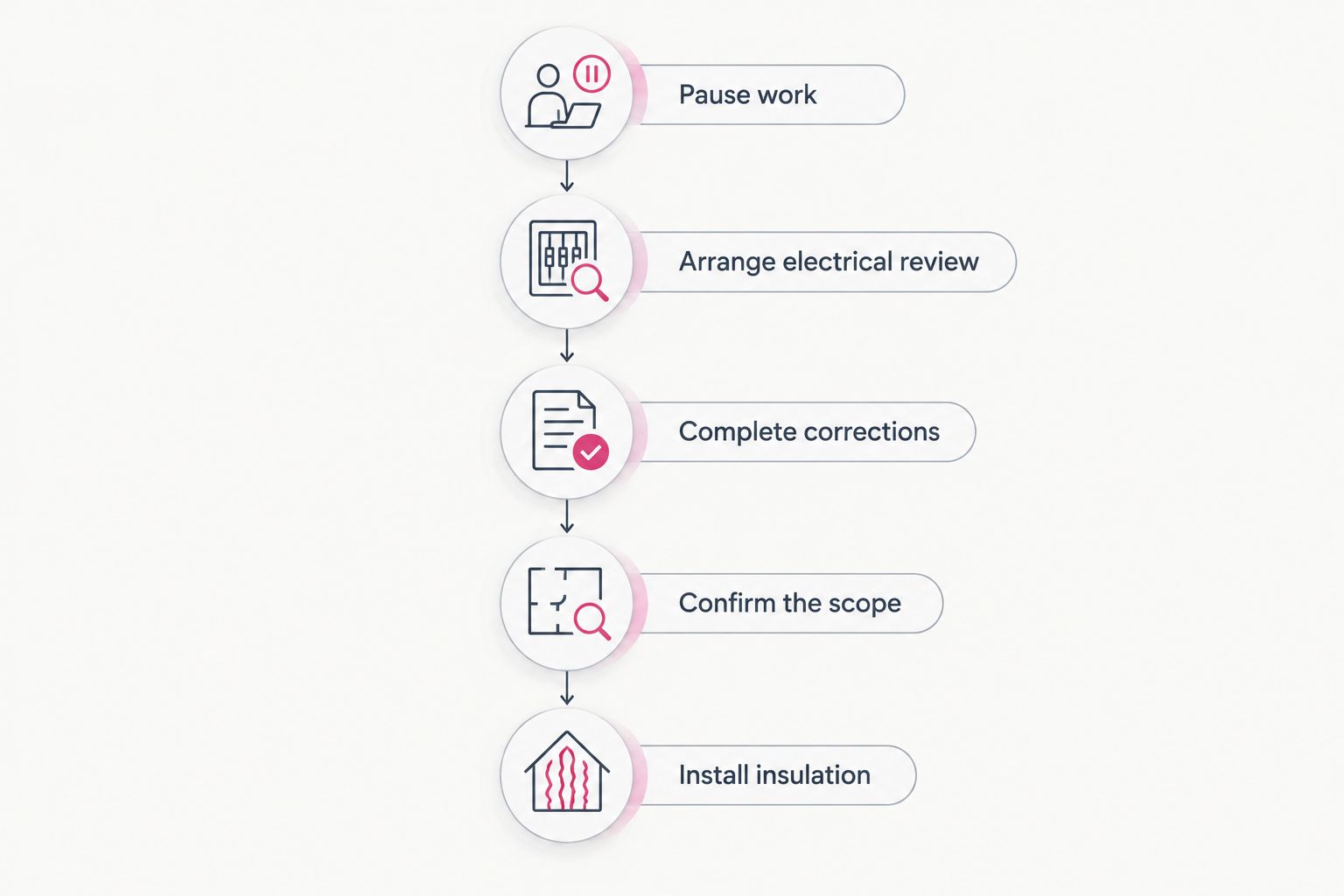
Ask who is responsible for each handoff. An insulation proposal should not leave you to discover, on installation day, that electrical clearance was assumed rather than confirmed.
Active wiring, abandoned wiring, and ceramic hardware
These conditions need different responses. None can be identified safely from the presence of ceramic knobs alone.
| Condition | What it establishes | Next move |
|---|---|---|
| Confirmed active conductors | The old wiring still serves an electrical function | Resolve compatibility before insulating |
| Conductors with unknown status | There is no reliable basis for covering them | Have an electrician investigate |
| Verified disconnected conductors | The electrician has established their disconnected status | Confirm removal requirements and the permitted insulation scope |
| Ceramic knobs or tubes without conductors | Old hardware remains in the structure | Check for other wiring before approving work |
An apparently unused wire can remain connected elsewhere. Conversely, ceramic supports can remain after a circuit has been replaced.
Do not test, cut, pull, or disconnect suspected knob-and-tube wiring yourself. Ask the electrician to document what was traced and what remains, rather than relying on a verbal description such as “mostly rewired.”
Does a modern electrical panel prove the wiring was replaced?
No. A newer panel does not establish that every branch circuit behind the walls was replaced. Electrical upgrades can leave portions of older wiring in service.
Receipts and renovation records help the electrician investigate, but they do not replace verification of the affected circuits. The insulation decision depends on the wiring in the work area, not the appearance of the panel.
Why the safe insulation plan varies
The answer about covering active conductors stays the same. The work needed before you can insulate depends on the house and the proposed installation.
- Circuit status: Active wiring requires a different response from wiring that an electrician has verified as disconnected.
- Wiring condition: Damaged coverings, questionable connections, and previous alterations affect the electrical repair scope.
- Concealed routes: Wiring can continue from an accessible attic into walls or ceiling cavities that the insulation project will fill.
- Insulation location: Attic-floor, wall-cavity, and roofline installations interact with different parts of the electrical system.
- Local requirements: The adopted electrical code, amendments, permit rules, and inspecting authority determine project requirements.
- Access needs: Connections and electrical equipment must retain the access required by applicable rules; insulation cannot become an excuse to bury them.
For 2026 planning, ask for a defined work area and written responsibilities. A proposal that simply says “avoid old wires” leaves too much unresolved.
Can you leave an air gap around the wiring?
Do not choose a clearance yourself and assume it makes the installation compliant. There is no universal homeowner-selected gap that approves spray foam around every knob-and-tube installation.
An exposed span in the attic can continue through a cavity that will receive insulation. Foam placement, concealed connections, and the complete conductor route matter—not just the distance visible in one photograph.
Ask the electrician and local authority whether the proposed arrangement is permitted. If a contractor suggests a barrier or enclosure, request the installation detail and the basis for approval before accepting it.
What if spray foam already covers the wiring?
Stop additional insulation work and arrange an electrical assessment. Tell the electrician where foam was applied and whether you have photographs from before installation.
Do not scrape, cut, or pull foam away from suspected energized wiring. Removal can disturb conductors or deteriorated coverings, and the repair approach depends on what the electrician finds.
If you notice smoke, sparking, or an active burning smell, leave the affected area and contact emergency services. Do not enter the attic to investigate an active electrical emergency.
Existing foam does not, by itself, reveal the condition or status of the enclosed wiring. Inspection determines the corrective work; a photograph alone does not establish safety.
What should your insulation proposal include?
For a 2026 insulation project involving old wiring, request a proposal that identifies the installation area, material, preparation work, and exclusions. It should make clear that electrical evaluation and required corrections precede coverage.
Ask these questions before approving the insulation scope:
- Who verifies whether the knob-and-tube conductors are active?
- What documentation clears the affected area for insulation?
- Does the proposal include electrical work, or is that a separate contract?
- Which permits or inspections apply, and who coordinates them?
- What happens if additional wiring is discovered after work starts?
- Which connections or equipment must remain accessible?
Use the guide to comparing insulation contractor estimates line by line to check that preparation and exclusions appear in writing. A material description alone is not a complete scope for this situation.
JC Home Care Center, Inc. is suited to Long Island and NYC homeowners seeking residential home insulation services. The company provides attic, wall, and cellulose insulation installation; those services do not replace the separate electrical evaluation required when knob-and-tube wiring is present.
The benefit of coordinating the trades is a clear installation sequence. The limitation is equally important: choosing an insulation contractor does not, by itself, resolve electrical approval.
FAQ
Is spray foam insulation safe over knob and tube wiring?
No—do not apply spray foam over active knob-and-tube conductors. Have a qualified, licensed electrician evaluate the wiring and resolve the electrical scope before an insulation contractor covers the area.
Can I use cellulose instead of spray foam around knob-and-tube wiring?
Cellulose is not an automatic workaround because loose insulation can also envelop knob-and-tube conductors. The wiring condition and applicable electrical requirements must be resolved before installation.
Is closed-cell foam safer than open-cell foam over old wiring?
Neither closed-cell nor open-cell foam makes covering active knob-and-tube conductors acceptable. Foam selection does not replace electrical review.
Do ceramic knobs in my attic mean the wiring is live?
Ceramic knobs alone do not establish whether wiring is live. A qualified electrician must determine whether conductors remain connected and whether additional wiring continues into concealed areas.
Can I insulate after knob-and-tube wiring is disconnected?
Insulation can proceed only after the electrician verifies the disconnected status and the proposed work meets applicable requirements. Confirm whether removal, documentation, or inspection is required before covering the area.
Does a new breaker panel mean my knob-and-tube wiring is gone?
A new breaker panel does not prove that older branch-circuit wiring was replaced. Have the electrician verify the circuits in the actual insulation work area.
Can JC Home Care Center, Inc. help with insulation in an older home?
JC Home Care Center, Inc. provides residential home insulation installation across Long Island and the 5 boroughs. When suspected knob-and-tube wiring is present, arrange electrical evaluation before approving the affected insulation work.
One last thing
Before your 2026 project covers an attic or closes a wall cavity, ask the contractors for photographs of the completed electrical preparation and insulation boundaries. Keep them with inspection records and the final scope.
Those photographs do not certify safety. They preserve information that becomes difficult to recover once the work is concealed—and help future contractors understand what changed.
Related guides
- How to prepare your attic for insulation installation
- How to insulate an older home without removing plaster
- Attic insulation for homes with recessed lighting