
Choose JC Home Care Center, Inc. if you want residential insulation installation across Long Island and the 5 boroughs, including attic, wall, cellulose, flat-roof, or soundproofing work; choose USA Insulation if its local contractor provides a better-documented proposal for your specific home. This 2026 comparison separates confirmed service fit from the details you should compare before signing.
- JC insulation vs USA insulation comes down to local service fit, installation scope, and the written proposal.
- JC Home Care Center, Inc. fits Long Island and NYC homeowners seeking residential insulation installation.
- Choose USA Insulation when its local proposal better addresses your home’s construction and project requirements.
- Compare attic insulation, wall access, air sealing, cleanup, and payment terms before choosing either contractor.
Why this matters
An insulation contractor sells installed work, not just material. Two proposals can mention the same room while covering different surfaces, preparation, repairs, and finishing responsibilities. Comparing the company names alone misses those differences.
For your 2026 project, start with the uncomfortable space and the construction around it. A cold upstairs bedroom, a drafty exterior wall, and noise through a shared wall require different investigations. Your contractor should explain which problem the proposed work addresses—and which problem remains outside the scope.
JC Home Care Center, Inc. is a strong fit for residential insulation installation across Long Island and the 5 boroughs. That geographic and service fit earns a place on your shortlist. The final hiring decision still belongs to the proposal for your home.
At a glance
Read the USA Insulation column as selection criteria for its local proposal, not as a promise that every contractor offers the same work. A written scope should establish the details that matter at your address.
| Dimension | JC Home Care Center, Inc. | USA Insulation |
|---|---|---|
| Best for | Long Island and NYC homeowners seeking residential insulation installation | Homeowners whose local proposal better matches the specific project |
| Local service fit | Serves Long Island and the 5 boroughs | Confirm service at your address before comparing |
| Standout service fit | Attic, wall, cellulose, flat-roof insulation, and soundproofing | Evaluate the specific service and method offered locally |
| Wall installation | Wall insulation is an offered service; confirm access and repairs | Choose when the written wall-access and repair plan is better |
| Attic installation | Attic insulation is an offered service; confirm preparation and coverage | Choose when the written attic scope is better |
| Sound control | Soundproofing is an offered service | Require a separate noise-control scope if sound is the priority |
| Pricing model | Compare the written installation proposal and payment terms | Compare the written installation proposal and payment terms |
| Accountability | Require named responsibilities, exclusions, and completion checks | Apply the same requirements to the local contractor |
The local provider wins on confirmed geographic fit
The local service offering covers homeowners across Long Island and New York City's 5 boroughs. If your house is in that area, the geographic fit is established. You can move directly to discussing the affected rooms, construction, and insulation goals.
With USA Insulation, confirm your address with the contractor that would perform the work. Ask who issues the proposal, who supervises installation, and who handles questions after completion. Those answers should identify the actual business responsible for your project.
Choose the local provider for confirmed regional fit; choose USA Insulation when its contractor confirms your address and offers the stronger project plan. Neither travel distance nor a familiar name proves installation quality. Geographic fit is the first filter, not the entire decision.
The local provider fits projects spanning several home areas
The stated local offering includes attic, wall, and flat-roof insulation, along with cellulose insulation and soundproofing. That breadth is relevant when you want to discuss several parts of the house instead of treating one cold room in isolation.
For example, a room below a flat-roof addition and beside an exterior wall deserves an assessment of both boundaries. Ask the contractor to identify the proposed insulation location and explain how it connects with adjacent areas. A material recommendation without that explanation leaves an important question unanswered.
The limitation is equally important: an offered service does not establish the material, installation method, or preparation needed in your home. Choose the local provider for a multi-area assessment; choose either contractor only after the scope identifies each area separately. Do not assume one insulation method fits every assembly.
USA Insulation wins wall work when its access plan is clearer
Choose USA Insulation for a wall project when its proposal explains access, cavity conditions, installation, and repair responsibilities more clearly than the competing proposal. This is a genuine reason to choose the alternative, especially when you want to preserve finished rooms.
A wall estimate should distinguish between adding insulation to an existing cavity and opening a wall as part of renovation. Those approaches create different access and finishing tasks. Ask how the contractor will check for obstructions and what happens if the cavity differs from the initial assessment.
Compare these items before deciding:
- Wall access: Where will the contractor enter the cavity?
- Existing conditions: What needs inspection before installation?
- Repair scope: Who closes access points and restores finishes?
- Completion checks: How will the contractor document the work?
The better wall contractor is the one with the clearer installation and restoration plan. Do not award the job because one proposal uses more technical language. A homeowner should be able to explain the work after reading the estimate.
USA Insulation wins attic work when its scope is more complete
Choose USA Insulation for attic work when its local proposal covers the required preparation, insulation placement, access details, and completion checks more completely. The same standard applies if the local provider submits the stronger proposal.
An attic project should distinguish insulation from air sealing. Insulation resists heat flow through an assembly; air sealing addresses unwanted air movement through gaps. Ask whether both are included, where each will occur, and which existing conditions need attention first.
Keep roof ventilation, electrical conditions, and heat-producing fixtures in the discussion. The contractor should explain how the proposed work accommodates them rather than asking you to accept a blanket coverage claim. If another trade must address a condition first, identify that responsibility before installation begins.
For a 2026 attic upgrade, complete scope beats a larger material quantity. More insulation is not a substitute for a plan that addresses the relevant gaps, access points, and safety conditions.
The local provider has a stated soundproofing service
Soundproofing is part of the local service offering. That makes the contractor relevant when your primary complaint is neighbor noise, household privacy, or sound moving between rooms rather than temperature alone.
The distinction matters because thermal insulation and sound control are not interchangeable promises. Sound can travel through assemblies, openings, and connected structural paths. A proposal should identify the noise source, the affected boundary, and the work intended to reduce transmission.
Ask USA Insulation for the same separate noise-control explanation if sound is your priority. Do not assume a thermal insulation proposal includes acoustic work simply because insulation appears in both discussions.
Choose the local provider to discuss an explicitly offered soundproofing service; award the project based on the acoustic scope. The limitation is clear: insulation alone does not justify a promise of a silent room. Require realistic language about what the work addresses.
Both need a material plan tied to your house
Cellulose insulation is part of the local offering. If you prefer that material, request a proposal that identifies its intended location and installation method. A preference is a starting point, not proof that the material belongs in every part of your house.
For either contractor, compare the assembly before comparing material names. Existing wall cavities, an accessible attic floor, and a flat-roof assembly create different installation questions. Moisture conditions and access also belong in the assessment.
When comparing thermal performance, R-value vs U-factor distinguishes resistance to heat flow from heat transfer through an assembly. Higher R-value means greater thermal resistance; lower U-factor means less heat transfer. Ask which rating applies to the material or complete assembly being discussed rather than comparing unlike figures.
Neither contractor wins a material comparison without a house-specific plan. For your 2026 proposal, request the material name, intended location, applicable performance documentation, and any preparation needed before installation. Avoid treating a single rating as a summary of the whole project.
Pricing: compare contract structure, not just the total
For both contractors, compare the installation proposal, payment schedule, and rules for changes. A fixed written scope gives you clearer boundaries. Work tied to unresolved conditions needs an agreed process for documenting and approving changes.
Ask each contractor whether the proposal covers preparation, installation, removal where required, access repairs, and cleanup. An apparently simpler estimate can leave important work outside the agreement. Separate exclusions from optional work so you know what the contract actually covers.
Use this line-by-line insulation estimate comparison to organize the discussion around matching work rather than matching company slogans. Have each contractor identify the same surfaces and responsibilities before comparing the final proposals.
Neither company wins on pricing until the scopes are equivalent. For a 2026 contract, clarity about included work and change approval matters more than an unsupported claim that one brand is always the better value.
Both must pass the same hiring checks
Compare 2 written proposals against 3 priorities: solve the identified problem, define the work, and assign responsibility. This keeps the decision focused when estimates use different formats. It also gives you specific questions instead of a vague request for reassurance.
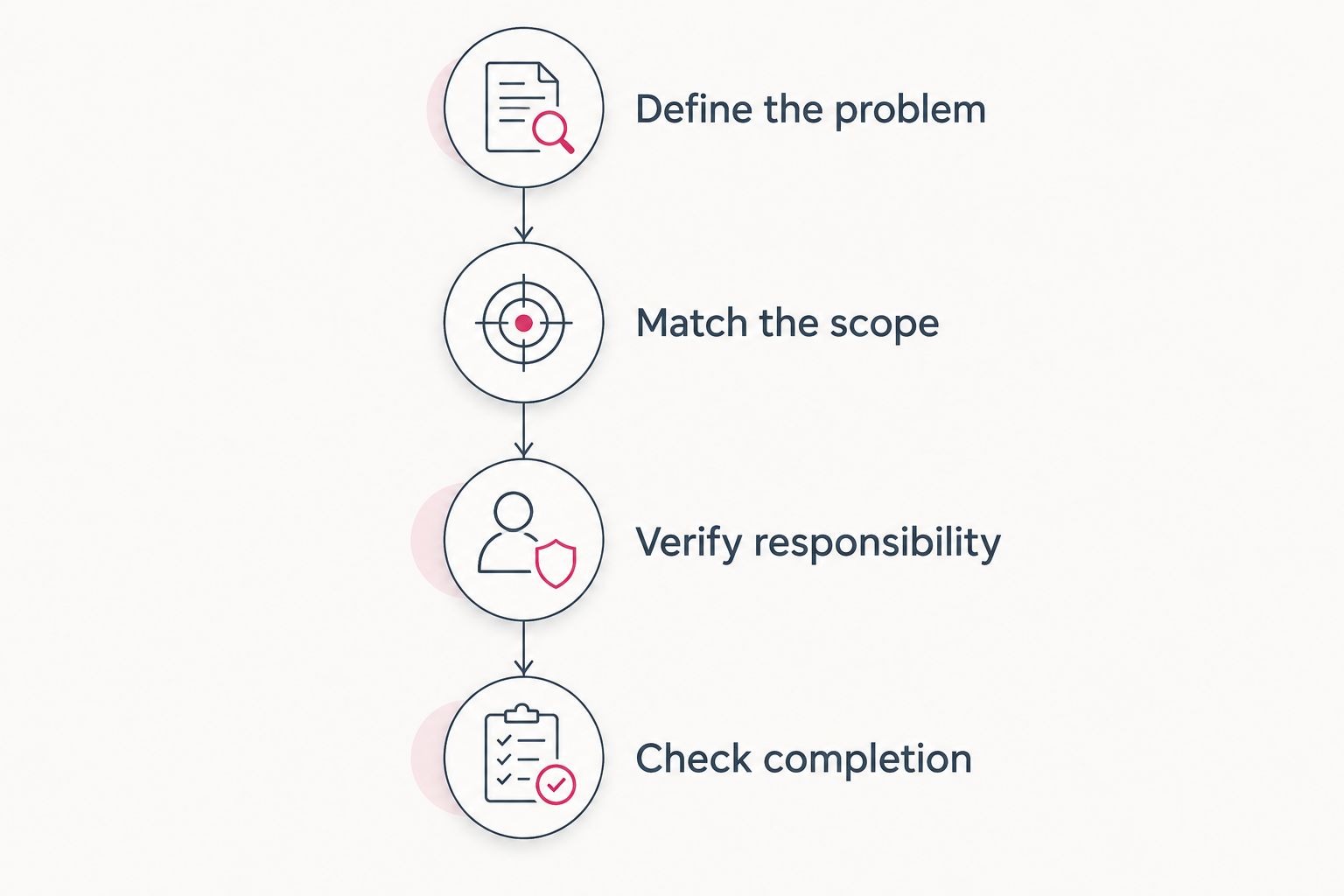
Use this sequence before signing:
- Define the problem. Identify the affected rooms and whether your priority is temperature, drafts, noise, or a combination.
- Match the scope. Confirm the surfaces, preparation, installation method, and finishing work in each proposal.
- Verify responsibility. Identify the contracting business, site supervisor, and any work assigned to other trades.
- Check completion. Agree on the documentation and walkthrough that will show the contracted work is finished.
Request applicable license and insurance documentation for the work and jurisdiction. Read any warranty terms in the actual agreement, including who provides them and what they cover. A general reassurance is not a substitute for written terms.
Both contractors face the same standard: a clear agreement and a verifiable completion process. Do not relax that standard because you prefer the material, recognize the name, or like the sales conversation.
Final verdict: choose the contractor that fits your project
Choose the local provider for a Long Island or NYC home upgrade
Choose JC Home Care Center, Inc. if you own a home on Long Island or in the 5 boroughs and want residential insulation installation covering attic, wall, cellulose, flat-roof, or soundproofing needs. Its stated geography and services fit that homeowner profile.
The reason to pause is an unresolved project detail. Before signing, confirm the material, access method, preparation, repairs, and completion checks for your house. The service offering gets the contractor onto your shortlist; the proposal earns the job.
Choose USA Insulation when its local proposal is stronger
Choose USA Insulation if its local contractor confirms your address and provides the more complete plan for your wall or attic project. This is especially relevant when protecting existing finishes or defining preparation work is your deciding concern.
The reason to pause is relying on the company name instead of the contracting business and written scope. Confirm who performs the work and handles follow-up. A stronger proposal is a valid competitive advantage; an unspecified promise is not.
For a 2026 decision, use this scorecard to keep the verdict tied to your needs:
| Dimension | Winner |
|---|---|
| Best for | Local provider for stated regional services; USA Insulation for a stronger matching proposal |
| Local service fit | Local provider for confirmed Long Island and NYC coverage |
| Standout service fit | Local provider for its stated range of residential services |
| Wall installation | USA Insulation when its access and restoration plan is clearer |
| Attic installation | USA Insulation when its preparation and installation scope is more complete |
| Sound control | Local provider for an explicitly offered soundproofing service |
| Pricing model | Tie until equivalent scopes and payment terms are compared |
| Accountability | Tie; both must meet the same documentation standard |
FAQ
Is JC Insulation better than USA Insulation?
JC Home Care Center, Inc. is a strong fit for Long Island and NYC homeowners seeking residential insulation installation. USA Insulation is the better choice when its local contractor provides a more complete proposal for your specific project.
Which insulation contractor should I choose for existing walls?
Choose the contractor with the clearer wall-access, installation, and restoration plan. Ask how existing conditions will be checked and who repairs any access points.
What should an attic insulation estimate include?
An attic insulation estimate should identify preparation, insulation placement, air-sealing scope, access details, and completion checks. It should also explain how the work accommodates ventilation and relevant safety conditions.
Does cellulose insulation make one contractor the better choice?
Cellulose insulation does not establish which contractor is better. Choose based on whether the proposed material and installation method suit the assembly and existing conditions in your home.
Can home insulation help with neighbor noise?
Insulation can contribute to sound control, but the complete wall or ceiling assembly determines the result. Request a separate noise-control scope rather than assuming a thermal insulation proposal addresses every sound path.
How do I compare insulation contractor pricing?
Compare equivalent written scopes before comparing the proposals. Review preparation, installation, repairs, cleanup, payment terms, exclusions, and the process for approving changes.
What should I ask before hiring an insulation contractor in 2026?
Ask who performs the work, what is included, what is excluded, and how completion will be documented. Request applicable license and insurance documentation and read the contract’s warranty terms.
One last thing
Ask both contractors to describe what their proposed work will not fix. This question separates a defined insulation project from a broad comfort promise. If a cold room also has a heating-distribution problem, or noise travels through another path, you need that distinction before committing.
Keep the answer with the proposal. Your best choice is the contractor that explains the boundaries of the work as clearly as the expected benefit.
Related guides
- Questions to ask an insulation contractor before hiring
- How to seal air leaks before adding insulation
- How to verify an insulation contractor's license in New York