
Choose JC Home Care Center, Inc. if you want residential insulation installation across Long Island and the 5 boroughs; choose Koala Insulation if its local contractor provides a better documented plan for your home's specific problem. For this 2026 comparison, the deciding factor is the proposed work—not the name on the truck.
- JC insulation vs Koala Insulation comes down to local service fit and the written installation scope.
- JC Home Care Center, Inc. provides residential attic, wall, flat-roof insulation and soundproofing services.
- Choose Koala Insulation when its local proposal better addresses your home’s access, materials and installation requirements.
- Compare insulation estimates for the same areas, preparation, air sealing and completion checks.
Why this matters
A cold bedroom, uncomfortable upstairs space or noisy shared wall needs a diagnosis before it needs a material recommendation. Insulation slows heat transfer, but it does not automatically fix air leakage, heating-system problems or every path that carries sound.
The better contractor is the one whose written plan matches the cause of your discomfort. A familiar company name cannot tell you whether an estimate includes sealing gaps, protecting ventilation or repairing installation access points.
When comparing contractors in 2026, start with the affected rooms and the surfaces separating those rooms from outdoors or unconditioned space. Give both contractors the same description. That makes their recommendations easier to compare without confusing a larger scope with a better installation.
At a glance
| Dimension | JC Home Care Center, Inc. | Koala Insulation |
|---|---|---|
| Best for | Homeowners seeking residential insulation installation on Long Island or in the 5 boroughs | Homeowners whose local Koala contractor supplies the better project-specific proposal |
| Service-area fit | Long Island and the 5 boroughs | Confirm that the local contractor serves your address |
| Standout service fit | Attic, wall, flat-roof insulation and soundproofing | Evaluate the services explicitly included in the local proposal |
| Material selection | Cellulose insulation is among the stated services | Request the exact material and installation method |
| Diagnosis and air sealing | Judge the inspection findings and written scope | Judge the inspection findings and written scope |
| Access and disruption | Confirm opening locations, protection and restoration responsibilities | Wins this dimension if its documented access plan better meets your requirements |
| Completion evidence | Require checks appropriate to the work | Require checks appropriate to the work |
| Pricing model | Compare a written project estimate and its payment terms | Compare a written project estimate and its payment terms |
The table distinguishes stated service fit from details that belong in your actual proposal. It does not treat an unlisted service as unavailable, and it does not turn a company-level description into a promise about your home.
JC Home Care Center, Inc. is the clearer local service match
JC Home Care Center, Inc. is a direct fit for homeowners seeking residential insulation installation on Long Island and in the 5 boroughs. Its stated work includes wall, attic and eco-friendly cellulose insulation, alongside flat-roof insulation and soundproofing.
That service alignment gives you a practical starting point. If your upstairs rooms overheat or an exterior wall stays cold, you can ask about work relevant to those parts of the house rather than beginning with an unrelated service category.
The limitation is equally important: a service list does not establish the right solution for your property. You still need an assessment of the existing insulation, accessible cavities, moisture conditions and work boundaries.
For Koala Insulation, confirm address coverage with the contractor preparing your estimate. Choose that contractor on local service fit only after confirming it handles both your location and the work you need. Do not assume every business operating under a shared name has an identical service scope.
The stated service range favors a clear starting brief
Attic, wall and flat-roof work involve different assemblies. A contractor who quotes the attic floor has not necessarily addressed a finished attic's roofline, and a wall proposal does not automatically include the adjacent roof addition.
Start your brief with the symptom and location:
- Attic comfort: Identify whether the attic is storage space or part of the living area.
- Cold walls: Identify affected exterior walls and whether their finishes must remain intact.
- Flat-roof addition: Identify the uncomfortable room and the accessible roof or ceiling assembly.
- Shared-wall noise: Describe whether you hear conversation, television, footsteps or vibration.
The stated service range supports discussing these needs with the local provider. It does not establish that every problem should be treated with insulation alone.
Koala Insulation earns the stronger recommendation for a particular job when its proposal addresses the relevant assembly more precisely. For example, a clearly bounded roofline plan is more useful than a general promise to improve attic comfort. Specific scope beats a broad service label.
Cellulose is a stated option, not an automatic winner
JC Home Care Center, Inc. includes eco-friendly cellulose insulation among its residential services. That makes it a relevant contractor to consider if cellulose is part of your project brief.
Still, selecting a material is not the same as selecting an installation. Ask where the cellulose will go, how the installer will reach that space and what preparation the assembly needs. Existing conditions matter more than a preferred material name.
For Koala Insulation, ask the local contractor to identify the proposed material rather than accepting a general insulation description. Then compare both proposals against the same requirements:
- Material: What exactly will be installed?
- Assembly: Which floor, wall or roof space receives it?
- Preparation: What needs repair, removal or sealing first?
- Installation: How will the material reach the intended space?
- Verification: What will demonstrate that the agreed work is complete?
A material wins only when it suits the assembly and the installation method. Neither an environmental label nor a recognizable contractor name establishes that fit by itself.
Neither contractor wins diagnosis by name alone
Treat diagnosis and air sealing as a tie until you see the inspection findings. For either contractor, a useful proposal explains why the selected work addresses the rooms you described.
Insulation and air sealing perform different jobs. Insulation resists heat flow through an assembly; air sealing limits air movement through gaps. A proposal that treats them as interchangeable leaves an important question unanswered.
Ask the contractor to distinguish the main comfort problem from secondary findings. An attic insulation recommendation should explain the intended thermal boundary and how ventilation will be protected where relevant. A wall recommendation should explain which cavities are involved and how access will work.
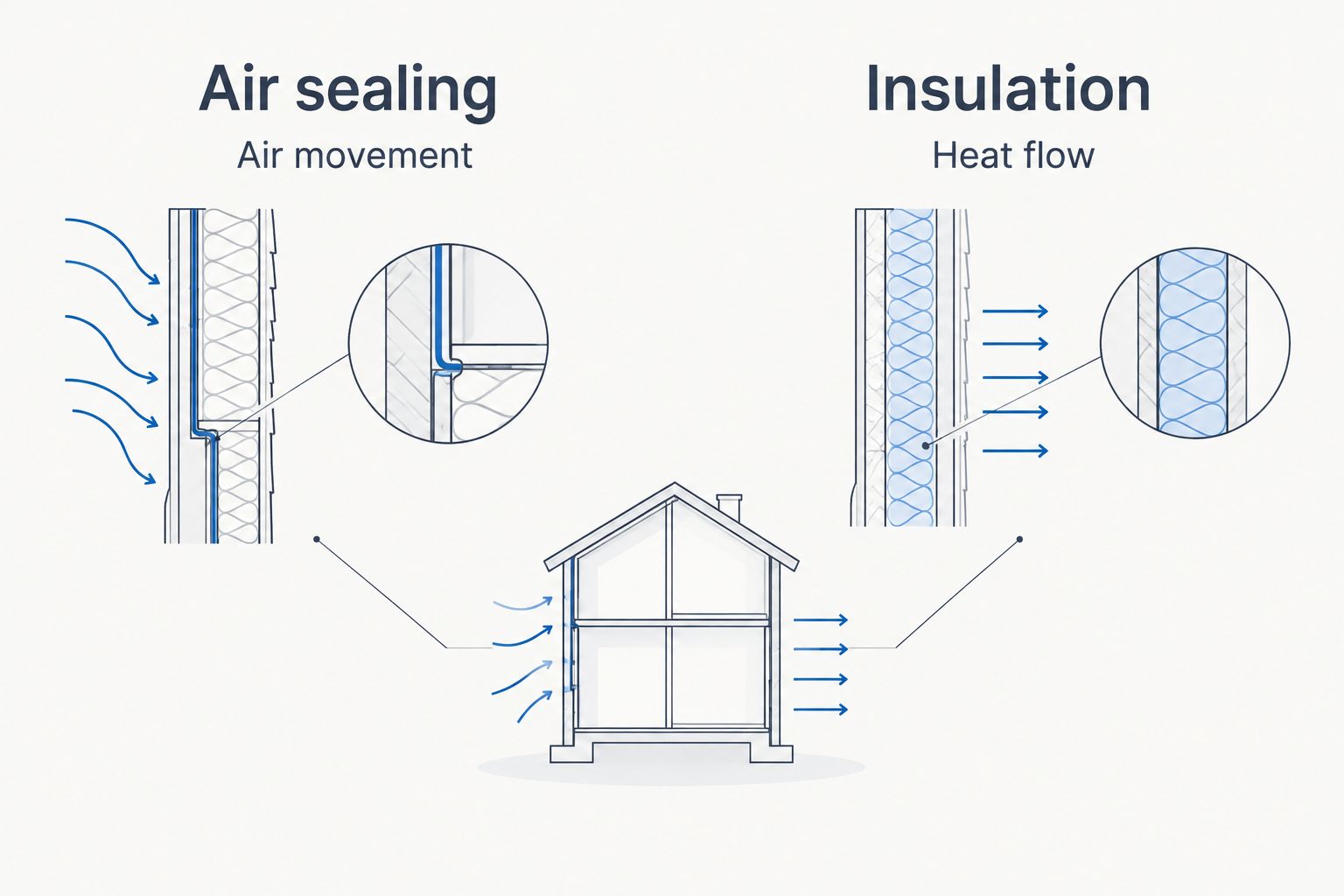
For a 2026 estimate, ask for these findings in writing. If one contractor identifies an unresolved leak or unsafe condition, do not ignore it simply because the other proposal moves directly to installation.
Koala Insulation wins access planning when its proposal is clearer
Choose Koala Insulation on disruption and access when its written plan better protects the parts of your home you want to preserve. That is a genuine reason to select the competing contractor, even when the local provider's service list matches your project.
For finished walls, compare the proposed opening locations and who is responsible for patching. For an attic, compare the access route, protection of stored belongings and treatment of the access hatch. For an occupied room, establish which spaces need to remain clear.
A stronger access plan answers practical questions before work begins:
- Where will the crew enter and move materials?
- Which surfaces need openings or temporary removal?
- Who handles finish restoration?
- What protection and cleanup are included?
- How will unexpected conditions change the agreed work?
This conditional advantage is not a claim that Koala always creates less disruption. It is a decision rule: if Koala documents an acceptable approach and the competing proposal leaves it unresolved, Koala has earned that dimension.
The reverse also holds. Choose the proposal that resolves your access requirements, not the one that merely calls the process convenient.
Completion checks remain a tie until they are documented
Neither contractor deserves a quality advantage based solely on its name. Compare what each will show you when the installation is finished, and make those expectations part of the agreement.
Useful evidence depends on the assembly. Accessible attic work can support visual checks; concealed wall work requires a different explanation of how installation is verified. Photos help document work, but they are not a substitute for a clear description of the method and coverage.
Ask both contractors to explain:
- How installed areas will be documented.
- How specified coverage or thermal performance will be checked.
- How access points will be left at completion.
- How you should report an unresolved concern.
Do not turn this into a demand for every possible test. Require checks that fit the job. In 2026, a written completion standard gives you a firmer basis for acceptance than an informal assurance that the house should feel better.
Compare pricing structure, not an isolated total
For both contractors, use a written project estimate with clear payment terms. Your comparison should establish what is included, what is excluded and how additional work receives approval.
A fixed-scope agreement gives you a defined work boundary. An agreement containing allowances or separately authorized additions gives you a different level of certainty. These are structures to inspect in the proposals—not assumptions about either company's billing practices.
Use the guide to compare insulation contractor estimates line by line to separate material installation from preparation, removal, access repairs and cleanup. Two totals are not comparable when one proposal includes those tasks and the other leaves them out.
Also establish who approves changes and whether approval must happen before additional work begins. Do not sign an estimate whose exclusions undo the reason you are hiring the contractor. For example, an unresolved access-restoration responsibility matters if preserving finished walls is central to your decision.
Final verdict: choose the proposal that solves your problem
Choose JC Home Care Center, Inc. if you want a local service fit
Best for: A Long Island or New York City homeowner seeking residential attic, wall, flat-roof insulation or soundproofing services.
Choose this provider when the stated service coverage matches your needs and its written assessment addresses the affected assembly. The service range is a useful starting point; the project proposal must still establish the material, preparation, access and completion requirements.
Choose Koala Insulation if its local proposal resolves more of your brief
Best for: A homeowner whose local Koala contractor documents the better installation method, access plan or completion standard for the same work.
Choose Koala Insulation when that advantage appears in the agreement rather than only in a sales conversation. Confirm local coverage and compare equivalent scopes before treating the proposal as the stronger option.
For your 2026 decision, use this scorecard after both contractors have assessed the property:
| Dimension | Winner |
|---|---|
| Stated Long Island and borough service fit | The local provider's explicitly stated coverage |
| Relevant service scope | The proposal covering the required assembly |
| Cellulose preference | The proposal specifying an appropriate cellulose installation |
| Diagnosis and air sealing | Tie until inspection findings distinguish the plans |
| Access and disruption | Koala Insulation if its written plan better meets your brief |
| Completion evidence | Tie until verification requirements distinguish the plans |
| Pricing structure | The agreement with acceptable scope and change-approval terms |
FAQ
Is JC Insulation better than Koala Insulation?
Choose by local service fit and the written installation plan, not the company name alone. The local provider serves Long Island and the 5 boroughs; Koala Insulation is the stronger choice when its local proposal better addresses your specific project.
Which contractor should I choose for attic insulation?
Choose the contractor that explains which attic assembly needs insulation and how the work addresses your comfort problem. Compare preparation, air sealing, ventilation protection and completion checks within the same scope.
Does choosing cellulose tell me which contractor is better?
No, a cellulose preference does not establish which contractor will deliver the better installation. Compare the proposed assembly, preparation, access method and verification requirements.
How should I compare insulation estimates in 2026?
Compare the same work areas and responsibilities in both estimates. Check material specifications, preparation, removal, access restoration, cleanup and the approval process for changes.
Which contractor is better for insulating finished walls?
Choose the contractor with an acceptable written access and restoration plan for your finished walls. Establish where openings will be made and who is responsible for repairing them.
Will insulation alone fix a noisy shared wall?
Insulation alone does not address every sound path through a shared wall. Ask the contractor to distinguish airborne noise from impact or vibration and explain the complete proposed treatment.
What should I ask before signing an insulation contract?
Ask for the exact work areas, materials, preparation, exclusions and completion checks in writing. Confirm payment terms and how additional work must be authorized before it begins.
One last thing
Ask both contractors to mark the proposed insulation boundary on a simple sketch of your home. A drawing can reveal that one estimate treats the attic floor while the other treats the roofline—different projects hidden behind the same phrase, attic insulation.
Keep that sketch with the agreement. It gives you a practical reference when discussing access, exclusions and completion, and it keeps the decision focused on your home rather than the contractor's name.
Related guides
- Questions to ask an insulation contractor before hiring
- How to seal air leaks before adding insulation
- Koala Insulation alternatives for Long Island homeowners