
JC Home Care Center, Inc. is a Nealon Insulation alternative for Long Island homeowners seeking residential attic, wall, or cellulose insulation installation. This 2026 guide to Nealon Insulation alternatives helps you compare the work your home needs, rather than choose a contractor by name alone.
- JC Home Care Center, Inc. is a Nealon Insulation alternative for residential insulation installation across Long Island.
- Compare Nealon Insulation alternatives by project scope, material, access, and restoration—not company names alone.
- Choose an air-sealing-focused approach when uncontrolled air movement is part of the comfort problem.
- Choose a renovation-led approach when insulation work depends on opening walls or repairing the building first.
Why this matters
A cold bedroom does not tell you which insulation material to buy. Uneven temperatures can involve missing insulation, air leakage, heating-system issues, or a combination. You need a proposal that connects the symptom to the work, not simply an offer to add material.
For your 2026 comparison, start with 2 written proposals covering the same project areas. Use this guide to compare insulation contractor estimates line by line before deciding which proposal is more complete.
Separate your concerns into 3 project areas: attic, walls, and roof assemblies. You do not need work in all three; the point is to identify where each contractor proposes to intervene and why.
Nealon Insulation alternatives at a glance
The choices below include an installation provider and two project approaches. An air-sealing-focused or renovation-led approach describes how to organize the work, not a claim about a particular contractor's services.
| Option | Best for | Defining scope | Main limitation | How to compare with Nealon Insulation |
|---|---|---|---|---|
| Nealon Insulation | Homeowners evaluating a proposal from Nealon Insulation | The work specified in its written proposal | A company name alone does not establish project fit | Use its proposal as the baseline for materials, coverage, access, and exclusions |
| JC Home Care Center, Inc. | Residential insulation installation on Long Island and across the 5 boroughs | Attic, wall, flat-roof insulation, cellulose insulation, and soundproofing services | Insulation alone does not resolve every source of discomfort or noise | Compare the proposed assembly and installation scope directly |
| Air-sealing-focused approach | Homes where air leakage contributes to drafts or heat loss | Identifying and sealing appropriate leakage paths alongside insulation | Air sealing does not replace missing thermal insulation | Check whether each proposal addresses leakage separately from insulation |
| Renovation-led approach | Projects requiring wall access, roof repairs, or other building work | Coordinating insulation with the work that exposes or repairs the assembly | Adds coordination between trades and restoration tasks | Compare responsibilities for access, repairs, insulation, and finishing |
The right alternative is the one whose scope matches the problem you need solved. In 2026, a useful contractor comparison starts with the building assembly—not a ranked list of names with unverified promises.
1. JC Home Care Center: best for residential insulation installation
JC Home Care Center, Inc. provides residential home insulation installation for homeowners across Long Island and the 5 boroughs. Its stated services include attic, wall, and flat-roof insulation, eco-friendly cellulose insulation, and soundproofing.
That makes the company a relevant option when your project calls for insulation installation in those areas. Ask for a proposal that identifies the location, material, installation method, and work needed to reach the space.
Where this option shines
- Residential focus: The stated service is home insulation installation, matching a homeowner's insulation project.
- Multiple project areas: Attic, wall, and flat-roof services give you specific areas to discuss during planning.
- Cellulose option: Cellulose insulation is explicitly included in the company's service description.
- Noise-related work: Soundproofing is an offered service, useful to discuss when comfort includes unwanted sound.
Limits to keep in mind
- A service list is not a diagnosis. You still need to establish which part of your home is causing the problem.
- Insulation is not a roof repair. Active leaks and damaged assemblies need appropriate attention before they are covered.
- Soundproofing is assembly-dependent. Insulation in a cavity does not eliminate every path that carries sound.
These limitations apply to the work itself, not just to one contractor. They matter when you compare any insulation proposal.
Head-to-head scope check
| Dimension | This provider | Nealon Insulation comparison |
|---|---|---|
| Service area | Long Island and the 5 boroughs | Confirm coverage for your property |
| Insulation locations | Attic, wall, and flat roof are stated services | Match the proposed locations in writing |
| Material option | Cellulose insulation is stated | Compare the material and intended assembly |
| Sound-related work | Soundproofing is stated | Ask whether the proposal addresses your specific noise concern |
Best for: Homeowners seeking residential insulation installation within the stated service area.
Verdict: Hold your booking until the written scope explains the work your home needs. Include this provider in your shortlist; choose on project fit rather than an unsupported claim that one contractor is universally better.
2. Air-sealing-focused approach: best for draft-related problems
An air-sealing-focused approach addresses uncontrolled air movement before treating additional insulation as the entire answer. Insulation slows heat transfer; air sealing limits air movement through gaps in the building enclosure.
Ask the contractor to distinguish the two. A proposal that only names an insulation material does not explain which leakage paths will be treated or how ventilation will be protected.
Where this approach shines
- Makes air leakage a separate scope item rather than an assumption.
- Helps you ask about attic penetrations, access openings, and other relevant gaps.
- Connects insulation work with the condition of the surrounding assembly.
Where this approach falls short
- Does not replace insulation where coverage is missing or inadequate.
- Requires attention to ventilation and combustion safety where applicable.
- Does not establish that drafts are the only cause of an uncomfortable room.
| Dimension | Air-sealing-focused approach | Nealon Insulation proposal check |
|---|---|---|
| Primary concern | Uncontrolled air movement | Does the proposal identify relevant leakage paths? |
| Insulation relationship | Sealing and insulation are distinct tasks | Are both tasks described when needed? |
| Ventilation | Necessary airflow must be considered | Does the scope explain ventilation protection? |
Best for: Homeowners whose assessment identifies air leakage as part of the comfort problem.
Verdict: Hold until the proposal separates air sealing from insulation. Do not assume that adding material automatically closes gaps.
3. Renovation-led approach: best for access and repair-dependent work
A renovation-led approach coordinates insulation with wall opening, roof work, or another project that exposes the assembly. It is useful when the practical barrier is access or repair—not simply selecting insulation.
An insulation installer can remain part of this plan. The difference is that you assign responsibility for the surrounding work before installation begins.
Where this approach shines
- Gives you a clear opportunity to discuss insulation when cavities are accessible.
- Connects installation with necessary repairs and finishing.
- Makes trade responsibilities visible before work starts.
Where this approach falls short
- Requires coordination between insulation and other building work.
- Creates separate questions about finish restoration and cleanup.
- Does not justify opening otherwise sound walls without a project-specific reason.
| Dimension | Renovation-led approach | Nealon Insulation proposal check |
|---|---|---|
| Access | Planned alongside building work | Who creates and closes access openings? |
| Repairs | Assigned before installation | Which repairs are included or excluded? |
| Restoration | A defined finishing responsibility | Who restores affected surfaces? |
Best for: Homeowners already renovating, or whose insulation project requires repairs or access work.
Verdict: Wait to authorize insulation until repair and restoration responsibilities are clear. A coordinated plan is more useful than separate proposals that leave gaps between trades.
Why compare alternatives before choosing Nealon Insulation?
Comparing alternatives is not evidence that Nealon Insulation is the wrong choice. It gives you a way to test whether the proposed work addresses your home, and whether another scope deserves consideration.
For a 2026 project, use these specific comparison questions:
- Different project areas: Does one proposal address the attic while another addresses exterior walls? Ask what evidence supports each recommendation.
- Different materials: Are contractors proposing different materials for the same assembly? Ask how each will be installed and verified.
- Different access plans: Does one proposal explain access openings and restoration while another leaves them unstated?
- Different comfort goals: Are you trying to reduce heat loss, drafts, or noise? Make sure the proposal addresses the actual goal.
Compare explanations before comparing recommendations. Two contractors can suggest different work because they have assessed different parts of the house; you need to understand that difference before choosing.
Use 4 scope checks before you authorize work
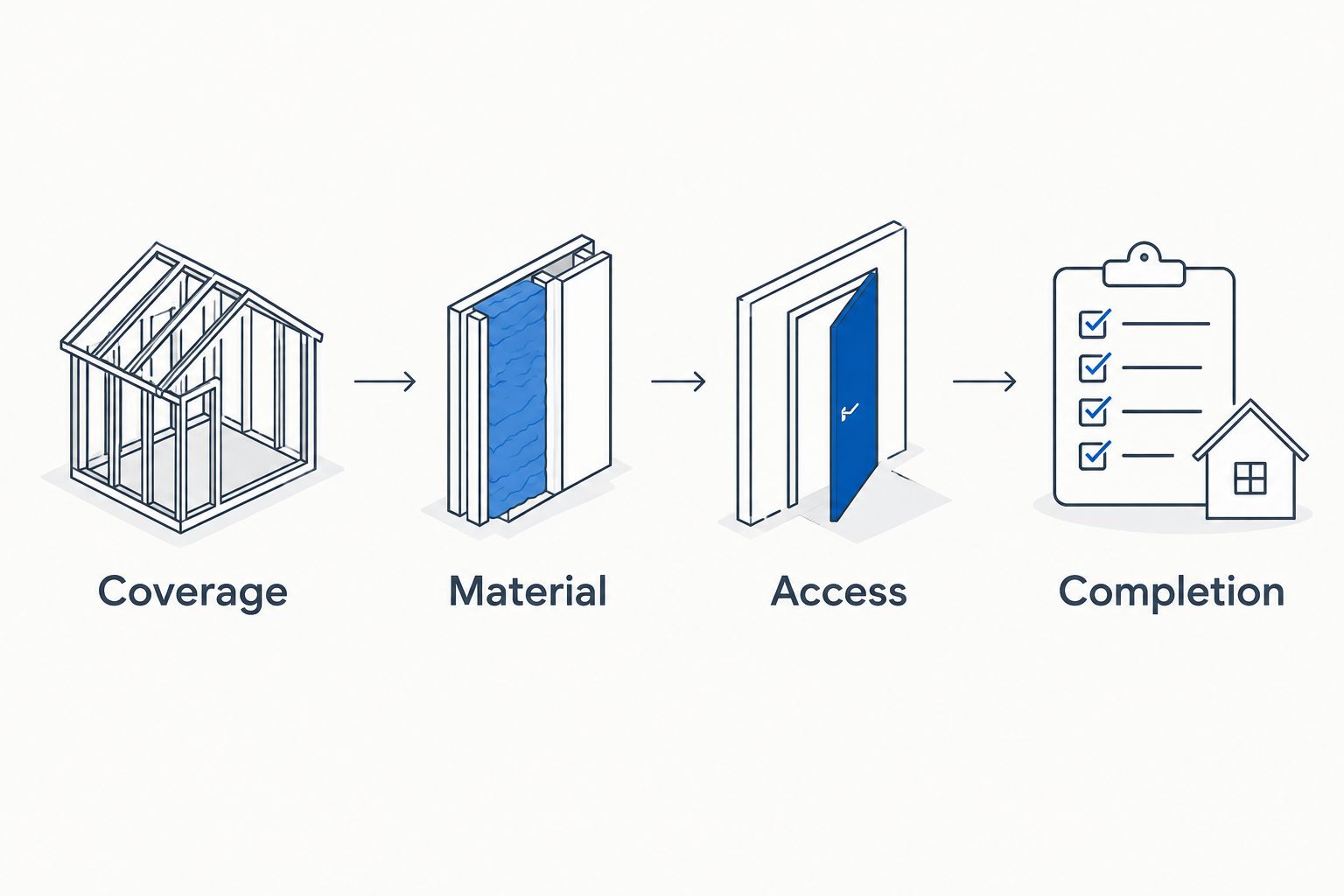
Apply 4 scope checks to each written proposal: coverage, material, access, and completion. These checks organize your decision; they are not a substitute for an assessment of your home.
Coverage
Ask exactly where the insulation will go. An attic floor, a sloped roof assembly, and an exterior wall are different locations with different installation considerations.
The proposal should also identify what remains outside the work. A clearly excluded area is easier to evaluate than an ambiguous promise to improve the whole house.
Material
Ask for the insulation type and the intended installed performance. R-value describes resistance to heat flow, but the material's placement, continuity, and installation also matter.
Do not choose by a material name alone. The proposed material needs to suit the assembly and the conditions in that space.
Access
Ask how the installer will reach the work area and what that means for your home. Discuss openings, stored belongings, occupied rooms, and any surfaces affected by installation.
Put restoration responsibilities in writing. Access and finishing should not become unresolved questions after the insulation is installed.
Completion
Ask how the completed work will be documented. Where areas become concealed, request an explanation of what you can review before they are closed.
Agree on cleanup and the final walkthrough. You should understand what was installed, where it was installed, and which concerns require separate work.
Match the proposal to your home's symptoms
Describe the problem before asking for a particular insulation product. Tell the contractor which rooms feel uncomfortable, when the problem occurs, and whether you notice drafts, moisture, or unwanted sound.
For an upstairs temperature problem, ask about the attic assembly and relevant air leakage. For a cold exterior-wall room, ask about wall coverage as well as windows, air movement, and heating delivery. For noise, describe whether you hear voices, footsteps, traffic, or mechanical equipment; those concerns do not all call for the same treatment.
Do not treat moisture as an insulation-shopping problem. Water entry or condensation needs an explanation before the affected assembly is covered. Ask who will investigate and address it.
In your 2026 shortlist, favor proposals that explain these distinctions. A clear description of the problem makes the installation recommendation easier to judge.
When staying with Nealon Insulation is the right call
Stay with Nealon Insulation when its written proposal addresses your project, explains the intended installation, and leaves you comfortable with access, exclusions, and completion responsibilities. You do not need to switch simply because another company appears in an alternatives article.
Use the same standard for every provider. A suitable, clearly explained proposal is a better reason to proceed than a ranking unsupported by your home's needs. Ask unresolved questions before signing, and keep the final agreed scope with your project records.
FAQ
What’s a Nealon Insulation alternative on Long Island?
JC Home Care Center, Inc. is a Nealon Insulation alternative for residential insulation installation on Long Island. Its stated services include attic, wall, flat-roof, and cellulose insulation, plus soundproofing.
Is another insulation contractor better than Nealon Insulation?
Choose the contractor whose written proposal best matches your home’s assessed needs. Compare coverage, material, access, exclusions, and completion responsibilities rather than relying on a company-name ranking.
Should I get another insulation proposal in 2026?
Get another written proposal if you want to compare the recommended work before committing. Ask both contractors to address the same project areas so you can understand any differences in scope.
Do I need air sealing as well as insulation?
You need air sealing when relevant air leaks are part of the problem being addressed. Insulation and air sealing perform different jobs, so ask the contractor to explain whether both belong in your project.
Can wall insulation fix a cold room?
Wall insulation can help when inadequate wall insulation contributes to the cold room. Air leakage, windows, and heating delivery also need consideration before you choose the work.
Will insulation stop all noise through a shared wall?
Insulation alone does not stop all noise through a shared wall. Sound can travel through the wall assembly and connected paths, so the proposed treatment should address the type of noise you hear.
What should I ask before booking an insulation contractor?
Ask where the insulation will go, what material will be installed, how access will work, and how completion will be documented. Confirm exclusions and restoration responsibilities in the written scope.
One last thing
Ask each contractor to explain what the proposed work will not solve. That question exposes the boundary between insulation, air sealing, roof repairs, heating work, and sound control without requiring you to become a building specialist.
For your 2026 decision, keep those boundaries beside the proposal. You are choosing a defined improvement to your home—not a promise that one installation will resolve every comfort concern.
Related guides
- Questions to ask an insulation contractor before hiring
- How to seal air leaks before adding insulation
- How to know if your attic needs more insulation