
A backyard sauna needs mineral wool insulation in the walls and ceiling, a heat-rated foil vapor barrier facing the interior, and cedar paneling as the final layer to hold heat above 150°F without moisture damage. Skip the vapor barrier or use standard fiberglass batts instead of mineral wool, and the structure will trap condensation inside the wall cavity by its second winter on Long Island.
- Mineral wool at R-14 in the walls and R-30 in the ceiling is the standard for how to insulate a backyard sauna for year-round use in 2026.
- The foil vapor barrier goes on the interior, hot side of the wall — backwards from how most home insulation is installed.
- Fiberglass batts are not recommended near the heater; mineral wool tolerates the 150-195°F range a sauna reaches without off-gassing.
- JC Home Care Center installs mineral wool in freestanding backyard structures across Long Island and the five boroughs, saunas included.
Why this matters
A sauna wall assembly does the opposite job of a house wall. Home insulation keeps heat in during winter and out during summer; sauna insulation has to survive sustained heat well above 150°F on the inside while the outside face sits at outdoor temperature, sometimes below freezing on a Long Island night in January 2026.
Get the vapor barrier orientation wrong and moisture from the sauna's own steam works into the insulation cavity, soaks the wood framing, and rots the structure from the inside before you notice a problem. That's the failure mode most DIY backyard saunas run into within a year or two, not heat loss.
A pool house built for year-round use deals with a similar high-moisture, temperature-swing problem, and the material logic carries over: moisture control matters as much as R-value.
How do you insulate a backyard sauna for year-round use?
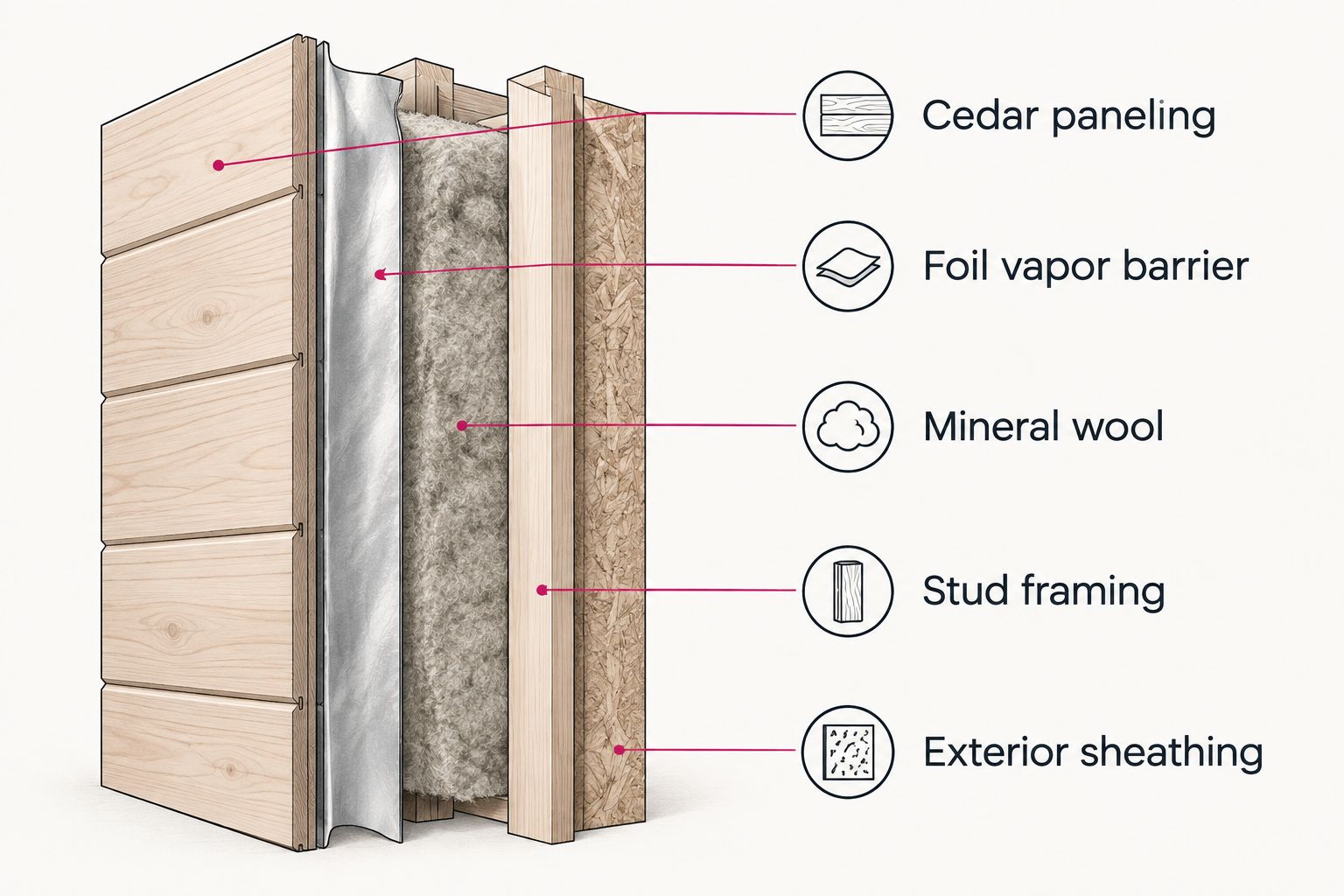
Insulating a backyard sauna for year-round use in 2026 follows a fixed order: frame the cavity, install mineral wool, add a foil vapor barrier on the interior face, then finish with cedar tongue-and-groove. Each layer has one job and skipping or reordering any of them shortens the life of the structure.
| Layer | Material | Placement |
|---|---|---|
| Structural cavity | 2×4 or 2×6 stud framing | Walls and ceiling joists |
| Insulation | Mineral wool (rock wool) batts | Inside stud/joist cavities |
| Vapor barrier | Aluminum foil rated for high heat | Interior side, facing the sauna room |
| Interior finish | Cedar tongue-and-groove paneling | Over the foil barrier |
| Floor | Tile or sealed concrete | No vapor barrier needed |
Fiberglass shows up in some budget kits, but it's not the standard pick once you understand what mineral wool does differently at sauna temperatures.
Wall insulation: R-14 mineral wool batts
R-14 mineral wool in a standard 2×4 wall cavity is the baseline for backyard sauna walls in 2026. Mineral wool holds its shape and R-value at sustained heat near 195°F, where fiberglass can compress, sag, or off-gas over repeated heat cycles.
Dense-pack mineral wool also resists moisture better than fiberglass batts, which matters given how much humidity a sauna session pushes into the wall cavity even with a proper vapor barrier in place.
Verdict: mineral wool wins over fiberglass for sauna walls — buy mineral wool, skip the fiberglass kit insulation.
Ceiling insulation: R-30 mineral wool or batt
Heat rises, and a sauna ceiling takes the most sustained thermal load in the structure — R-30 is the standard ceiling target for year-round performance. Undersized ceiling insulation is the single biggest reason a backyard sauna takes longer to heat up and struggles to hold temperature once the outdoor air drops into the 30s.
A converted shed or she-shed frame can be built out the same way. The material choices for backyard office pods and she sheds overlap heavily with sauna builds, since both are small, freestanding structures fighting the same exposed-on-all-sides heat loss.
Vapor barrier: foil rated for 200°F, installed on the interior
The vapor barrier in a sauna faces the room, not the outdoors — the reverse of how a house wall is typically built. A heat-rated aluminum foil barrier, installed directly under the cedar paneling and facing the hot interior, stops sauna steam from migrating into the mineral wool and framing behind it.
Miss this step and the insulation absorbs moisture every session, loses R-value, and eventually grows mold inside a cavity you can't see until the paneling is pulled off.
Why sauna insulation requirements vary
Not every backyard sauna needs identical wall and ceiling specs. A few factors change the build:
- Sauna type — a wood-fired sauna runs hotter and longer than an electric or infrared unit, putting more sustained load on the insulation.
- Climate exposure — a sauna on an exposed Long Island lot facing coastal wind loses heat faster than one tucked against a house or fence line.
- Structure origin — a converted shed with existing walls needs insulation retrofitted around framing that wasn't designed for it, unlike a sauna built from scratch.
- Ceiling height — taller ceilings hold more hot air volume, which can call for R-30 or higher rather than the baseline.
- Stove placement — insulation and clearance requirements around the heater differ from the rest of the wall assembly and follow the stove manufacturer's spec.
- Year-round vs seasonal use — a sauna used through a full Long Island winter needs the same ceiling and wall targets as a heated living space, not a summer-only structure.
Insulating a backyard structure in 2026?
Mineral wool installs for saunas, pool houses, and studio sheds across Long Island.
Can you use regular fiberglass insulation in a sauna?
Fiberglass is not the recommended choice for sauna walls because it can compress and lose R-value at sustained temperatures near 195°F, unlike mineral wool. Some low-cost prefab sauna kits still use it, but for a structure meant to run year-round in 2026, mineral wool holds up better against repeated heat cycling and moisture exposure.
Do you need a vapor barrier in a sauna?
Yes — a vapor barrier is required in a sauna wall assembly, and it goes on the interior side facing the heat rather than the exterior side. Without it, steam generated inside the sauna migrates into the wall cavity and saturates the insulation and framing over repeated sessions.
Is mineral wool better than fiberglass for backyard saunas?
Mineral wool is the better choice for backyard saunas because it tolerates the 150-195°F range a sauna reaches without the sagging or off-gassing risk that comes with fiberglass at high, sustained heat. It also resists moisture better, which matters directly behind a vapor barrier that's managing steam every time the sauna runs.
A sauna insulated to the R-14 wall and R-30 ceiling standard behaves a lot like a small backyard studio or tiny home built for year-round comfort — same exposed envelope, same need for a material that doesn't quit at temperature extremes.
FAQ
What insulation is best for a backyard sauna?
Mineral wool (rock wool) is the best insulation for a backyard sauna because it holds its R-value at sustained heat near 195°F without sagging or off-gassing. Fiberglass is used in some budget kits but performs worse under repeated heat cycling.
How much insulation does a sauna ceiling need?
A sauna ceiling needs R-30 insulation as a baseline for year-round use in 2026, since heat concentrates at the top of the room during every session. Taller ceilings or wood-fired stoves may call for more.
Can you insulate a sauna without a vapor barrier?
No — skipping the vapor barrier lets steam from every sauna session soak into the wall cavity, which saturates the insulation and rots framing over time. The foil barrier must face the interior, hot side of the wall.
Is fiberglass insulation safe in a sauna?
Fiberglass is not the preferred insulation for a sauna because it can compress and lose performance at the 150-195°F range a sauna reaches, unlike mineral wool. It’s used in some entry-level kits, but not the standard for year-round builds.
Can I insulate an existing backyard shed to convert it into a sauna?
Yes, a converted shed can be insulated for sauna use, but the existing framing needs mineral wool retrofitted into the cavities plus a properly oriented foil vapor barrier before the cedar interior goes up. Structures not originally built for a sauna often need extra air sealing first.
Does a sauna floor need insulation?
A sauna floor typically doesn’t need the same vapor barrier and mineral wool assembly as the walls and ceiling — tile or sealed concrete over a standard subfloor is the usual approach. Heat loss through the floor is minor compared to the walls and ceiling.
How cold does it get inside an uninsulated backyard sauna in winter?
An uninsulated sauna struggles to hold its target temperature range once outdoor air drops into the 30s or lower, forcing the heater to run continuously and never fully recover between sessions. Proper wall and ceiling insulation is what makes year-round use realistic on Long Island.
One last thing
The detail that trips up most DIY sauna builds isn't the R-value math — it's which side the foil vapor barrier faces. Every instinct from insulating a house says put the barrier toward the cold exterior; a sauna needs it facing the hot interior instead, and that single reversal is the difference between a sauna that lasts through a 2026 winter and one that's rotting behind the paneling by spring.
Related guides